This document serves as a comprehensive user reference guide and cookbook for the Brother GTX direct-to-garment printer, providing essential information on its operation, maintenance, and best practices to ensure optimal performance and longevity.
Function Description
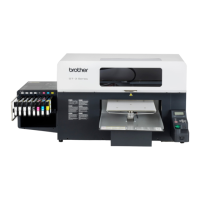
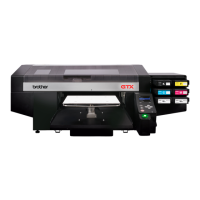
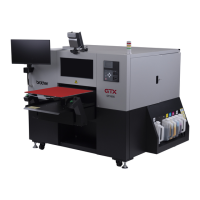
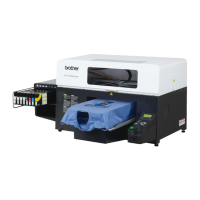
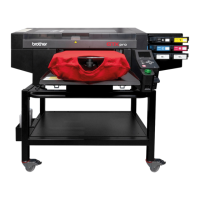
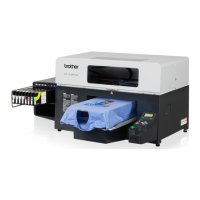
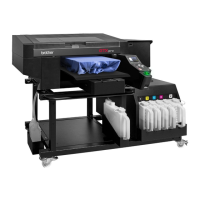
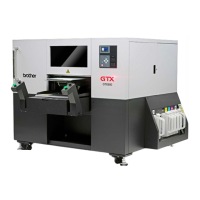
The Brother GTX is a direct-to-garment (DTG) printer designed for printing high-quality images directly onto various textile materials, primarily T-shirts and hoodies. It utilizes a combination of CMYK and white inks to achieve vibrant and detailed prints. The printer is equipped with features that allow for precise control over ink application, platen height adjustment, and environmental conditions to ensure consistent print quality. Its core function is to transform digital designs into physical prints on fabric, catering to both small-scale custom jobs and larger production runs. The system includes components for pre-treatment application, ink curing, and various maintenance procedures to support its printing capabilities.
Usage Features
The GTX printer offers several usage features to facilitate efficient and high-quality printing:
- Environmental Control: The printer has mandatory temperature and humidity requirements (18-30°C and 35-85% humidity) for optimal operation, ink consumption, and print speed. Operating outside these ranges may lead to increased ink usage or slower printing. The printer automatically switches to Low-Temp Mode if the temperature is too cold, reducing speed.
- Pre-Treatment Ratio: The guide provides specific mixing ratios for pre-treatment solution and distilled water (e.g., 1 Litre solution with 1.25 Kg distilled water, 2 Litres with 2 Kg, 3 Litres with 3.25 Kg). This ratio may vary depending on the garment type.
- Pre-Treatment Quantity: Recommended pre-treatment quantities are provided based on garment absorbency: 40-50 grams for high absorbency (thick materials, hoodies), 30-39 grams for medium absorbency (regular cotton tees), and 15-29 grams for low absorbency (thin material, blends, specialty items). Users are instructed to define a surface area (35 x 40 cm) and weigh the T-shirt after applying pre-treatment.
- Heat Press Settings for Pre-Treatment Drying: After pre-treatment, garments should be dried using a heat press at 180°C for 35 seconds at 75-80 PSI. A silicone sheet is recommended to cover the pre-treatment and clean the surface, or parchment paper to minimize cleaning and prevent fibers from standing up.
- Heat Press & Tunnel Dryer Settings for Ink Curing: For ink curing, a heat press should be set to 180°C for 35 seconds at 10-20 PSI. Alternatively, a tunnel dryer can be used at 160°C for 3 minutes and 30 seconds. Users are advised to check the real temperature with a probe or strips to ensure washability.
- Power Management: The Brother GTX should always be left powered ON. The printer should never be shut off unless instructed by the display panel, as power is required for white ink recirculation. In case of power outage or error during printing, the carriage should be pushed all the way to the left to dock it and locked in place with the fixing pin.
- White Ink Agitation: Daily agitation of white ink is crucial. If the "Remove the white ink cartridge and shake it" message appears, the cartridge should be removed and shaken horizontally 100 times for one minute. If the ink pouch is about 15cm in length, the cartridge cover should be opened, and the cartridge shaken to unwind the ink pouch, making it easier to stir. This process should be repeated for all white ink cartridges.
- Ink Pouch Replacement: When replacing ink pouches, new white ink should be agitated 100 times side-to-side while still in the carton to agitate both pouches simultaneously. The empty pouch is removed, and a new one is carefully unpacked, avoiding wrinkling. The green tip of the new pouch is pushed into the cartridge until it clicks, then aligned with the gutters and mounted in the metal spring. The lid is closed, and the spring verified to roll to the front. The cartridge is raised to a 45° angle, and the upper metallic latches are pushed to add tension. A shelf-life sticker should be attached to the front of the cartridge.
- Stored Ink Management: If white ink is stored for more than one week without use, the ink carton should be flipped over weekly to prevent pigments from settling.
- Platen Height Adjustment: For optimal print quality on thicker textiles, the platen height can be adjusted. This involves loosening the Platen Fixing Lever, moving the Platen Height Adjustment Lever to a lower position, and then re-tightening the fixing lever. Wrinkles in the fabric should be flattened. To check if the textile is detected by the sensor, the button is pushed. If further gap decrease is needed, collars can be removed, the knob loosened, and the platen bearing pushed down. After adjustment, the platen should be returned to the 'A' position for thicker materials, and the knob kept tight. For printing above hems and seams, UNI-directional printing is recommended.
- Long-Term Storage (White Ink Pause Mode): For periods of non-use exceeding two weeks, the printer offers a "White Ink Pause Mode." This involves cleaning the nozzle guard, wiper blade, and exhaust cap, emptying the waste ink tank, ensuring the cleaning solution tank is full, enabling White Ink Pause Mode via the menu, removing white ink cartridges, and replacing them with Maintenance Pouches (GCX-4S70). When resuming white ink printing, the White Ink Pause Mode must be disabled, the waste ink tank emptied, and new white ink pouches installed.
Maintenance Features
The Brother GTX requires regular maintenance to ensure proper functioning and extend its lifespan. The manual outlines daily, weekly, and prompted maintenance procedures:
- Daily Maintenance - Nozzle Test: A nozzle test for both White and CMYK inks must be performed every morning before use to check the status of the nozzles. This involves placing the platen at level A and selecting "Menu > Test Print > Nozzle Check CMYK" for colors on white paper, and "Menu > Test Print > Nozzle Check White" for white ink on black paper or inkjet plastic sheet.
- Missing Nozzles & Deflection Cleanings: If the nozzle test shows missing horizontal pins (blocked nozzles) or deflection (blurred/staggered lines), specific cleaning functions are required.
- Only a few missing nozzles: Perform "Powerful Cleaning" (Menu > Head Cleaning > Powerful Cleaning, then choose affected color/channel).
- 10 or more missing nozzles: Perform "Super Cleaning" (Menu > Head Cleaning > Super Cleaning, then choose affected color/channel).
- Deflection: Perform "Flash Cleaning" (Menu > Head Cleaning > Flash Cleaning, then choose affected color/channel).
These cleaning processes can be repeated up to three times. Users are also advised to ensure the cap and wiper blade are clean and the wiper cassette is fresh and moist. If no improvement after three attempts, contact service.
- Weekly Maintenance Procedures:
- Suction Cap & Exhaust Cleaning: The black silicon lips of the two suction caps should be cleaned using a Cleaning Stick T dipped in Cleaning Solution to remove dried ink build-up, preventing air leaks and maintaining pump suction. The foam should not be touched. The four extrusion lances and the exhaust hole on the capping side also need to be cleaned, starting with the exhaust hole and then proceeding backward to clean the lances.
- Wiper Cleaning: Both white plastic wipers (White & CMYK) should be cleaned on both sides and the top with a Cleaning Stick T dipped in Cleaning Solution. The tip of the stick should be used to clean under the teeth of the wiper holder. Separate cleaning sticks should be used for each color.
- Nozzle Guards Cleaning: The two nozzle guards (1 & 2) should be wiped clean with a Clean Stick R dipped in Cleaning Solution. The nozzle surface (3) must not be touched. The carriage should be manually moved for easy access. A mirror can be used for better visibility. Any remaining cleaning solution from the Cleaning Cup should be discarded into the Waste Tank, not poured into the printer mechanism.
- Maintenance Parts Exchange:
- Wiper Cleaner Replacement: The old wiper cleaner is lifted up and replaced with a new one.
- Flushing Foam Replacement: The flushing receivers are lifted, and placed on a waste cloth. The flushing foams are removed, and the holes of the two receivers are cleaned. The area where the retainer sits on the maintenance unit is checked to ensure ink is not blocking drainage. New foams are installed, and the receivers returned to their original location.
- Fan Filter Replacement: The two fan filter holders from the top rear of the printer are removed. The old filters are replaced with new fan filters, ensuring the coarse mesh side faces the inside of the printer and the fine mesh side faces the outside.
- Additional Weekly Maintenance:
- Visual Inspection: Regular visual inspection of moving parts and checking for ink leakage is important.
- Error/Warning Messages: Users should follow all instructions displayed on the printer panel, especially when a yellow number indicates warning messages.
- Internal Cleaning of Printer: If the inside of the printer is covered with ink, it should be cleaned. The 3 Carriage Roller Guides are wiped with a Clean Stick R dipped in Cleaning Solution. The Carriage Guide Shaft and its three sides are cleaned with a non-pilling cloth moistened with isopropyl alcohol (95%). Alcohol should not be used on other parts. A small amount of Molykote 30 Grease is applied only to the Carriage Guide Shaft (never on the Roller Guide). The encoder metal cover is removed (3 screws), and both sides of the Encoder Strip are carefully cleaned with a non-pilling cloth moistened with alcohol. A CR Speed Adjustment is then performed via "Menu > Printer Setting > CR Speed Adjustment." Finally, a Nozzle Check pattern is printed.
- Ink & Solutions Storage: CMYK and white inks, cleaning solution, maintenance solution, and pre-treatment solution should be stored at a temperature range between 0°C and 40°C. Consumables should not be stored outside this range.
- Log File Extraction: To extract a log file, the printer is switched on, a USB stick is inserted, and "Menu > Maintenance > Log copy to USB" is selected.

 Need help?
 General

 To Next Page