Power Amplifier Type 2732 – User Manual4
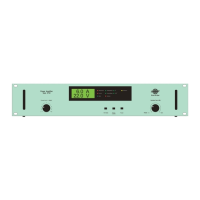
Current Limit A (RMS): Single-turn potentiometer for limiting RMS current output.
Phase: Push-button switch to set the phase shift, output/input, 0 or 180 degrees.
V/C Mode: Push-button switch for selection of feedback and output-impedance modes. The
positions are:
• Voltage Mode: Provides constant voltage characteristics independent of changes of test object
on the exciter. Gives the best acceleration waveform and is therefore preferable for most vibra-
tion tests
• Current Mode: Provides constant current characteristics, keeping the generated force inde-
pendent of changes of test object. This is the preferred setting for most modal-test applications
Back Panel
Fig.2.2 Back panel of Type 2732
Signal Input DC: BNC socket providing a direct-coupled input to the amplifier. It enables a
DC offset voltage to be applied for centring the exciter's armature. The input impedance is
>10 k Ω. If DC Static Centering Unit Type 1056 (optional) is used, the output from Type 1056 –
using a BNC to BNC cable – must be connected to the Signal Input DC socket of Type 2732.
Signal Input AC: BNC socket providing a capacitive-coupled input to the amplifier.
Output: Power output Neutrik
®
Speakon
®
socket accepting a 4-pin Neutrik Speakon plug or
connecting cable for connection of an exciter. For a full power output of 120 VA, the moving
coil of the exciter or load should have a nominal load impedance of 4 Ω.
Mains Voltage Selector and Fuse: Voltage selector for operation of the amplifier from a 100,
120, or 230 V ±10% (50 to 60 Hz) single phase, AC mains supply. To select the correct voltage
setting or to change the fuse, see “Mains Supply Connections” on page 8.
Mains Input: Input socket accepting the power cable provided. For connection of a mains
supply, see “Mains Supply Connections” on page 8.
Mains Output: Output socket accepting a power cord from DC Static Centering Unit Type
1056 (optional).
Voltage Monitor: BNC socket providing an output of the amplifier voltage waveform (includ-
ing DC component) for display on an oscilloscope. The monitor signal is the amplifier output
voltage attenuated 20 dB or 0.1 V/V.


 To Next Page
 Loading...