7. Position clear base next to the
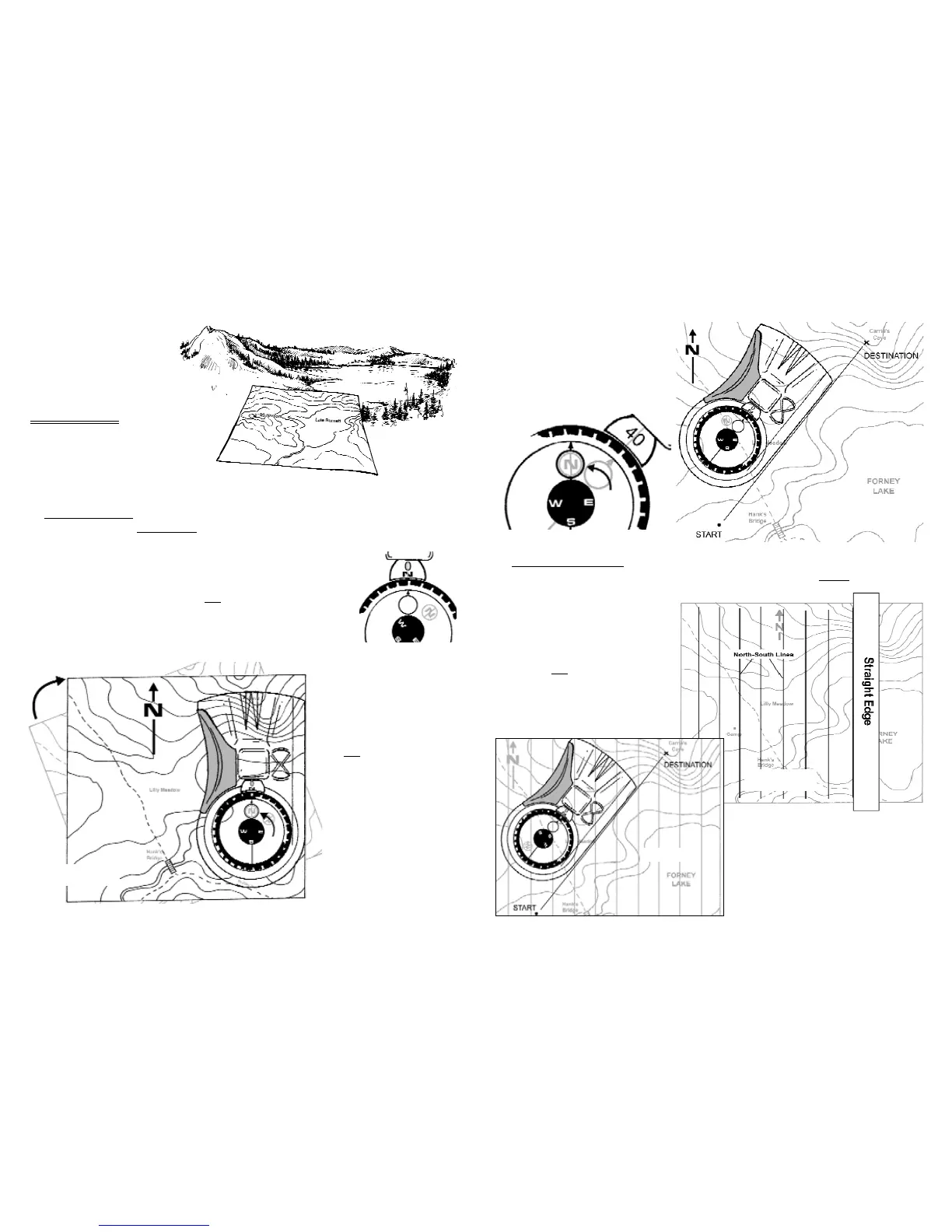
line. (Fig 14)
· Do not move the map.
8. Rotate azimuth ring until vial dis
plays “circle over circle”. (Fig 15)
9. Read bearing.
6.2 Compass Alignment
The compass alignment method allows for quick bearing determination, without aligning the
map to true north. This is not as
accurate as the map alignment
method, but it can be used for
pre-planning at home or in the office.
1. Adjust for 0° magnetic declination.
2. Draw true
north-south lines on a
map, spaced approximately 1 inch
apart. (Fig 16)
3. Mark a start position with a "point"
and a destination with an "X".
4. Draw a line connecting both marks.
5. Place clear base next to the bearing line.
(Fig 17)
7
With practice, you’ll begin to
recognize many different contours
on a topo-map, and identify the
best possible route from one
position to another. (Fig 11)
6 – Map Bearing
Whether in the field or at home, it
is possible to determine a bearing
from one position to another,
directly from a map. The 8097
provides three methods of finding map bearings - map, compass and protractor alignment methods.
6.1 Map Alignment
Map alignment is the most accurate method. Align map to true north, then find a map bearing.
Using this method, it is possible to compare the map to the actual terrain.
1. Adjust 8097 for magnetic declination.
2. Rotate azimuth ring until compass reads 0°. (Fig 12)
3. Place clear base along the map’s true
north-south margin (edge of
printed map). (Fig 13)
· On maps other than a USGS or BLM, true north-south may not be
aligned with the map’s margin, so it may be necessary to place
the clear base next to the true north indicator.
4. Rotate map until vial dis
plays “circle over circle”.
(Fig 13)
The topo-map is now aligned
with true
north, and it is
possible to compare the map
to the actual terrain. Now, find
the map bearing.
5. Place a "point" at a starting
position and an "X" at a
destination.
6. Draw a line connecting
both marks.
Figure 16
Figure 11
Figure 12
Figure 13
Figure 14
Figure 15
Figure 17
6


 To Next Page