NOTE: Use AWG No. 18 color-coded copper thermostat wire
for lengths up to 100 ft. For wire lengths over 100 ft, use AWG No.
16 wire.
C. Accessories
1. Electronic Air Cleaner (EAC)
Two quick-connect terminals marked EAC-1 and EAC-2
are provided for EAC connection. (See Fig. 25.) These
terminals are energized with 115-v, (1.5-amp maximum)
during blower motor operation.
2. Humidifier (HUM)
A quick-connect terminal (HUM) and screw terminal (C
OM)
are provided for 24-v humidifier connection. (See Fig. 24.)
HUM terminal is energized with 24-v (0.5-amp maximum)
after inducer pressure switch closes.
NOTE: A field-supplied, 115-v controlled relay connected to
EAC terminals may be added if humidifier operation is desired
during blower operation.
IX. DIRECT VENTING
The 350MAV Furnaces require a dedicated (one 350MAV furnace
only) direct-vent system. In a direct-vent system, all air for
combustion is taken directly from outside atmosphere, and all flue
products are discharged to outside atmosphere.
A. Removal of Existing Furnaces from Common Vent
Systems
If furnace being replaced was connected to a common vent system
with other appliances, the following steps shall be followed with
each appliance connected to the venting system placed in opera-
tion, while any other appliances connected to the venting system
are not in operation:
1. Seal any unused openings in the venting system.
2. Inspect the venting system for proper size and horizontal
pitch as required in the National Fuel Gas Code, ANSI
Z223.1 or 24 the CAN/CGA B149 Installation Codes and
these instructions. Determine that there is no blockage or
restriction, leakage, corrosion, and other deficiencies which
could cause an unsafe condition.
3. In so far as is practical, close all building doors and
windows and all doors between the space in which the
appliance(s) connected to the venting system are located
and other spaces of the building. Turn on clothes dryers and
any appliance not connected to the venting system. Turn on
any exhaust fans, such as range hoods and bathroom
exhausts, so they shall operate at maximum speed. Do not
operate a summer exhaust fan. Close fireplace dampers.
4. Follow the lighting instructions. Place the appliance being
inspected in operation. Adjust thermostat so appliance shall
operate continuously.
5. Test for draft hood equipped appliance spillage at the draft
hood relief opening after 5 minutes of main burner opera-
tion. Use the flame of a match or candle.
6. After it has been determined that each appliance connected
to the venting system properly vents when tested as outlined
above, return doors, windows, exhaust fans, fireplace damp-
ers, and any other gas-burning appliance to their previous
conditions of use.
7. If improper venting is observed during any of above tests,
the venting system must be corrected.
Vent system or vent connectors may need to be resized. For any
other appliances when resizing vent systems or vent connectors,
system or connector must be sized to approach minimum size as
determined using appropriate table found in the NFGC or NSC-
NGPIC.
B. Combustion-Air and Vent Piping
GENERAL
Combustion-air and vent pipe fittings must conform to American
National Standards Institute (ANSI) standards and American
Society for Testing and Materials (ASTM) standards D1785
(schedule-40 PVC), D2665 (PVC-DWV), D2241 (SDR-21 and
SDR-26 PVC), D2661 (ABS-DWV), F628 (schedule-40 ABS),
F891 (PVC-DWV cellular core), or F441 (schedule-40 CPVC
pipe) and F438 (schedule-40 CPVC fittings). Pipe cement and
primer must conform to ASTM standards D2564 or F493 (PVC or
CPVC) or D2235 (ABS). See Table 6 for maximum pipe lengths
and Fig. 30, 31, 32, 33, and 34 for exterior piping arrangements.
In Canada construct all combustion-air and vent pipes for this unit
of CSA or ULC certified schedule-40 PVC, PVC-DWV or
ABS-DWV pipe and pipe cement. SDR pipe is NOT approved in
Canada.
NOTE: Furnace combustion-air and vent pipe connections are
sized for 2-in. pipe. Any pipe size change should be made outside
furnace casing in vertical pipe. (See Fig. 26.) This allows proper
drainage of vent condensate.
Combustion-air and vent pipes must terminate together in same
atmosphere pressure zone, either through roof or sidewall (roof
termination preferred), using accessory termination kit. See Table
5 for required clearances.
Furnace combustion-air and vent pipe connections must be at-
tached as shown in Fig. 27. Combustion-air intake plug fitting and
inducer housing alternate vent cap may need to be relocated in
some applications.
NOTE: Slope combustion-air and vent pipes a minimum of 1/4
in. per linear ft with no sags between hangers.
CAUTION: When combustion-air pipe is installed
above a suspended ceiling, pipe must be insulated with
3/8-in. thick Armaflex-type insulation. Combustion-air
pipe should also be insulated when it passes through
warm, humid space.
CAUTION: When vent pipe is exposed to temperatures
below freezing, such as when it passes through an
unheated space or when a chimney is used as a raceway,
pipe must be insulated as shown in Table 7 with
Armaflex-type insulation.
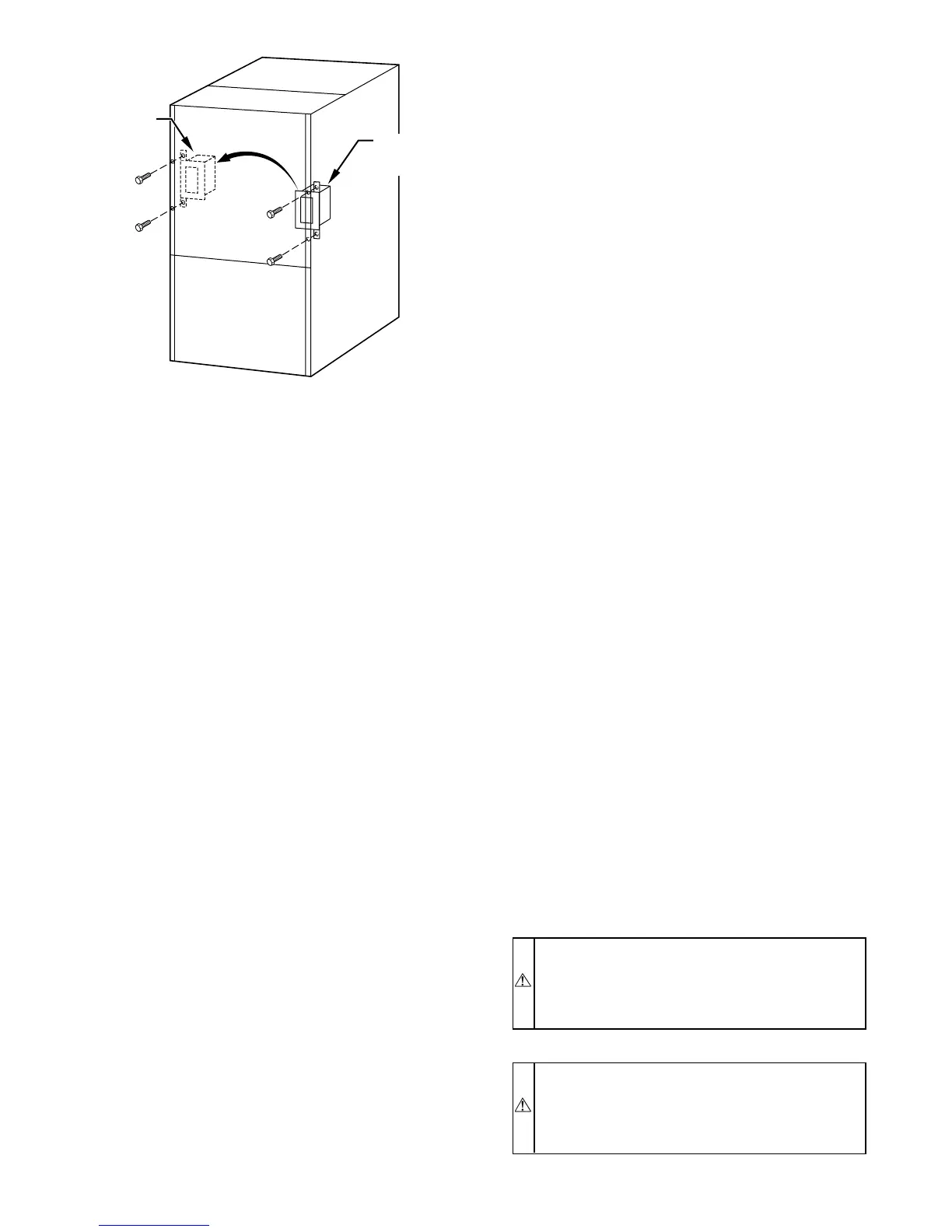
Fig. 23—Relocating J-Box
A00212
FACTORY
INSTALLED
LOCATION
ALTERNATE
FIELD
LOCATION
—20—



 To Next Page