43
Length in Table 16 minus the number of fittings multiplied by the
deduction for each type of fitting used from Table 17.
OPTIONAL CONFIGURATION FOR COMBUSTION
AIR INLET PIPE
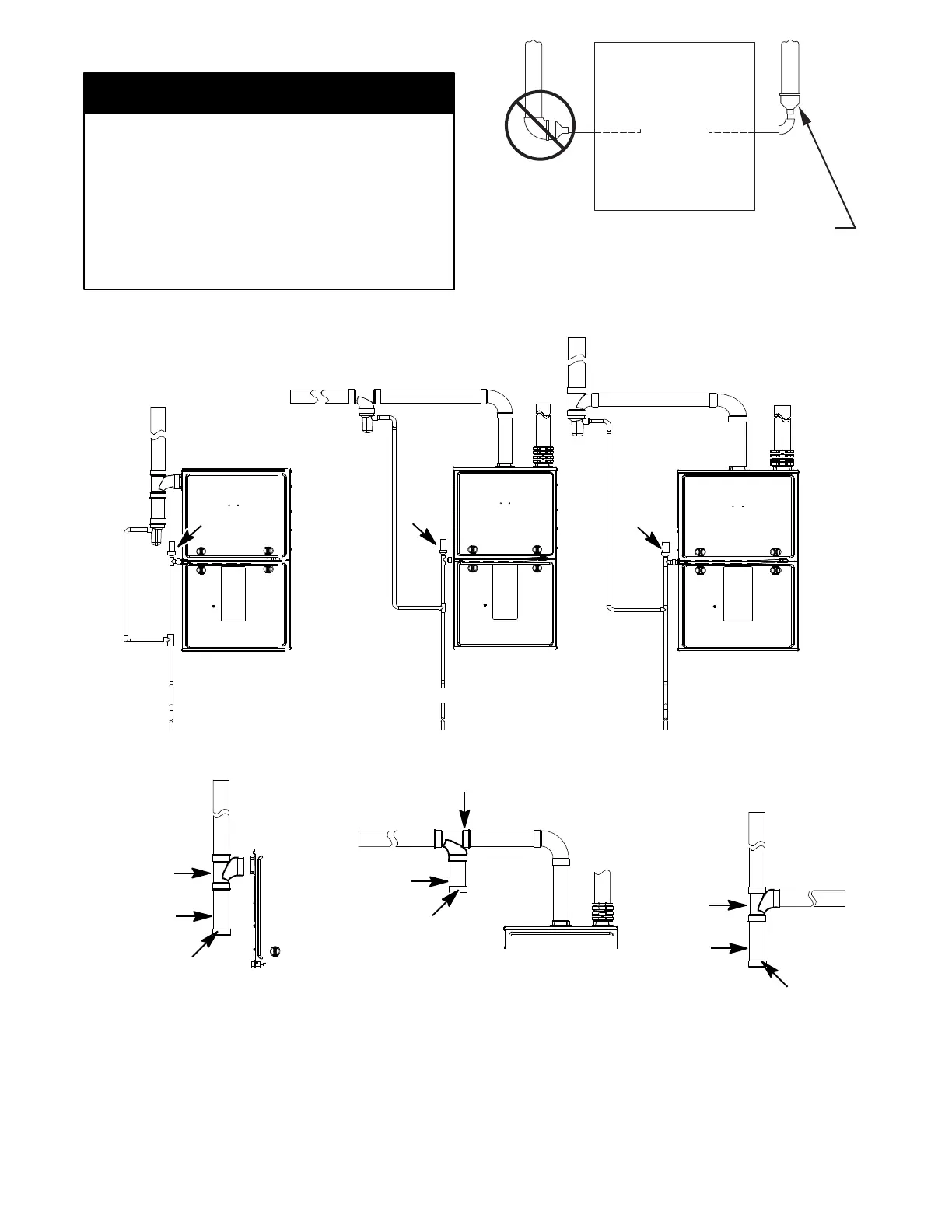
In applications where there is a risk of excessive moisture
entering the combustion air inlet pipe, a moisture trap may be
added to the inlet pipe to help prevent moisture from entering
the furnace from the combustion air inlet pipe. See Fig. 43.
When sizing venting systems, the equivalent length of the
optional moisture trap (15 feet/5 M) must be taken into
account.
NOTICE
FURNACE
PIPE DIAMETER
TRANSITION IN
VERTICAL SECTION
NOT IN
HORIZONTAL
SECTION
A93034
Fig. 42 -- Combustion Air and Vent Pipe Diameter Transition
Location and Elbow Configuration
Representative drawing only, some models may vary in appearance.
TO CODE--APPROVED DRAIN OR CONDENSATE PUMP
Recommend “T” fitting with 4--inch minimum height standpipe (A) of same diameter or larger extending upward.
A
A
A
Representative drawing only, some models may vary in appearance.
Tee
Dry Well
Cap
(water tight
and removable)
Tee
Dry Well
Cap
(water tight
and removable)
Tee
Dry Well
Cap
(water tight
and removable)
A170122A
Fig. 43 -- Recommended Combustion Air Inlet Moisture Trap
Recommended Combustion Air Inlet Moisture Trap
Recommended to prevent moisture from trickling into the furnace
vestibule, a trap can be installed in the intake air pipe near the
furnace. To prevent moisture, connecting a drain line to the trap is
recommended as trace amounts of moisture will evaporate into the
intake air stream. If the combustion air inlet is located near a
moisture exhaust duct, or there are other concerns of excessive
moisture being drawn into the combustion air inlet, it is
encouraged to connect a drain line to the trap.



 To Next Page