4 Description of function
This section explains the basic principle of the instrument, shows how it is structured and gives a
functional description of the assemblies.
4.1 Functional principle
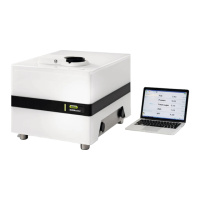
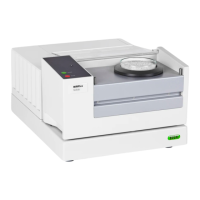
The NIRFlex N-500 is a modular optical instrument (basic instrument and measuring cell) to determine
the matter and concentration of substances in samples.
In detail, the NIRFlex N-500 is a Fourier Transformation Near Infrared spectrometer (FT-NIR). It gener-
ates an invisible near infrared interferogram beam which interacts with the molecules of a sample,
generating a characteristic feedback. The feedback is picked up via a measurement cell by a detector
and mathematically processed via Fourier transformation into a spectrum. This spectrum is used to
extract the requested material information.
Inside the spectrometer, a laser beam is used as a high-precision wavelength reference to allow best
possible reproducibility and accuracy of detection.
Advantages of FT-NIR polarization inteferometer
• Simultaneous measurement of all wavenumbers giving an improved signal-to-noise ratio
• Higher intensity giving an improved signal-to-noise ratio and short measuring times
• Laser as wavenumber reference giving high wavenumber stability and good data
transferability
• Single-beam interferometer without typical double-beam divergence for mechanically and tempera-
ture stable beam alignment
• More robust design than standard Michelson interferometer
How the interferogram is generated
An interferogram is an interference pattern of phase-shifted beams. The NIRFlex N-500 is a single-
beam polarisation interferometer, generating its interferogram in four steps:
Step 1— Polarization of the light source output
The polarizer B generates a well-defined polarization output of the undefined polarized light, emitted
by the light source A. Thus, only diagonally polarized light is transmitted.
Step 2 — Beam splitting and orthogonal polarization
The polarized light enters a double refracting block (comparator) C. Here, the light is broken down
into two, orthogonally polarized components with a small, static phase shift.
Step 3 — Generating the ongoing phase shift
An assembly of two double refracting wedges is arranged after the comparator. Wedge D is
stationary, while wedge E is constantly shifted back and forwards by a fast linear-drive. The move-
ment and the geometric arrangement provides a change of thickness in the light path. This leads to an
ongoing phase shift between the light beams.
Step 4 — Beam recombination and interferogram output
A second polarizer F converts the phase shifted beams into a single light output with intensity varia-
tion – the interferogram.


 To Next Page