
 Need help?
Do you have a question about the Buffalo TeraStation 1000 and is the answer not in the manual?
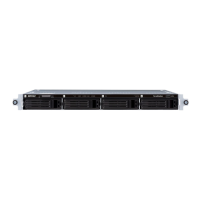
Visual overview of TeraStation hardware components and ports.
Step-by-step instructions for powering the device on and off safely.
Guide to modifying the default administrator password for security.
Accessing detailed configuration options via NAS Navigator2.
Accessing simplified common settings through the Easy Admin interface.
Steps to create, manage, and configure shared folders for network access.
Adding, managing, and setting up user accounts and permissions.
Setting up permissions for users and groups on shared folders.
Overview of supported RAID configurations (RAID 0, 1, 5, 6, 10, JBOD).
Detailed explanation of RAID array operations and management.
Step-by-step guide for replacing a failed hard drive.
Enabling and configuring remote file access via the internet.
Setting up and using the FTP server for remote file access.
Creating and scheduling automated backup tasks.
Setting up data replication between TeraStations for redundancy.
Using Direct Copy to transfer data from USB drives.
Sharing media files with DLNA-compatible devices.
Enabling the iTunes server for music sharing.
Setting up email alerts for system events and errors.
Connecting and configuring a UPS for power outage protection.
Enabling access to files even when disconnected from the network.
Using the utility to manage settings and check drive status.
Manually configuring the TeraStation's IP address.
Using the utility to manage settings on macOS.
Troubleshooting error codes indicated by red LED blinking patterns.
Overview of default administrator credentials and shared folders.
FCC compliance statements for US users.
CE marking and compliance information for European users.
 General
| Category | Storage |
|---|---|
| Total Bays | 2 |
| Interface | Gigabit Ethernet |
| USB Ports | 2 x USB 2.0 |
| Drive Type | SATA |
| Maximum Capacity | 8TB |
| RAID Levels | RAID 0, RAID 1 |
| Power Supply | Internal AC 100-240V |
| Dimensions (W x D x H) | 170 x 230 x 170 mm |
| Weight | 4.5 kg |
| Operating Temperature | 5 to 35 °C |
| Operating Humidity | 20% to 80% (non-condensing) |
| Storage Capacity | 1TB to 8TB |


 To Next Page