-14-
PRELIMINARY TUNING PROCEDURE
It is not always convenient or even possible to adjust the antenna at its full height above ground, so it is
suggested that the following "Near-Ground" tuning procedure be used. Even if further tunning is
contemplated once the antenna is raised to its full height, this procedure can greatly reduce the time one
must spend on the tower.
IMPORTANT: This procedure calls for the reflector element to be set aside during the adjustment of the
driven element. This means far enough away from the latter that it can't possibly exert any influence on
the driven element tuning. Any attempt to adjust the driven element close to the earth with the reflector
element in place will be a total waste of time and effort. Be sure not to place the driven element any
higher than seven feet off the ground because resonance on all bands will increase rapidly at much
greater heights. The SWR information below was gathered during examination of the driven element of
an HF5B that had been carefully (and tediously) adjusted at a height of 50 feet for lowest SWR consistent
with good F/B ratio.
The initial adjustment height of seven feet was chosen because it's not too hard to erect a simple and
temporary mast of that height for adjustment purposes and because the earth itself will take the place of
the reflector at that height, at least as far as driven-element resonance is concerned.
Remember that the height above ground and the mutual impedance between elements will have a lot to do
with antenna resonance, feed point impedance, SWR, and F/B. The advantage of this tuning procedure is
that if it's done properly you need not readjust the driven element once the antenna is raised to its final
position. If later adjustments are needed for better F/B ratio or SWR they can be confined to the
REFLECTOR element,
Be sure that the feed line approaches the driven element at right angles and that the driven element is well
away from other conductors. Use good quality coax in runs that are no longer than necessary. Long runs
of inexpensive RG-58 are to be avoided because the losses that go with it can produce abnormally broad
SWR curves that make it difficult to find the frequency of lowest SWR with any accuracy.
A final thought or two for the perfectionist: it is all but impossible to adjust a parasitic array so that the
maximum gain, maximum F/B rejection and lowest SWR will all occur at some particular frequency on a
given band. Finally, the dimensions for the driven element given are only approximate. They MAY
produce the desired resonances without further adjustment, but the likelihood is that they will not. The
HF5B element is reduced to about 41% of normal size on 20 meters, so slight errors in measurement and
the effect of nearby conductors will have greater effect on the tuning that with dipole element of more
normal size. The key is to adjust the driven element for lowest SWR (not necessarily 1:1) at one of the
frequencies given, and to set the reflector as described below.
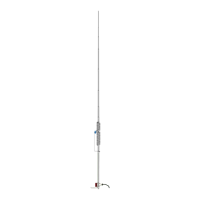
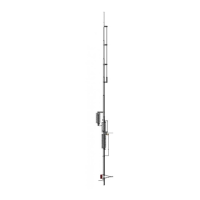
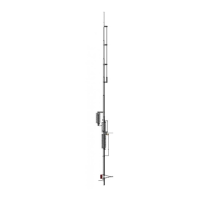
For arrangement of components along the main tube of the driven element be guided by the pictorials, and
if you find that one component interferes with the free travel of another simply reset that clamp to the
other side of the obstruction and resume tuning. There are countless tuning combinations that will
produce the desired resonances, but you need to find only one. The 17 meter coil adjustment is more
critical than most, so adjustments must be made slowly and carefully.
The SWR bridge may be placed anywhere along the transmission line, but for the sake of convenience it
may be left near the transmitter and monitored while another person makes tuning adjustments out at the
driven element.
PRELIMINARY TUNING - DRIVEN ELEMENT
Please note that in the following steps you will be tuning only the driven element. Set the reflector
element aside during this procedure. Note too that you may be asked to tune the driven element for
resonance or lowest SWR at frequencies far removed from those on which you intend to operate. No
matter, for the resonances will change considerably when both elements are in place at their operating
height.



 To Next Page