I
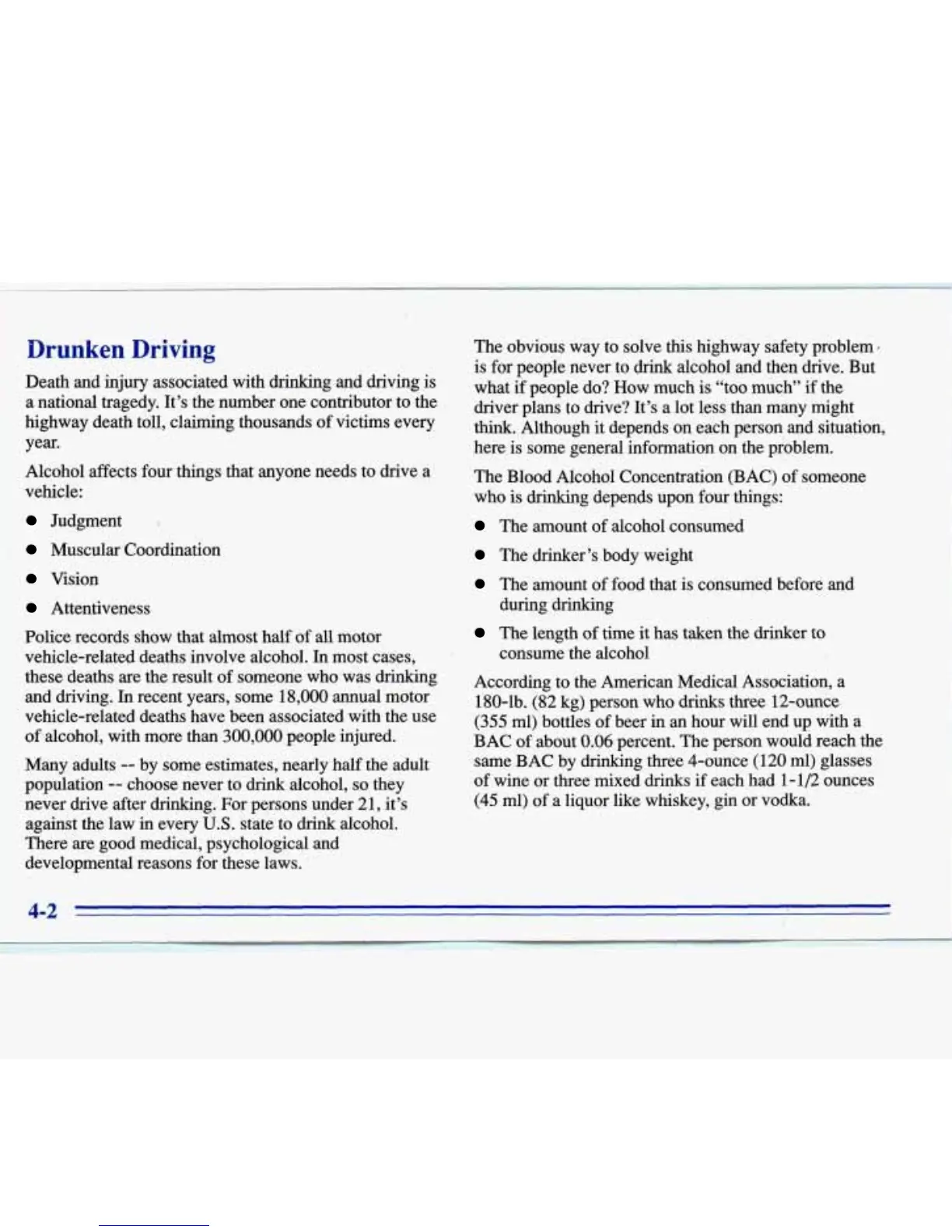
Drunken
Driving,
Death and injury associated with drinking and driving is
a national tragedy. It’s the number one contributor to the
highway death toll, claiming thousands of victims every
year.
Alcohol affects four things that anyone needs to drive a
vehicle:
Judgment
Muscular Coordination
Vision
Attentiveness
Police records show that almost half of all motor
vehicle-related deaths involve alcohol.
In
most cases,
these deaths are the result
of
someone who was drinking
and driving.
In
recent years, some
18,000
annual motor
vehicle-related deaths have been associated with the use
of alcohol, with more than
300,000
people injured.
Many adults
--
by some estimates, nearly half the adult
population
--
choose never to drink alcohol,
so
they
never ‘drive after drinking. For persons under
21,
it’s
against the law in every
U.S.
state to
drink
alcohol.
There are good medical, psychological and
developmental reasons for these laws.
The obvious way to solve this highway safety problem
is
for people never to drink alcohol
and
then drive. But
what
if
people do? How much
is
“too much” if the
driver plans to drive? It’s a lot less than many might
think.
Although
it
depends on each person and situation,
here is some general information on the problem.
The Blood Alcohol Concentration (BAC) of someone
who is drinking depends upon
four
things:
The amount of alcohol consumed
The drinker’s body weight
The amount of food that is consumed before and
during
drinking
The length of time it has taken the drinker to
consume the alcohol
According to the American’ Medical Association, a
180-lb. (82
kg)
person who
drinks
three 12-ounce
(355
ml) bottles of beer in an hour will end up with a
BAC
of
about
0.06
percent. The person would reach the
same BAC by drinking three 4-ounce
(120
ml) glasses
of
wine or three mixed drinks if each had 1-1/2 ounces
(45 ml) of
a
liquor like whiskey,
gin
or vodka,
4-2



 To Next Page