Inflation
--
Tire
Pressure
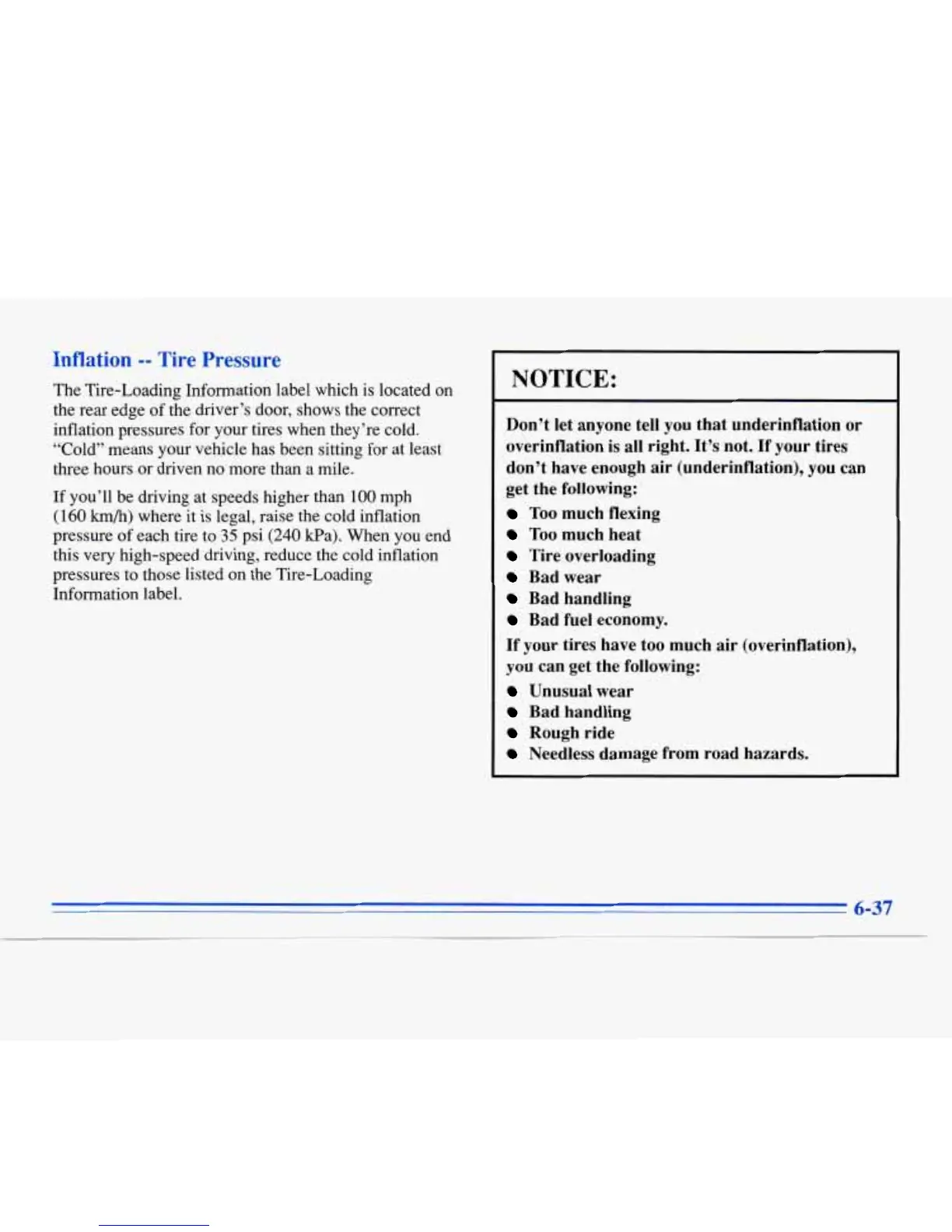
The Tire-Loading Information label which is located
on
the rear edge of the driver’s door, shows the correct
inflation pressures for your tires when they’re cold.
“Cold” means your vehicle has been sitting for at least
three hours or driven no more than a mile.
If
you’ll be driving at speeds higher than
100
mph
(160
km/h)
where it is legal, raise the cold inflation
pressure
of
each tire
to
35
psi
(240
Wa). When you end
this very high-speed driving, reduce the cold inflation
pressures to those listed on the Tire-Loading
Information label.
NOTICE:
Don’t let anyone tell you that underinflation or
overinflation is all right.
It’s
not. If your tires
don’t have enough air (underinflation), you can
get the following:
Too
much flexing
Too much heat
Tire overloading
Bad wear
Bad handling
Bad fuel economy.
If
your tires have too much
air
(overinflation),
you can get the following:
Unusual wear
Bad handling
Rough ride
Needless damage from road hazards.
6-37
I



 To Next Page