Maintenance
– 20 –
7. Maintenance
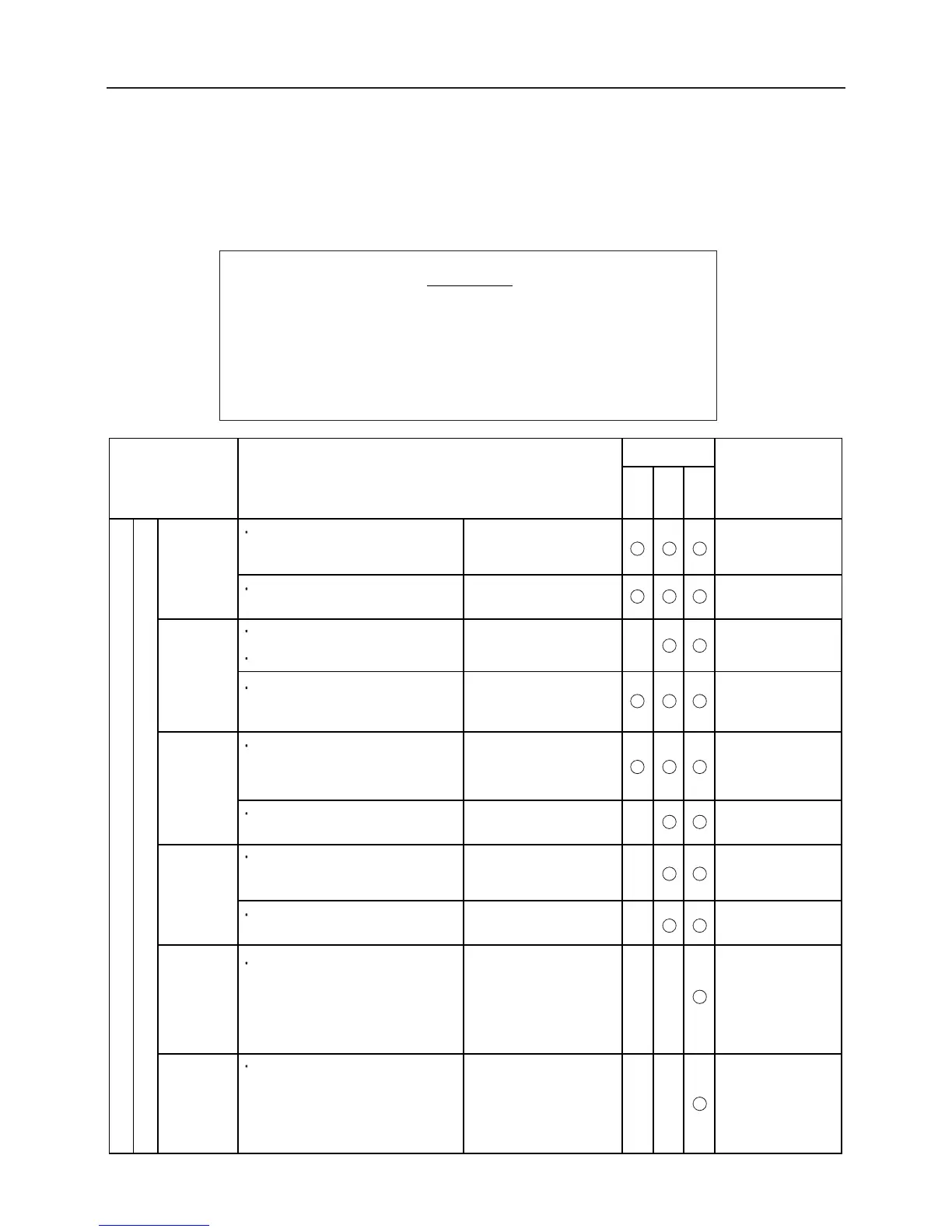
7.1 Periodic Inspection Table
Failure to carry out inspection and maintenance properly will cause machine failure.
Refer to the following table for inspection procedures and frequency.
Some inspection and maintenance procedures in the table
below require technical knowledge or specific tools and mea-
suring instruments. If you have difficulty performing these pro-
cedures, or do not have the correct tools or instruments,
contact your dealer or a Canycom service center.
Item Content of inspection Remarks
Investigate starting condition of
engine and check for abnormal
noise.
There must be no catching,
stalling of engine,
or knocking.
Exhaust gas color and
exhaust sound must be
normal.
There must be no cracks,
deformation of case,
looseness of cover or
connecting piping.
There must be no gas
leakage.
The valve clearance must be
normal.
There must be no noticeable
dirt or damage.
Must work properly.
Must be at specified speed.
Must rotate smoothly.
Check for catching of accelerator
lever when accelerating engine,
engine stall, or knocking.
Check speed at low idling and at
high idling.
Check that rotation is smooth.
Warm up engine thoroughly, then
check for abnormal exhaust gas
color or exhaust sound, low idling to
high idling.
Check if glow plug works prop-
ery.
Check for cracks, deformation of
case, looseness of cover or
connecting piping.
Check for looseness of nuts and
bolts at tightening portion of
cylinder head and manifold
*If no leakage of gas or water is
found from these portions, this
check can be omitted.
Check for dirty or damaged element.
Check for gas leakage from exhaust
pipe or muffler.
Check the valve clearance
* When noise due to abnormal valve
clearance is absent and the engine is
running smoothly, this inspection may
be omitted.
Ease of
starting
Condition
of rotation
Exhaust
gas
condition
Air cleaner
Tightening
Valve
clearance
Engine
Engine proper
Inspection
interval
Inspection
interval
Monthly
Annually
Checks
before
starting



 To Next Page