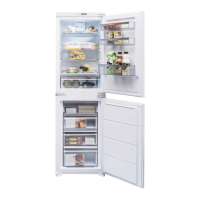
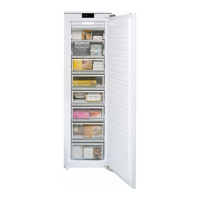
31Instruction manual CAFF42Please keep this instruction manual for future reference
TO AVOID CONTAMINATION OF FOOD, PLEASE RESPECT THE
FOLLOWING INSTRUCTIONS:
› Opening the door for long periods can cause significant increase of the temperature in the
compartments of the appliance.
› Regularly clean surfaces that can come in contact with food accessible drainage systems.
› Store raw meat and fish in suitable containers in the refrigerator, so that it is not in contact
with or drips onto other food.
› Two -star frozen-food compartments are suitable for storing pre-frozen food, storing or
making ice cream and making ice cubes.
› One-, two- and three-star compartments are not suitable for freezing of fresh food.
› If the refrigerating appliance is left empty for long periods, switch off, defrost, clean, dry and
leave the door open to prevent mould developing within the appliance.
FOOD
MAXIMUM
STORAGE TIME*
HOW AND WHERE
TO STORE
Vegetables and fruits 1 week Vegetable bin
Meat and fish 2 - 3 days
Wrap in plastic foil, bags, or in a meat
container and store on the glass shelf
Fresh cheese 3 - 4 days On the designated door shelf
Butter and margarine 1 week On the designated door shelf
Bottled products
e.g. milk and yoghurt
Until the expiry date
recommended by the producer
On the designated door shelf
Eggs 1 month On the designated egg tray
Cooked food 2 days All shelves
These are guidelines only, always refer to the expiry date, or best before date recommended by
the producer.
NOTE:
Potatoes, onions and garlic should not be stored in the refrigerator. The table below is a
quick guide to show you the most efficient way to store the major food groups in your
refrigerator compartment.


 To Next Page