2
Proofed by: Date:
Dimensions checked: Copy checked:
W
arnings
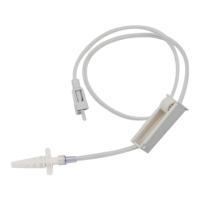
Do not put anything except the access tip of the
l
ockable drainage line or PleurX Vacuum Bottles into
t
he PleurX Catheter valve since this could damage
t
he valve. A damaged valve may allow air into the
body or let fluid leak out through the valve when not
d
raining.
Cautions
For single use only. Re-use may result in a non-
f
unctional product or contribute to cross
c
ontamination.
S
terile technique should be used when placing and
draining the catheter.
Use the filter straw for aspiration only. Do not use
f
or injection.
C
are must be taken when inserting the guidewire
i
ntroducer needle to avoid puncturing or lacerating
the lung or liver.
If the needle is left in place with the guidewire
introducer, damage to the guidewire may result if
w
ithdrawn through the needle.
E
xercise care when placing the catheter to prevent it
f
rom coming into contact with surfaces such as
drapes or towels. Silicone rubber is highly
electrostatic and attracts airborne particles and
surface contaminants.
Use rubber-shod instruments when handling the
catheter. Possible cuts or tears can occur if rubber-
shod instruments are not used.
Place a thumb over the end of the sheath as the
dilator is removed to avoid air entering the pleural
cavity. Care must be taken not to bend or kink the
sheath. Damage to the sheath may prevent passage
of the catheter.
Do not use forceps on the introducer to break its
handle and/or peel the sheath.
Exercise care when placing ligatures to avoid cutting
or occluding the catheter.
Re-expansion pulmonary edema may occur if too
much fluid is removed too rapidly. Therefore, it is
recommended to limit the initial drainage to no more
than 1,500 ml. The volume of pleural fluid removed
should be based on the patient's individual status.
The pinch clamp must be fully closed to occlude the
drainage line. When not connected to a suction
source, make sure the pinch clamp is fully closed.
Otherwise the drainage line may allow air into the
body or let fluid leak out.
When connecting to a vacuum bottle, make sure the
pinch clamp on the drainage line is fully closed.
Otherwise, it is possible for some or all of the
vacuum in the bottle to be lost.
W
hen draining with glass vacuum bottles, do not
use a needle larger than 17 Ga. If wall suction is
u
sed, it must be regulated to no greater than
(
-)60 cm H
2
O
.
K
eep the valve on the PleurX Catheter and the
l
ockable access tip on the drainage line clean. Keep
them away from other objects to help avoid
c
ontamination.
M
ake sure that the valve and lockable access tip are
s
ecurely connected when draining. If they are
accidentally separated, they may become
contaminated. If this occurs, clean the valve with an
a
lcohol pad and use a new drainage set to avoid
p
otential contamination.
P
recautions should be taken to ensure the drainage
line is not tugged or pulled.
It is normal for the patient to feel some discomfort
or pain when draining fluid. If discomfort or pain is
e
xperienced when draining, clamp the drainage line
t
o slow or stop the flow of fluid for a few minutes.
Pain may be an indication of infection.
Potential complications of access and drainage of
the pleural cavity include, but may not be limited to,
t
he following: re-expansion pulmonary edema,
pneumothorax, laceration of lung or liver,
hypotension/circulatory collapse, wound infection,
empyema and infection in the pleural cavity.
The alcohol pads are flammable. Do not expose the
pads to an open flame.
Sterility
This product has been sterilized. It is for single use
only and is not to be resterilized. Do not use if
package is damaged. CareFusion will not be
responsible for any product that is resterilized, nor
accept for credit or exchange, any product that has
been opened but not used.
General Guidelines
1. The procedure for pleural placement can be
performed using local anesthetic and sedation.
However, depending on patient needs, it may be
performed using alternative approaches to
anesthesia or sedation.
2. Use of image guidance may aid in the accuracy
and safety of catheter placement. Care should be
taken to identify and avoid contact with
vasculature near the guidewire insertion site.
3. Catheter placement site selection should be
based upon patient anatomy and presentation
with consideration given to any possible
adhesions or loculated pockets of fluid.
4. Consideration should be given to the patient’s
ease of access in determining the location of the
catheter exit site.
RC041264
McGaw Park, IL
Richard Cisneroz
04-05-12
361-26801


 To Next Page
 Loading...