6.5 Radioactive Concerns
All radioactive isotopes and/or material, drapes, liquids, cleaning
materials, etc., that come in contact with a radioisotope, or item
that is contaminated with a radioisotope, must be handsetd as
per your institution’s radiation rules and regulations. Consult with
your Radiation Safety Ocer for guidance concerning the use
and disposal of radioactive material. See Appendix G for disposal
information provided by the manufacturer of the Care Wise
provided Cobalt 57 and/or Sodium 22 Check Source.
6.6 Use of Electrosurgical Devices
Electrosurgical and other electrocautery devices can emit
excess electromagnetic noise that may cause the C-Trak
®
analyzer to record false counts if these devices are used
to cut or cauterize concurrent with the probe’s use
in surgical exploration.
6.7 Use of Accessory Equipment
Only the accessories as defined in Section 8
should be used with this device.
6.8 Probe Handling Guidelines
Treat the probe as you would any expensive,
delicate, surgical instrument.
The probe is not a solid bar of metal. Inside are two crystals
and a photomultiplier tube. If the probe is dropped or hit
sharply against something hard, it can break.
PLEASE Handset THE PROBE CAREFULLY!
DO NOT PLACE C-TRAK
®
PROBES ON OR NEAR A
MAGNETIC INSTRUMENT PAD OR MAT. The magnetic
field can permanently degrade probe components
and diminish performance.
CAUTION: The C-Trak
®
system is not intended for use in
the presence of flammable anesthetics or other explosive
gases. There is a risk of explosion if the Apollo System
is used in the presence of flammable gases.
Storage
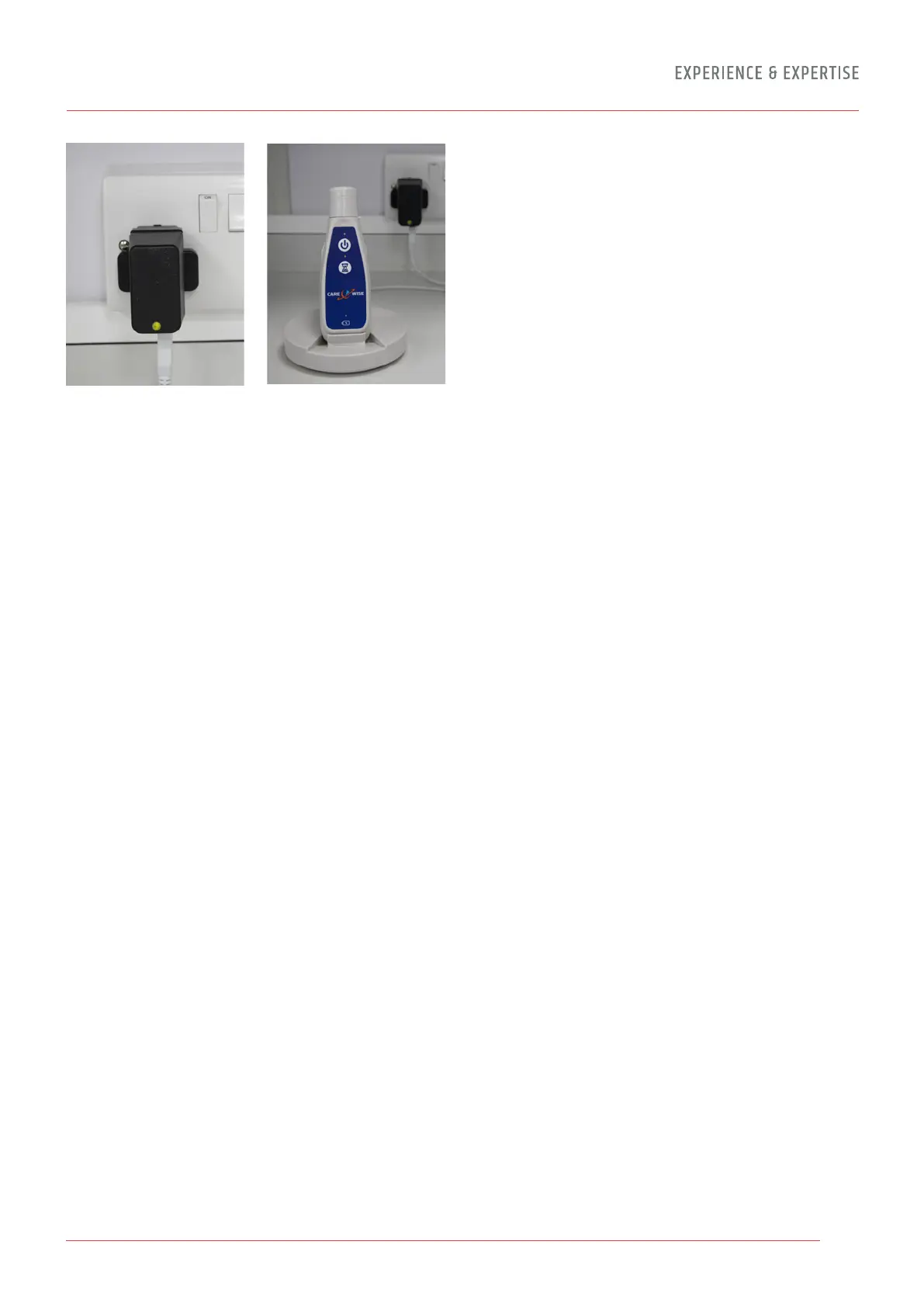
Charge or discharge the battery to approximately 66% of
capacity before storage for prolonged periods.
Charge the battery to approximately 66% of capacity at least
once every six months if the handset is not to be used for a
prolonged period.
Store the handset including the battery at temperatures
between 10 °C and 40 °C (50 °F and 104 °F).
Note: The battery self-discharges during storage.
Higher temperatures (above 50 °C or 122 °F) reduce
the battery storage life.
Handling Precautions
Do not disassemble, crush, or puncture a battery.
Do not short the external contacts on a battery if visible.
Do not dispose of a battery in fire or water.
Do not expose a battery to temperatures above 60 °C (140 °F).
Keep the battery away from children.
Avoid exposing the battery to excessive shock or vibration.
Do not use a damaged battery.
If a battery pack has visible leaking fluids from the handset,
do not touch any fluids. Dispose of a leaking battery pack
(see Disposal and Recycling).
In case of eye contact with fluid, do not rub eyes. Immediately
flush eyes thoroughly with water for at least 15 minutes, lifting
upper and lower lids, until no evidence of the fluid remains.
Seek medical attention.
Disposal and Recycling
Lithium-Ion batteries are subject to disposal and recycling
regulations that vary by country and region. Always check
and follow your applicable regulations before disposing of any
battery. In the UK and Europe, WEEE Regulations should be
followed. Contact Rechargeable Battery Recycling Corporation
(www.rbrc.org) for U.S.A. and Canada, or your local
battery recycling organisation.
Many countries prohibit the disposal of waste electronic
equipment in standard waste receptacles.
29


 To Next Page