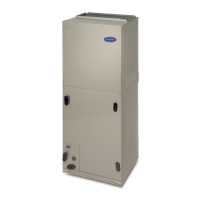
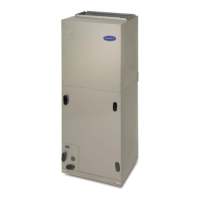
FCM/A5, FEV, FJM, FEM4, FHMA5, FMA4/5, FM(C,U)5, FS(A,M,U)4, FTMA5, F(V,X)M4, F5M4, REM4, WA(H,M,P,X) WB(G,H)L, WC(G,H)L: Service and Maintenance
Manufacturer reserves the right to change, at any time, specifications and designs without notice and without obligations.
17
6. Place a jumper across the R and G terminals on the low voltage
terminal block
7. Fault Code 44 should still be flashing.
8. The Motor LED should be flashing, indicating the board is able to
transmit a signal to the motor.
9. If Motor LED is not flashing, check to ensure that 24V is present
across R and C on the low voltage terminal block and that there is a
good connection with the R and G jumper.
10. If 24V is present and the jumper/connections are good,
11. Replace the board.
Check Board
1. If Fault Code 44 and the Motor LED are both flashing, place a DC
voltmeter across terminals PL1-1 Red (+) to PL1-2 Green (-)
(Fig. 13).
2. Across terminal PL1-1 and PL1-2, a 12VDC should be present. If
12VDC is not present, replace circuit board.
3. If Fault Code 44 is flashing and the Motor LED is flashing, place a
DC voltmeter across terminal PL1-3 (+) and PL1-2 (-).
4. Across terminal PL1-3 (+) and PL1-2 (-), the DC volt meter should
display 5VDC. The voltage should be very stable and should not
fluctuate more than 0.02VDC. If the voltage fluctuates, get a
different voltmeter before proceeding to the following steps.
5. Reconnect Plug 1 to circuit board and connect DC voltmeter across
terminals PL1-3 Yellow (+) and PL1-2 Green (-). Does the voltage
appear to fluctuate more than in step 15? Typical voltmeters will
show a fluctuation of 0.2VDC to 1VDC. The amount of fluctuation
is not important. You could see even more fluctuation depending on
the voltmeter used.
6. Check the blower motor serial output signal. The blinking LED on
the control board represents the serial output signal. You can
measure the signal with a DC voltmeter by removing Plug 1 from
the circuit board and connecting the DC voltmeter across PL1-4 (+)
and PL1-2 (-). The voltage should be near 0VDC but it will
fluctuate briefly several times per second. If you have an analog
voltmeter, the needle briefly will go high several times per second.
If you have a digital voltmeter with a bar graph, it will show a large
change in magnitude on the bar graph several times per second. If
you have a plain, digital voltmeter, it will show a brief fluctuation
in voltage, and the magnitude may vary depending on the voltmeter
used.
The minimum maintenance requirements for this equipment are as
follows:
1. Inspect and clean or replace air filter each month or as required.
2. Inspect cooling coil, drain pan, and condensate drain each cooling
season for cleanliness. Clean as necessary. An inspection port is
provided on all A-coil delta plates. Remove plastic plug to inspect.
Replace plug after inspection.
3. Inspect blower motor and wheel for cleanliness each heating and
cooling season. Clean as necessary.
4. Inspect electrical connections for tightness and controls for proper
operation each heating and cooling season. Service as necessary.
Filter Assembly
To clean or replace air filter, push plastic connectors toward center of
unit and remove filter access panel outward. Push filter up and back into
unit. Then slide filter out.
Clean filter by using cold water and mild detergent. Rinse and allow
filter to dry. No oiling or coating of filter is required.
New filters are available from your local distributor. Place filter in slot
with cross-mesh binding up or facing cooling coil and replace filter
access panel.
Cooling Coil, Drain Pan, and Condensate Drain
The cooling coil is easily cleaned when it is dry. Inspect the coil and
clean (if necessary) before each cooling season. To check or clean
cooling coil, remove coil access panel. If coil is coated with dirt or lint,
vacuum it with a soft brush attachment.
Be careful not to bend coil fins. If coil is coated with oil or grease, clean
it with a mild detergent and water solution. Rinse coil thoroughly with
clear water. Be careful not to splash water on insulation.
FMA4P, WAMA, FMA4X, WAXA
Fan Motor
The FMA4P, FMA5L and WAMA motor is three-speed PSC direct
drive. High-speed lead is black, medium-speed lead is red, low-speed
lead is blue, and common lead is purple. The FMA4X, FMA5X and
WAXA motor is a five speed ECM direct drive. The cooling speed tap is
selected by connecting the green wire to the desired motor tap number
indicated on the motor plug. For the electric heat fan speed selection
connect the white wire to the desired motor tap number indicated on the
motor plug. Be sure proper blower speed has been selected.
The blower motor in this unit has blower-off delays. The blower-off
delay is 30–90 seconds and will keep the motor running after a heating
or cooling call ends.
The motor is turned on through two different routes. The first occurs
when thermostat calls for the fan in cooling, heat pump, or fan-only
mode. A 24VAC signal is sent to relay, causing relay to close its
normally open contacts, turning fan on.
The second occurs when there is a call for electric heat. A 24VAC signal
is sent to heater sequencer/relay, causing it to close, directing 230V
through the normally closed contact of fan relay, turning fan on. The fan
remains on until sequencer/relay/PCB opens.
FMA5 only—has a third way to start the fan motor. If the dissipation
system detects a refrigerant leak, G is energized and completes the
circuit to the indoor blower motor.
If motor does not run, test motor for an open winding or a winding
shorted to motor case. If either is present, replace motor.
WARNING
!
ELECTRICAL SHOCK HAZARD
Failure to follow this warning could result in personal injury or death.
Disconnect all power to the unit before servicing the field wires or
removing the control package. The disconnect (when used) on the
access panel does not disconnect power to the line side of the
disconnect, but does allow safe service to all other parts of the unit.
CAUTION
!
CUT HAZARD
Failure to follow this caution may result in personal injury.
Sheet metal parts may have sharp edges or burrs. Use care and wear
appropriate protective clothing and gloves when handling parts.
WARNING
!
ELECTRICAL OPERATION HAZARD
Failure to follow this warning could result in personal injury or death.
Before installation or servicing system, always turn off main power to
system. There may be more than one disconnect switch. Turn off
accessory heater power if applicable. Lock out and tag switch with a
suitable warning label.


 To Next Page