20 • Telescope Basics
Each of the Celestron Schmidt-Cassegrain telescopes uses the same focusing
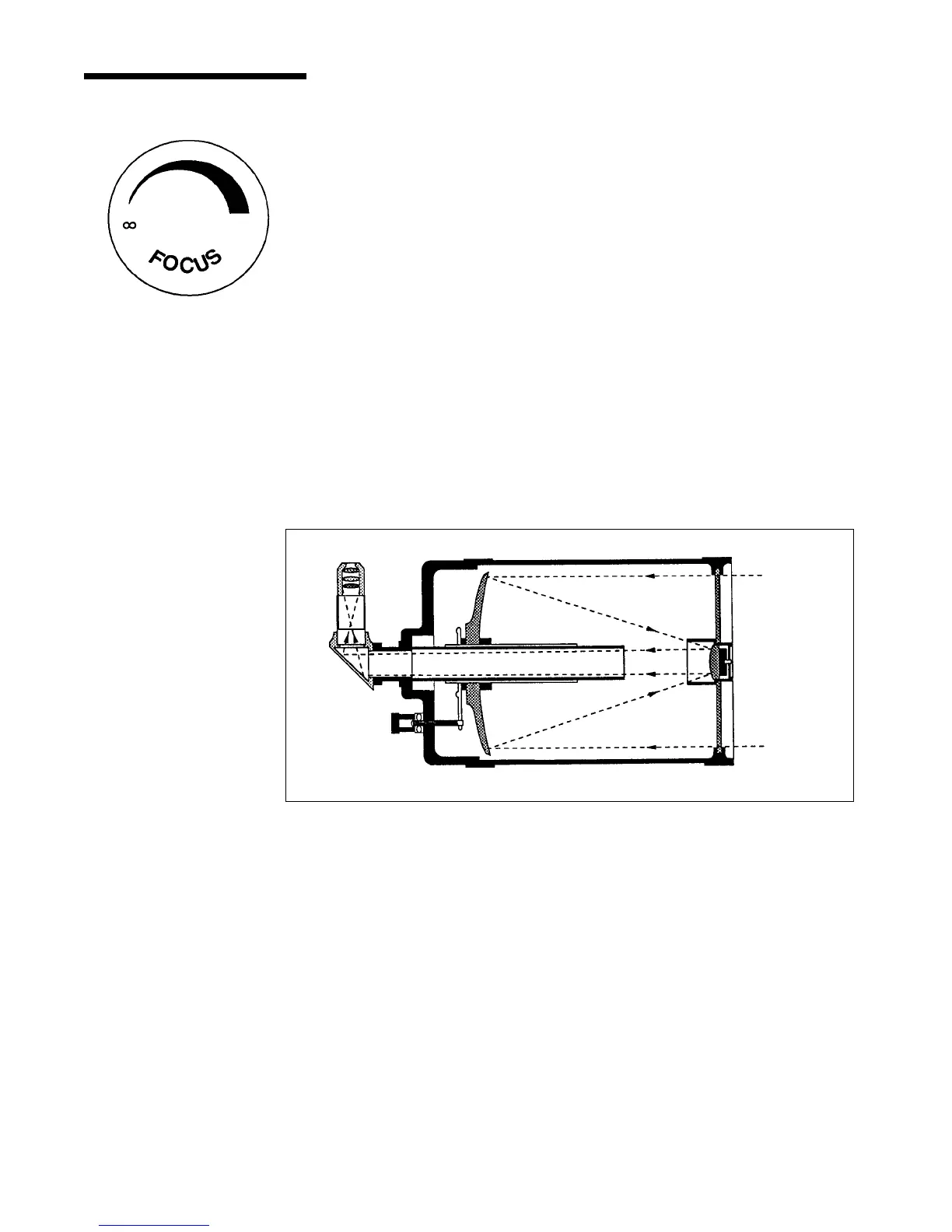
mechanism. The primary mirror is mounted on a ring which slides back and forth on
the primary baffle tube (see figure 3-5). The focusing knob, which moves the primary
mirror, is on the rear cell of the telescope. To focus, turn the focusing knob until the
image is sharp. If the knob will not turn, it has reached the end of its travel on the
focusing mechanism. Turn the knob in the opposite direction until the image is sharp.
Once an image is in focus, turn the knob clockwise to focus on a closer object and
counterclockwise for a more distant object (see figure 3-4). A single turn of the
focusing knob moves the primary mirror only slightly. Therefore, it will take many
turns (about 40) to go from close focus (approximately 60 feet) to infinity.
For astronomical viewing, out of focus star images are very diffuse making them
difficult, if not impossible, to see. If you turn the focus knob too quickly, you can go
right through focus without seeing the image. To avoid this problem, your first
astronomical target should be a bright object (like the Moon or a planet) so that the
image is visible even when out of focus.
Critical focusing is best accomplished when the focusing knob is turned in such a
manner that the mirror moves against the pull of gravity. In doing so, any mirror shift
is minimized. For astronomical observing, both visually and photographically, this is
done by turning the focus knob counterclockwise.
FocusingFocusing
FocusingFocusing
Focusing
Figure 3-4
The decal on the end of the
focus knob shows the correct
rotational direction for
focusing the G-9 1/4.
Figure 3-5
This diagram shows the focusing mechanism of the G-9 1/4 telescopes.


 To Next Page