Telescope Basics • 25
When working with any optical instrument, there are a few things to remember to
ensure you get the best possible image.
• Never look through window glass. Glass found in household windows is optically
imperfect and, as a result, may vary in thickness from one part of a window to the
next. This inconsistency can and will affect the ability to focus your telescope. In
most cases you will not be able to achieve a truly sharp image. In some cases,
you may actually see a double image.
• Never look across or over objects that are producing heat waves. This includes
asphalt parking lots on hot summer days or building rooftops.
• Hazy skies, fog, and mist can also make it difficult to focus when viewing terrestri-
ally. The amount of detail seen under these conditions is greatly reduced. Also,
when photographing under these conditions, the processed film may come out a
little grainier than normal with lower contrast.
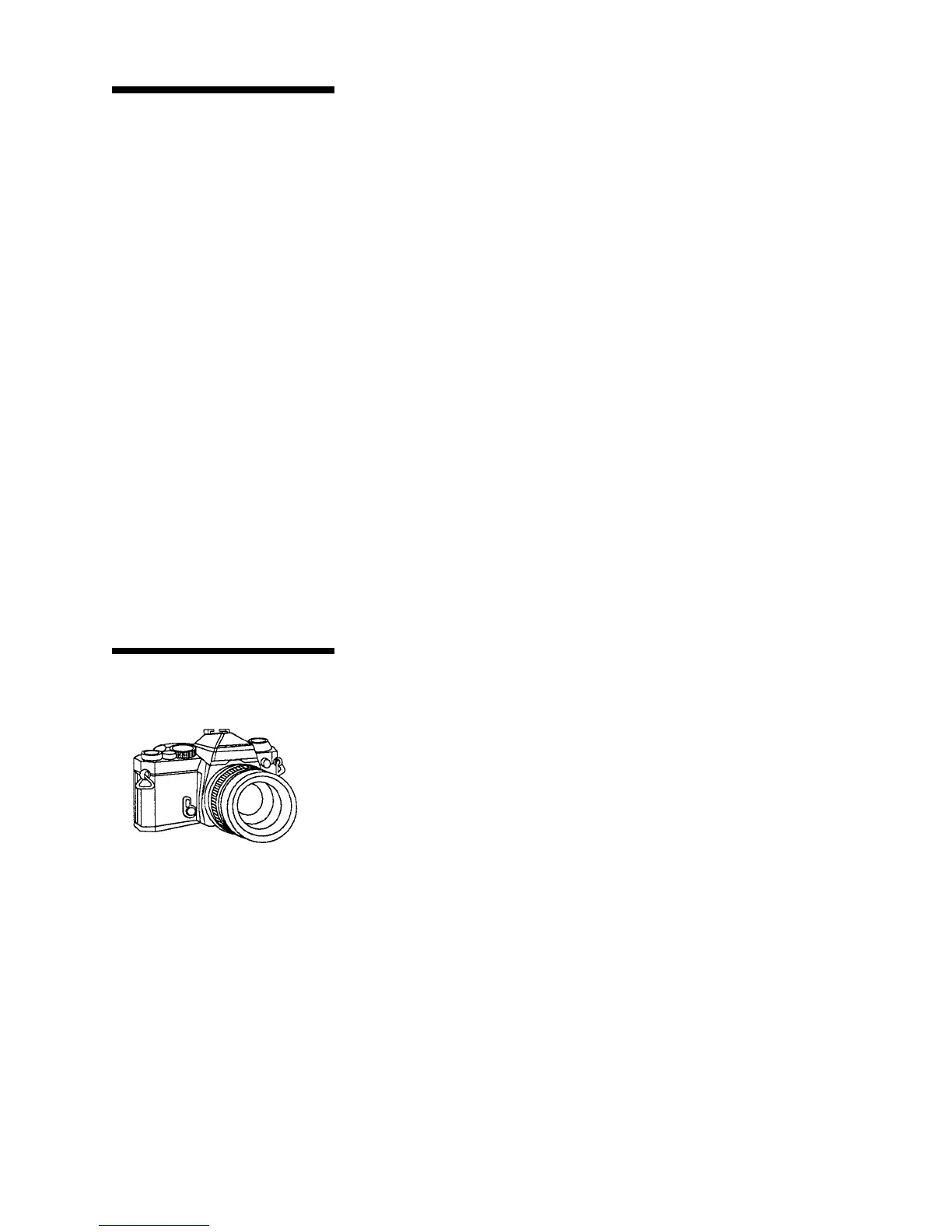
• When using your telescope as a telephoto lens, the split screen or microprism
focuser of the 35mm SLR camera may “black out.” This is common with all long
focal length lenses. If this happens, use the ground glass portion of your
focusing screen. To achieve a very sharp focus, consider using a focusing
magnifier. These are readily available from your local camera store.
• If you wear corrective lenses (specifically glasses), you may want to remove them
when observing with an eyepiece attached to your telescope. When using a
camera, however, you should always wear corrective lenses to ensure the sharp-
est possible focus. If you have astigmatism, corrective lenses should be worn at
all times.
Your Celestron telescope can be used for both terrestrial and astronomical photogra-
phy. Your G-9
1
/
4
has a fixed aperture and, as a result, a fixed f/ratio. To properly
expose your subjects photographically, you need to set your shutter speed accord-
ingly. Most 35mm single lens reflex (SLR) cameras offer through-the-lens metering
that lets you know if your picture is under or overexposed. This is important for
terrestrial photography where exposure times are measured in fractions of a second.
In astrophotography, the exposures are much longer, requiring that you use the “B”
setting on your camera. The actual exposure time is determined by how long you
keep the shutter open. More on this in the section on “Celestial Photography.”
To reduce vibration when tripping the shutter, use a cable release. Releasing the
shutter manually can cause vibration, something that produces blurred photos. A
cable release allows you to keep your hands clear of the camera and telescope, thus
reducing the possibility of shaking the telescope. Mechanical shutter releases can be
used, though air-type releases are best.
General Observing Hints
General Photography
Hints


 To Next Page