Generac
®
Power Systems, Inc. 15
Sparking can occur if the wire terminal does
not fit firmly on the spark plug terminal end. If
necessary, re-form the wire terminal to obtain a
tight fit.
3.6 CLEAN SPARK ARRESTOR
The engine exhaust muffler has a spark arrestor
screen. Inspect and clean the screen at least once
each year.
NOTE:
If using the generator on any brush-covered or
grass-covered unimproved land, it must equipped
with a spark arrestor. The spark arrestor must be
maintained in good condition by the owner.
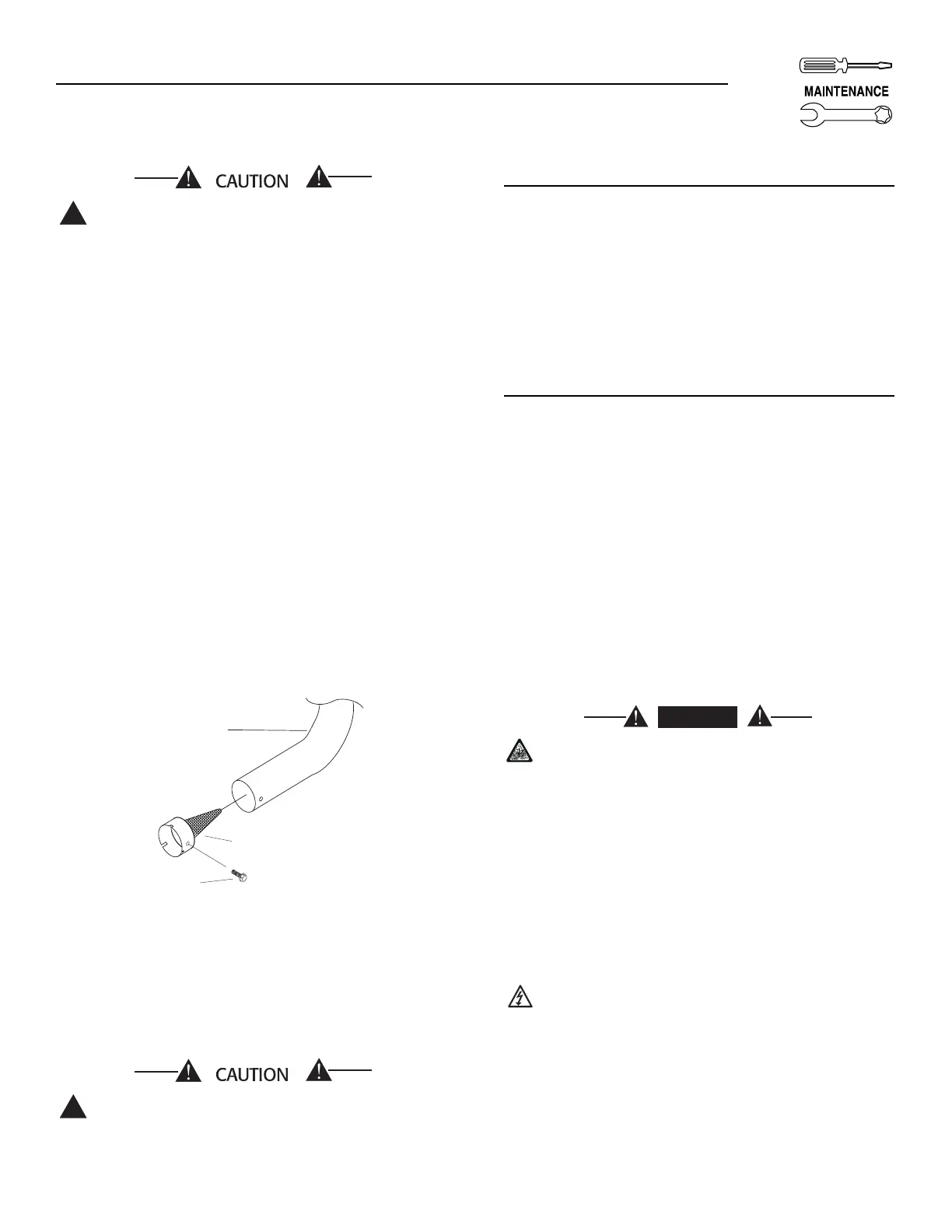
Clean and inspect the spark arrestor as follows:
• Remove the screen retaining bracket by removing
the screw (Figure 3.5).
• Slide the spark arrestor screen out from the
exhaust pipe.
• Inspect screen and replace if torn, perforated or
otherwise damaged. DO NOT USE a defective
screen. If screen is not damaged, clean it with com-
mercial solvent.
• Replace the screen and the retaining bracket.
Reinstall screw.
Figure 3.5 — Spark Arrestor
3.7 CLEANING THE GENERATOR
Keep the generator set as clean and dry as possible.
Protect the unit against excessive dust, dirt, corrosive
vapors, etc. Permitting dirt and moisture to accumu-
late on generator enclosure reduces the effectivity of
the power-coat paint to maintain color and appear-
ance.
Do NOT use a forceful spray of water to clean
the generator. Water will enter the generator
interior and cause problems, and may also
cause corrosion of brackets and linkage on the
generator.
3.7.1 CORROSION PROTECTION
Periodically wash and wax the generator enclosure
using automotive type products. Frequent washing is
recommended in salt water/coastal areas. Spray
engine linkage, steel brackets and fasteners with a
light oil such as WD-40
®
.
3.8 BATTERY MAINTENANCE
All lead-acid batteries will discharge when not in use.
The generator battery should be inspected as follows:
3.8.1 EVERY SIX MONTHS
• Inspect the battery posts and cables for tightness
and corrosion. Tighten and clean as necessary.
• Check the battery fluid level of unsealed batteries
and, if necessary, fill with Distilled Water Only. Do
not use tap water in batteries.
• Have the state of charge and condition checked.
This should be done with an automotive-type bat-
tery hydrometer if battery is not a maintenance
free type.
NOTE:
Servicing of the battery is to be performed or
supervised by personnel knowledgeable of batter-
ies and the required precautions. Keep unautho-
rized personnel away from batteries. Damage will
result if the battery connections are made in
reverse.
Do not dispose of the battery in a fire. The bat-
tery is capable of exploding. Storage batteries
give off explosive hydrogen gas. This gas can
form an explosive mixture around the battery
for several hours after charging. The slightest
spark can ignite the gas and cause an explo-
sion. Such an explosion can shatter the battery
and cause blindness or other injury. Any area
that houses a storage battery must be properly
ventilated. Do not allow smoking, open flame,
sparks, or any spark producing tools or equip-
ment near the battery. Discharge static electrici-
ty from body before touching the battery by
first touching a grounded metal surface.
A battery presents a risk of electrical shock and
high short circuit current. The following precau-
tions are to be observed when working on bat-
teries:
• Remove watches, rings or other metal objects;
• Use tools with insulated handles;
• Wear rubber gloves and boots;
• Do not lay tools or metal parts on top of the bat-
tery;


 To Next Page