65
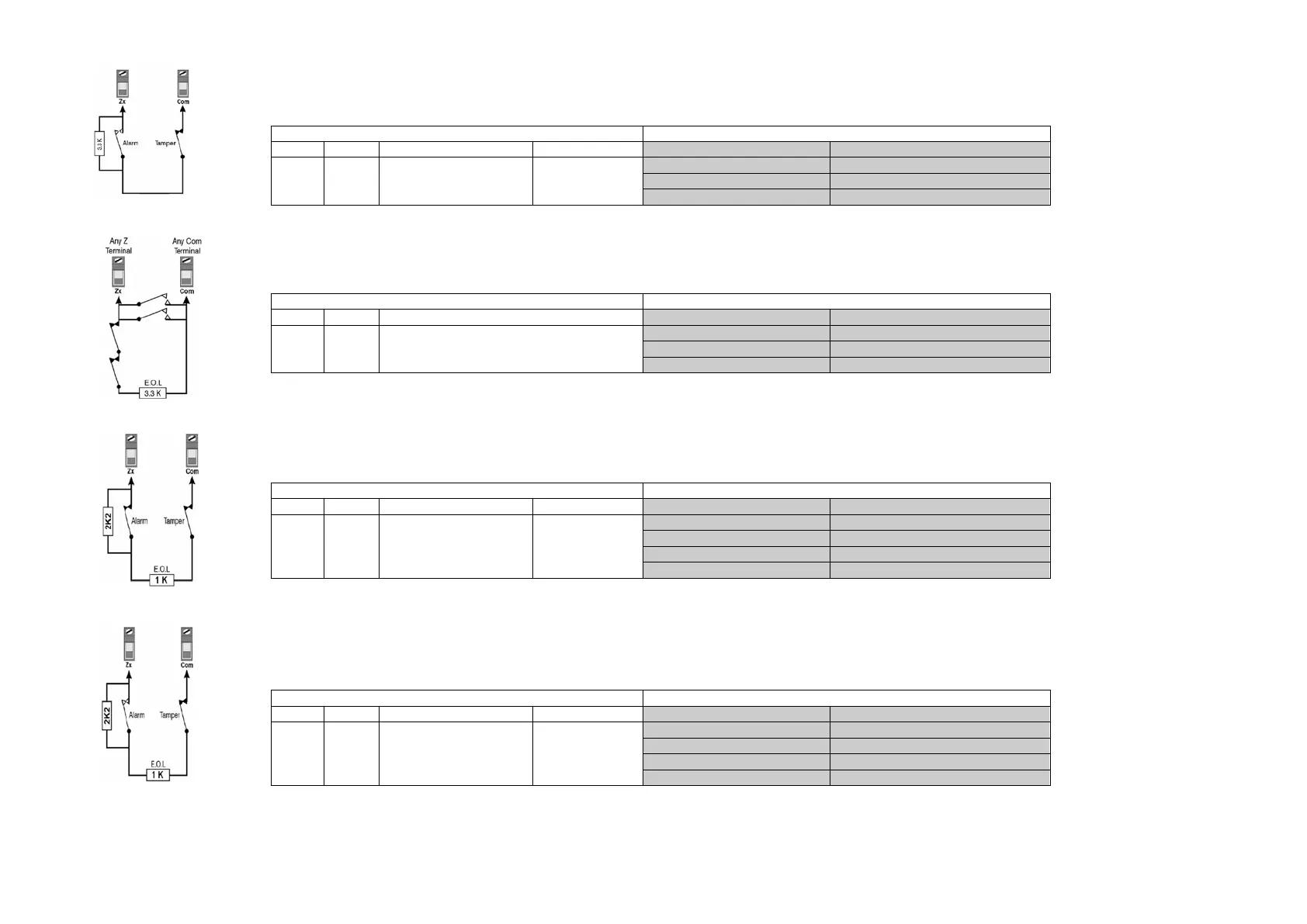
If some off your detection devices will use normally open contacts and your security installation requires tamper (open circuit) detection, but it does not require
wire fault recognition, connect the detection devices as shown in the next figure and ensure the zone wiring attributes are programmed as shown in the next table.
This setup will communicate the violated zone to the control panel which will display it on the keypads. The control panel will also communicate any open loops
(tamper trouble) as per Tamper / Wire Fault Recognition Options. Do not use devices with N.C. contacts in this zone setup, as this will cause the zone to remain in
alarm.
A.1.5. SINGLE ZONE with N.C. & N.O. CONTACTS, with EOL RESISTOR, without TAMPER RECOGNITION
If your security installation does not require tamper or wire fault recognition, but for some zones it requires to use a mixture of detection devices with normally
open and normally closed contacts, connect the detection devices with a 3K3 end of line (EOL) resistor, as shown in the next figure and ensure the zone wiring
attributes are programmed as shown in the next table. This setup will communicate the violated zone to the control panel which will display it on the keypads.
A.1.6. SINGLE ZONE with N.C. CONTACTS, with EOL RESISTOR and TAMPER RECOGNITION
If your security installation requires tamper (open circuit) and wire fault (short circuit) recognition, connect the detection devices with a 1K end of line (EOL)
resistor, as shown in the next figure and ensure the zone wiring attributes are programmed as shown in the next table. This setup will communicate the violated
zone to the control panel which will display it on the keypads. The control panel will also communicate any open loops (tamper trouble) and/or short circuits (wire
fault trouble) as per Tamper/Wire Fault Recognition Options. Do not use devices with NO contacts in this zone setup, as this will cause the zone to remain in alarm.
A.1.7. SINGLE ZONE with N.O. CONTACTS, with EOL RESISTOR and TAMPER RECOGNITION
If some off your detection devices will use normally open contacts and your security installation requires tamper (open circuit) and wire fault (short circuit)
recognition, connect the detection devices with a 1K end of line (EOL) resistor, as shown in the next figure and ensure the zone wiring attributes are programmed
as shown in the next table. This setup will communicate the violated zone to the control panel which will display it on the keypads. The control panel will also
communicate any open loops (tamper trouble) and/or short circuits (wire fault trouble) as per Tamper / Wire Fault Recognition Options. Do not use devices with
N.C. contacts in this zone setup, as this will cause the zone to remain in alarm.
2
OFF OFF ON N.O.
short circuit Zone violated
OFF ON OFF
ATZ EOL Tamper recognition Contact type Zone terminal status System Response
OFF ON ON N.C.
open circuit Tamper Trouble
2
OFF ON ON N.O.
short circuit Wire fault trouble



 To Next Page