(2) All other switches (except ignition switch) — "OFF."
(3) Check condition of circuit breakers to identify faulty circuit if
possible. Leave faulty circuit deactivated.
(4) Master Switch -- "ON."
(5) Select switches "ON" successively, permitting a short time delay
to elapse after each switch is turned on until the short circuit is
localized.
(6) Make sure fire is completely extinguished before opening venti-
lators.
FLIGHT IN ICING CONDITIONS.
Although flying in known icing conditions is prohibited, an unexpected
icing encounter should be handled as follows:
(1) Turn pitot heat switch "ON" (if installed).
(2) Turn back or change altitude to obtain an outside air temperature
that is less conducive to icing.
(3) Pull cabin heat control full out to obtain windshield defroster air-
flow. Adjust cabin air control to get maximum defroster heat and
airflow.
(4) Open the throttle to increase engine speed and minimize ice
build up on propeller blades.
(5) Watch for signs of carburetor air filter ice and apply carburetor
heat as required. An unexplained loss in engine speed could be caused
by carburetor ice or air intake filter ice.
(6) Plan a landing at the nearest airport. With an extremely rapid
ice build-up, select a suitable "off airport" landing site.
(7) With an ice accumulation of one quarter inch or more on the wing
leading edges, be prepared for significantly higher stall speed.
(8) Leave wing flaps retracted. With a severe ice build-up on the
horizontal tail, the change in wing wake airflow direction caused by wing
flap extension could result in a loss of elevator effectiveness.
(9) Open left window and scrape ice from a portion of the windshield for
visibility in the landing approach. The metal control lock shield may be
used as a scraper.
(10) Perform a landing approach vising a forward slip, if necessary,
for improved visibility.
(11) Approach at 75 to 85 MPH, depending upon the amount of ice ac-
cumulation.
(12) Avoid steep turns during the landing approach.
(13) Perform a landing in level attitude.
3-8
Section IV
OPERATING LIMITATIONS
OPE R A T I O NS AUTHORIZED.
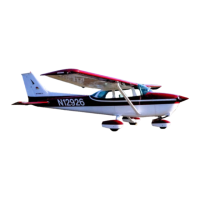
Your Cessna exceeds the requirements of airworthiness as set forth by the
United States Government, and is certificated under FAA Type Certificate No.
3A12 as Cessna Model No. 172L.
With standard equipment, the airplane is approved for day and night
operations under VFR. Additional optional equipment is available to increase
its utility and to make it authorized for use under IFR day and night. An
owner of a properly equipped Cessna is eligible to obtain approval for its
operation on single-engine scheduled airline service. Your Cessna Dealer
will be happy to assist you in selecting equipment best suited to your needs.
MANEUVERS - NORMAL CATEGORY.
This airplane is certificated in both the normal and utility category. The
normal category is applicable to airplanes intended for non-aerobatic
operations. These include any maneuvers incidental to normal flying, stalls
(except whip stalls) and turns in which the angle of bank is not more than 60°.
In connection with the foregoing, the following gross weight and flight load
factors apply:
Gross Weight . . . . . . . . . . . . . . . . . 2300 Ibs
Flight Load Factor
* Flaps Up . . . . . . . . . . . . . . +3.8 -1.52
* Flaps Down . ............. +3.5
*The design load factors are 150% of the above, and in all
cases, the structure meets or exceeds design loads.
Your airplane must be operated in accordance with all FAA-approved
markings, placards and check lists in the airplane. If there is any infor-
mation in this section which contradicts the FAA-approved markings, placards
and check lists, it is to be disregarded.
4-1



 To Next Page