
 Need help?
Do you have a question about the Chef's Choice Diamond Hone 4633 and is the answer not in the manual?
Introduces the three-stage diamond sharpener for 15° Asian and 20° Euro/American blades.
Provides detailed steps for sharpening 15° double-faceted Asian blades using specific stages.
Explains the process for sharpening serrated knife edges using the 'Polishing & Serrated' stage.
Offers instructions for sharpening 20° Euro/American style knives using designated stages.
Outlines the terms, limitations, and coverage of the product's limited warranty.
Provides details about EdgeCraft Corporation, assembly location, and contact methods.
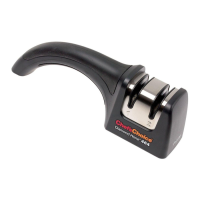
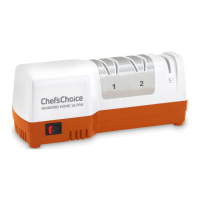
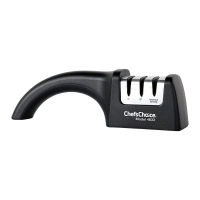
The Chef'sChoice® Manual Diamond Hone® Model 4633 is a versatile three-stage diamond sharpener designed to create razor-sharp edges on a variety of knife blades. Its primary function is to sharpen both 15° Asian double-faceted blades and all popular European or American style 20° knives, as well as sporting, pocket, and serrated blades. The sharpener utilizes 100% diamond abrasives, known for their hardness and durability, ensuring consistent and effective sharpening.
One of the key usage features of the Model 4633 is its three-stage design, which incorporates a two-step sharpening process to achieve a long-lasting, razor-sharp edge. For 15° Asian blades, the process begins in the "Asian" stage, where the blade is fully sharpened. Following this, the edge is micro-honed and polished to razor quality in the "Polishing & Serrated" stage. This dual-stage approach ensures that the blade not only becomes sharp but also maintains its edge for an extended period.
For 20° Euro/American style blades, the sharpening process starts in the "Euro/Amer" stage. Here, the blade is initially sharpened, and then it is honed and micro-polished in the "Polishing & Serrated" stage. This sequential sharpening and polishing ensures that Euro/American blades also achieve a superior, durable edge. The sharpener's design allows for simultaneous shaping and sharpening of both sides of the knife edge, which contributes to well-formed and consistently sharp results. The abrasives, consisting of 100% diamond crystals, are embedded on unique interdigitating steel support plates, further enhancing the sharpener's performance and longevity.
The Model 4633 is designed for ease of use, accommodating both left and right-handed users. To sharpen a knife, the user places the sharpener on a secure, level surface. For Asian Santoku or other 15° double-faceted edge blades, the knife blade is positioned in the slot marked "Asian." The blade should be centered to avoid touching the side walls of the slot. The user then slides the blade repeatedly forward and back along its full length, applying only modest downward pressure. Excessive pressure should be avoided to prevent damage to the sharpening elements. For blades that are very dull or have never been sharpened at 15°, up to one hundred or more full strokes may be required initially to reset the angle and achieve sharpness. For less dull blades, twenty-five back and forth full strokes are usually sufficient. The sharpening step is complete when the knife can cut paper well or slice easily through a tomato.
Following the sharpening step, the knife proceeds to the Honing/Polishing stage. For Asian blades, this involves moving the knife to the "Polishing & Serrated" stage. It is crucial not to use the "Euro/Amer" stage for Asian Santoku or other 15° blades during this step. In the "Polishing & Serrated" stage, the user continues with back and forth strokes, applying just enough downward pressure to maintain steady and consistent contact with the sharpening surfaces. The blade should remain centered, avoiding contact with the slot's sides. Approximately 25 light full strokes in this stage are recommended, after which the blade sharpness should be tested. Additional strokes can be made if necessary until the knife cuts easily and smoothly, indicating a very sharp and durable edge.
For 20° Euro/American knives, the sharpening procedure is similar but begins in the "Euro/Amer" stage. The blade is positioned in this slot, centered, and slid repeatedly forward and back with modest downward pressure. As with Asian blades, twenty-five back and forth full strokes are typically sufficient for less dull knives, while up to one hundred or more strokes may be needed for very dull blades to fully sharpen them in this stage. Once the sharpening in the "Euro/Amer" stage is complete, the knife is moved to the "Polishing & Serrated" stage for honing and polishing. Here, back and forth strokes are continued with sufficient downward pressure to ensure consistent contact. About 25 light but full strokes are recommended, followed by testing the blade sharpness. This process results in a very sharp and durable edge for Euro/American knives.
A notable maintenance feature is that the 20° Euro/American knives can be re-sharpened 5-10 times using only the "Polishing & Serrated" stage. If this process becomes too slow, it indicates that a full re-sharpening, starting with the "Euro/Amer" stage, is needed again.
The Model 4633 also excels at sharpening serrated knives. For these blades, only the "Polishing & Serrated" stage is used. The special diamonds in this stage create razor-sharp "micro-blades" along the dominant teeth, which enhances cutting action and reduces the typical sawing and tearing associated with serrated blades. Even new, "factory-fresh" serrated knives, which often have poorly formed or dull saw-teeth, can benefit from sharpening with the Model 4633. The sharpener restores dull teeth to a better-than-new condition. Generally, 25 back-and-forth strokes in the "Polishing & Serrated" stage are sufficient for serrated blades. If a serrated blade is heavily damaged, sharpening should begin in the "Euro/Amer" stage with about 25 full back and forth strokes to remove metal from both sides of the cutting teeth. Additional strokes can be made as needed, and the sharpening is finished in the "Polishing & Serrated" stage for further refinement. It's important to note that because serrated knives function like a saw, their cut will not be as smooth as that of a plain blade.
The cutting effectiveness of serrations largely depends on the sharpness of the points (edges) of the teeth. It is not necessary to sharpen the sides and bottoms of the scallops between the teeth, as these parts generally do not perform the cutting action.
Regarding maintenance and safety, users are advised to keep fingers clear of the blade at all times during sharpening. No sharpening oils or water are necessary with this diamond abrasive sharpener, simplifying the process and reducing mess. The Model 4633 is designed for household use only and is not intended for industrial or commercial applications.
The sharpener is not designed for single-sided (single-faceted) traditional Japanese blades or scissors of any style. To re-sharpen an Asian (15°) style edge, users should repeat the steps outlined in the Sharpening and Honing/Polishing sections for Asian blades. The unique arch structure created by the sharpener ensures a stronger, double-beveled, longer-lasting edge compared to conventional "V-shaped" or hollow ground edges, meaning the edge will stay sharp longer. This sharpener consistently outperforms conventional sharpeners that use less efficient abrasives and lack control over the sharpening angle. The diamonds, being the hardest known material, ensure extreme durability. Straight-edge knives sharpened on the Model 4633 will achieve a "shaving sharp" edge with a mild "bite," allowing them to cut effortlessly through various foods, making cutting and slicing a more enjoyable task and eliminating the drudgery of working with dull knives.
 General
| Type | Electric Knife Sharpener |
|---|---|
| Model | 4633 |
| Category | Accessories |
| Sharpening Stages | 3 |
| Blade Types | Straight and Serrated |
| Abrasive | Diamond |
| Sharpening Angle | 20 degrees |
| Power Source | Electric |
| Voltage | 120V |
| Wattage | 100W |
| Color | Black |
| Material | Plastic and Metal |




 To Next Page