EasyManua.ls Logo

Chevrolet Light - Page 50

Chevrolet Light
107 pages
Print Icon
To Next Page IconTo Next Page
To Previous Page IconTo Previous Page
Loading...
ice
brakes
with
mechanically
operated
parking
brakes.
Fun
c-
tionally,
the
brakin
g
systems
u
sed
on
all
truck
models
are
the
same;
however,
they
vary
somewhat
in
type,
size
and
braking
area
due
to
the
difference
in
vehicle
weight
and
load
capacity.
,
The
hydraulic
service
brakes
provide
brake
action
at
all
four
wheels,
while
the
mechanical
parking
brakes
operate
on
the
rear
wheels
of
all
truck
models
except
the
H~
and
2
ton
which
are
equipped
with
a
propeller
shaft
brake.
The
service
brake
system
consists
of
the
brake
pedal
,
main
cylinder,
brake
lines
to
all
wheel
s,
wheel
cylinders,
s
hoes
with
linings
and
brake
drums.
The
parking
brake
on
all
models
except
11,2
and
2 ton,
consists
of
the
brake
lever
or
peda
l,
pull
rods,
cables
and
the
toggle
at
the
whee
ls
which
actuates
the
brake
shoes.
Parking
brake
on
Ph
and
2
ton
consists
of
the
brake
lever,
bell
cranks,
pull
rod,
brake
drum
attached
to
the
transmission
drive
flange
and
an
interna
l
and
external
brake
shoe.
The
hydraulic
system
must
be
kept
full
of
fluid
at
all
times
in
order
to
function
properly.
The
main
cylinder
includes
a
res-
ervoir
for
a
reserve
supply
of
fluid.
Thi
s
automatically
keeps
the
system
full
of
fluid as
long
as
there
is a
reserve
supply
in
the
re
servo
ir.
Should
the
reservo
ir be
come
empty
or
the
hy-
draulic
system
be
opened
at
any
point,
air
will
enter
the
sys-
tem
and
affect
the
efficiency
of
the
brakes.
When
this
occurs
the
hydraulic
system
must
be
bled.
See
"Bleeding
Hydraulic
System."
Care.
The
Chevrolet
braking
system
requires
very
little
care;
however,
the
system
should
be
checked
occasionally
fo
r
indications
of
fluid
leak.
If
leaks
are
found
the
necessary
repairs
should
be
made
at
once.
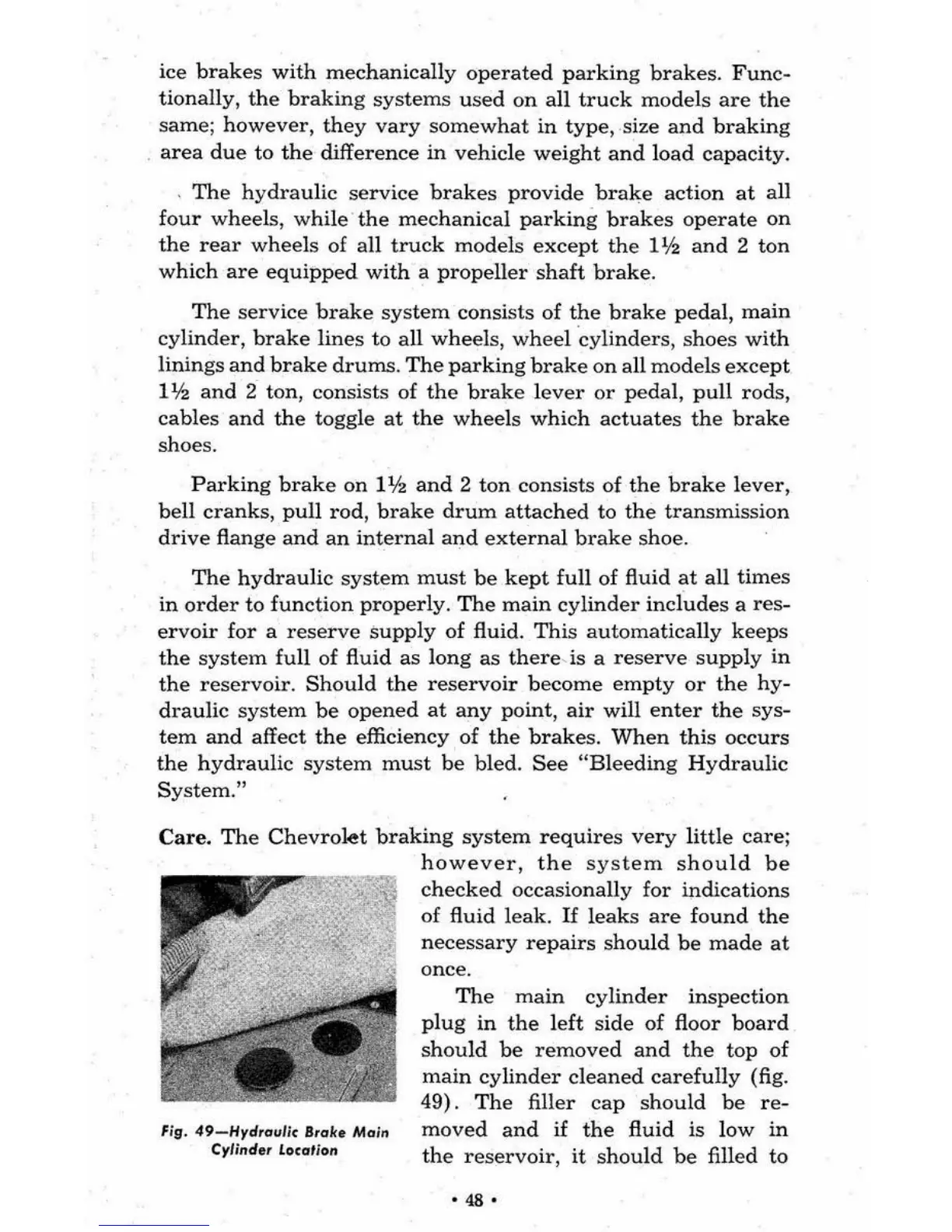
The
main
cylinder
inspection
plug
in
the
left
side
of
floor
board
should
be
removed
and
the
top
of
main
cylinder
cleaned
carefully
(fig.
49).
The
filler
cap
should
be
re-
Fig.
49-HrdrClu/i(
8rClh
MClin
moved
and
if
the
fluid is
low
in
c
rUnder
l
O(CI,lon
the
reservoir,
it
should
be
filled to
-
48·

Related product manuals