EasyManua.ls Logo

Chevrolet Light - Page 76

Chevrolet Light
107 pages
Print Icon
To Next Page IconTo Next Page
To Previous Page IconTo Previous Page
Loading...
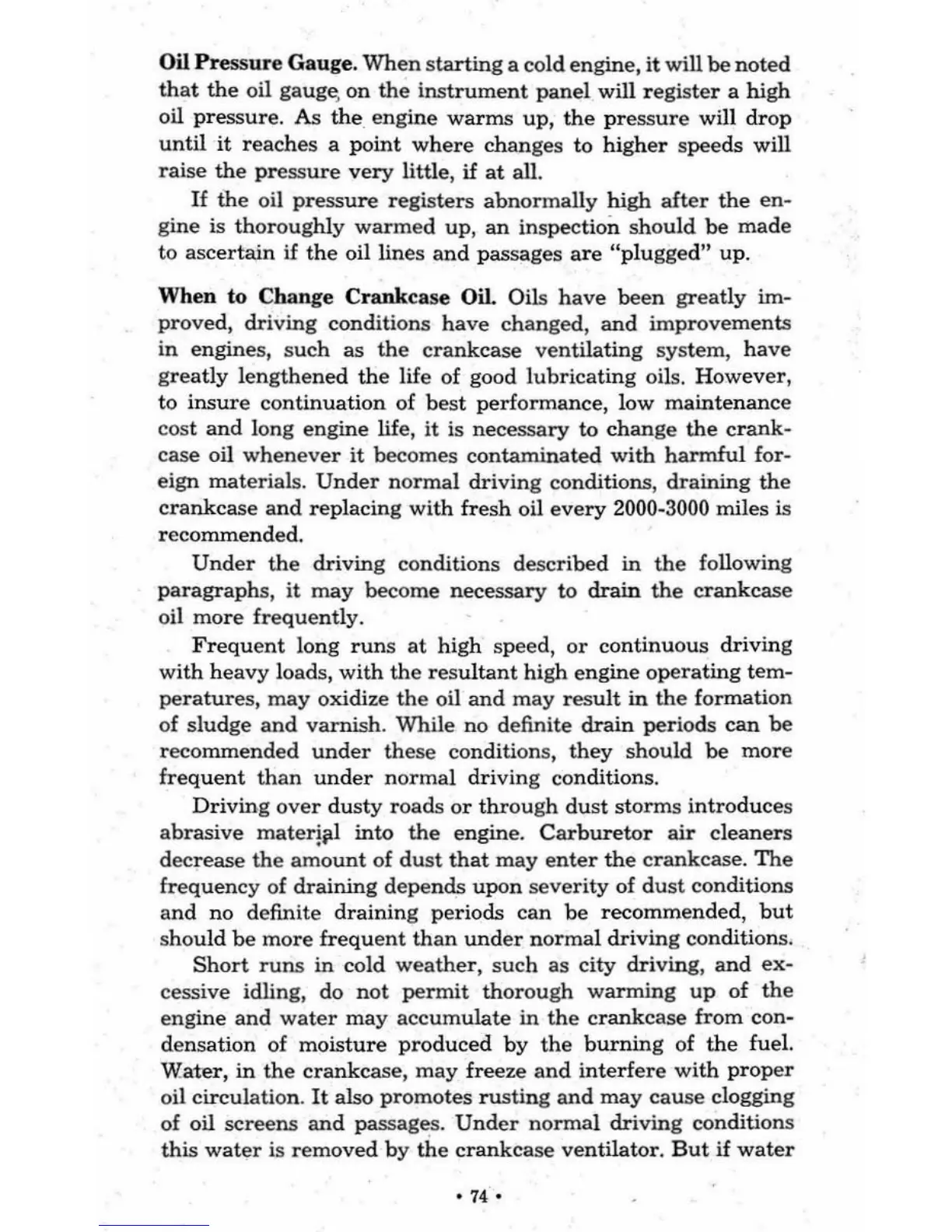
Oil
Pressure
Gauge.
When
starting
a co
ld
engine,
it
will be
noted
that
the
oil gauge,
on
the
instrument
panel will
re
gister a
high
oil pressure. As
the
_
engine
warms
up,
the
pressur
e will
drop
until
it
reaches
a
point
where
chan
ges to
higher
spee
ds will
raise
the
pressure
very
little,
if
at
all.
If
the
oil
pressure
registers
abnormally
high
after
the
en-
gine
is
thoroughly
warmed
up,
an
inspection
should
be
made
to
ascertain
if
the
oil lines
and
passages
are
"plug
ge
d"
up.
When
to
Change
Crankcase
Oil
Oils
have
been
grea
tly
im-
proved,
driving
conditions
have
changed,
and
improvements
in
engines,
such
as
the
crankcase
venti
lating
system,
have
grea
tly
lengthened
the
life of good
lubricating
oils.
However
,
to
insure
continuation
of
best
performance,
low
maintenance
cost
and
long engine life,
it
is
necessary
to
chan
ge
the
crank-
case oil
wheneve
r
it
becomes
contaminated
with
harmfu
l for-
eign
mat
er
ials.
Under
no
rmal
drivin
g conditions,
draining
th
e
crankcase
and
replacing
with
fresh oil
every
2000-3000 miles is
r
ec
ommended.
Under
the
driving
conditions
de
scribe
d
in
the
following
paragraphs,
it
may
become
necessary
to
drain
the
crankcase
oil
more
frequently.
Frequent
long
runs
at
high
speed,
or
continuous
driving
with
heavy
loads,
with
the
resultant
high
engine
operating
tem-
peratures,
may
oxidize
th
e oil
and
may
resu
lt
in
the
formation
of
sludge
and
varnish. While no defi
nite
drain
periods
can
be
recomme
nd
ed
under
these
conditions,
they
should
be
more
frequent
than
under
normal
drivin
g conditions.
Driving
over
dusty
roads
or
through
du
st
storms
introduces
abrasive
mater!pl
into
the
engine.
Carburetor
air
cleaners
d
ec
rease
the
amou
nt
of
dust
that
may
ente
r
the
crankcase.
The
frequen
cy of
draining
depends
upon
severity
of
du
st
conditions
and
no
definite
draining
periods
can
be
recommended,
but
sho
uld
be
more
frequent
than
under
normal
driving
conditions.
Short
runs
in
cold
weather,
such
as
city
driving
,
and
ex-
cessive idling, do
not
permit
thorough
w
arming
up
of
th
e
engi
ne
and
water
may
accum
ulate
in
the
c
rankc
ase
from
con-
de
nsation
of
moisture
produced
by
the
burning
of
the
fuel.
W.ater,
in
the
crankcase,
may
freeze
and
interfere
with
proper
oil circulation.
It
also
promotes
rustin
g
and
may
cause
clogging
of oil
screens
and
passages.
Under
normal
driving
conditions
this
water
is removed. by
the
crankcase
ventilator.
But
if
water
'74'

Related product manuals