This document describes the Clarke 10" Portable Thicknesser, Model No. CPT250 (Part No. 6500860), a woodworking machine designed for thicknessing wood. It includes operating and maintenance instructions, safety precautions, and a parts list.
Function Description:
The Clarke 10" Portable Thicknesser is a woodworking machine used to plane wood to a uniform thickness. It features a cutting head with blades that remove material from the workpiece as it passes through the machine, ensuring a consistent and desired thickness. The machine is designed for both DIY and professional use, offering precision and efficiency in wood preparation.
Important Technical Specifications:
- Model No.: CPT250
- Part No.: 6500860
- Voltage: 230vac
- Power Input: 1250 Watts
- No Load Speed: 8000 rpm
- Weight: 27 Kg
- Sound Power Level: 107.3 dBLwa
- Feed Speed: 8 m/min
- Max Cutting Depth: 2.5mm
- Max Machining Width: 254mm (10 inches)
- Min Machining Width: 19mm
- Min Machining Length: 355mm
- Min Machining Thickness: 12mm
- Declaration of Conformity: Complies with 93/68/EEC, 89/336/EEC, and 98/37/EC directives.
Usage Features:
- Assembly: The thicknesser requires some assembly, including attaching the thickness adjustment handle. It's crucial to check all components for shortages or damage upon receipt. The infeed and outfeed rollers must be correctly adjusted and rotate freely, aligned parallel to the base plate for safe and accurate operation. This involves loosening and tightening screws to set the rollers just clear of a straight edge placed across the base plate.
- Operation:
- Anchoring: The machine must always be securely anchored to a workbench or similar surface using four 10mm nuts and bolts to prevent free standing operation.
- Thickness Adjustment: The thickness of the material to be machined is set using the thickness adjusting handle and the depth gauge rule.
- Material Preparation: Before switching on, ensure the timber is free of nails, screws, or other foreign material that could damage the blades or cause personal injury.
- Cutting Depth: For the initial cut, a depth of 1mm is recommended. Subsequent cuts can be made up to a maximum of 2.5mm until the desired thickness is achieved.
- Switching ON/OFF: To switch ON, press the switch cover down, slide it in the direction of the arrow, and lift it up to expose the ON/OFF buttons. Press the green 'I' button to turn ON. Do not close the cover as this will switch the machine OFF. For normal OFF, press the red 'O' button and always close the cover to prevent accidental starting. In an emergency, quickly close the switch cover.
- No Volts Switch: The ON/OFF switch is a "No Volts Switch," preventing automatic restart after a power failure.
- Feeding Workpiece: Always feed material from the front of the thicknesser, never from the back. Do not force the workpiece into the machine, as this can overload the motor.
- Support for Long Pieces: When machining long pieces, ensure they are supported as they exit the machine.
- Push Stick: Always use a push stick when machining short or narrow workpieces.
- Dust Extraction: The thicknesser is equipped with a dust extraction facility, allowing connection to a vacuum extractor or dust bag. An adapter is provided and must be fitted at all times for safety, preventing finger access to the blades. The adapter is a bayonet type, fitted by pushing onto the outlet port and twisting clockwise, then secured with screws.
- Safety Precautions: The manual emphasizes numerous safety precautions, including wearing safety goggles and a face or dust mask, keeping the work area clean and well-lit, keeping children away, maintaining the machine in top condition, handling with care, ensuring the switch is off before plugging in, concentrating on the job, maintaining proper footing and balance, wearing proper apparel (avoiding loose clothing or jewelry), removing the plug from the electrical outlet when adjusting or servicing, and never operating under the influence of drugs or alcohol. It also specifically warns against using the machine in damp/wet locations or explosive atmospheres.
- Additional Precautions for Thicknessers: Always ensure cutters are secured and sharp, switch off immediately after use, ensure safety devices are in place, fit new blades as a pair, allow the machine to reach full speed before introducing workpiece, do not use if the electric cable/plug/motor is in poor condition, do not block ventilation slots, do not touch the cutter immediately after use, never leave the machine running unattended, secure the machine to a workbench, never attempt to reverse the workpiece, and avoid accidental starting by removing the plug.
Maintenance Features:
- General Cleaning: Regularly clean the machine and inspect for signs of wear or damage. Rectify any defects before using the machine again.
- Isolation: Before any cleaning or maintenance, always ensure the machine is switched OFF and isolated from the main electrical supply by removing the plug from the socket.
- Motor Brushes: Inspect motor brushes regularly for even wear and excessive sparking. Replace brushes if necessary (when worn down to less than 7mm), always in pairs. Brushes are located on either side of the motor housing and are accessed by unscrewing the brush cap.
- Belt Replacement: The drive belt is located behind the housing opposite the height adjustment handle. To replace, remove the top cover by unscrewing 8 cover screws, then remove 2 allen screws securing the side cover to the machine base. The belt is eased off the small pulley while rotating the blade cylinder by hand. When fitting a new belt, ensure it is centralized on both pulleys and all grooves are used.
- Blade Replacement: Plane blades require sharpening or replacing. They are very sharp and must be handled with care. Blades must always be fitted as a pair and be of the type recommended by the manufacturer.
- Removal: Lower the head for access, remove two screws securing the top bracket, remove 4 screws securing the dust extraction port, rotate the blade cylinder to access and loosen six blade securing bolts, then remove the blade clamp and blade assembly. Repeat for the other blade.
- Fitting New Blades: Loosen and remove two screws on each blade assembly, noting their orientation. Lay the blade onto the blade setting jig, ensuring the elongated holes align with the larger holes in the jig. Place the blade mounting bracket on the blade and secure with the two screws. Refit the blade assemblies to the blade cylinder, ensuring the mounting bracket locates in the slot. Reassemble the machine in reverse order, ensuring all locking washers are fitted and screws are tightened sufficiently.
- Blade Sharpening: Blade sharpening should only be performed by a qualified person. Blades are fitted to a sharpening jig using the screws from the blade mounting brackets. It's crucial to keep both blades in contact with the sharpening stone at all times to maintain the correct angle and ensure both blades remain the same size for balance and to reduce vibration.
- Anti Kickback Mechanism: Regularly inspect the kickback claws located at the front of the machine. Ensure all claws are in place, not broken, and move freely on the shaft. Replace any broken or missing claws before using the thicknesser again.
- Electrical Connections: The product is supplied with a standard 13 amp, 230 volt (50Hz), BS 1363 plug. It is double insulated. The blue wire connects to the neutral 'N' terminal, and the brown wire to the live 'L' terminal. If the plug needs changing, a plug of identical specification must be used, and the fuse must be a 13 amp ASTA approved to BS1362. Approved cable extensions suitable for the power rating should be used, with conductor size at least equal to or larger than that on the machine. Cable reels should be fully unwound.

 Need help?
 General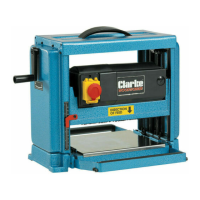

 To Next Page