20 • Important: Always read and follow the operating instructions.
Custom and Special
Wheels
Only tire technicians with experience and
training on custom wheels should attempt
to service expensive custom alloy or alu-
minum wheels and high-performance low-
profile tires.
Alloy Wheels
Some manufacturers offer wheels with little or no
drop center. These are not DOT approved. The tire or
wheel - or both - can be damaged and the tire could
explode under pressure , resulting in serious injury or
death. If you attempt to mount/demount this type of
wheel, use extreme caution (figure 43).
Figure 43 - No Drop Center
European Performance Wheels
(Asymmetrical Hump)
Some European wheels have very large humps
except near the valve hole. On these wheels, the
beads should be loosened at the valve hole on both the
upper and lower sides first (figure 44).
Figure 44 - Asymmetrical Hump on European Wheels
Wheels with Low Pressure Warning
Sensors
Performance wheels on some vehicles (including
Corvette, BMW, Lamborghini Diablo) have a pressure
sensor strapped to the rim opposite the valve hole. On
these wheels, the beads should be loosened at the
valve hole on both upper and lower sides first (figure 45).
Figure 45 - Wheels with Low Pressure Sensor
Tube Type Tires
Mounting
1. Avoid pinching or forcing the tube.
2. Apply rubber lubricant to the beads of the tire.
3. Mount the bottom bead.
4. Round out the tube with a small amount of air.
5. Apply rubber lubricant to the tube.
6. Insert the tube into the tire.
7. Mount the top bead.
Demounting
1. After tire beads are loosened, lubricate the beads
and rim liberally.
2. Position demount head and bead lifting tool as
described in steps 8 through 12 on pages 5 and 6.
Depress table top pedal and rotate only a short dis-
tance at a time. This allows you to stop the process
should the tube get pinched.
3. After upper bead is demounted, remove tube and
demount lower bead.
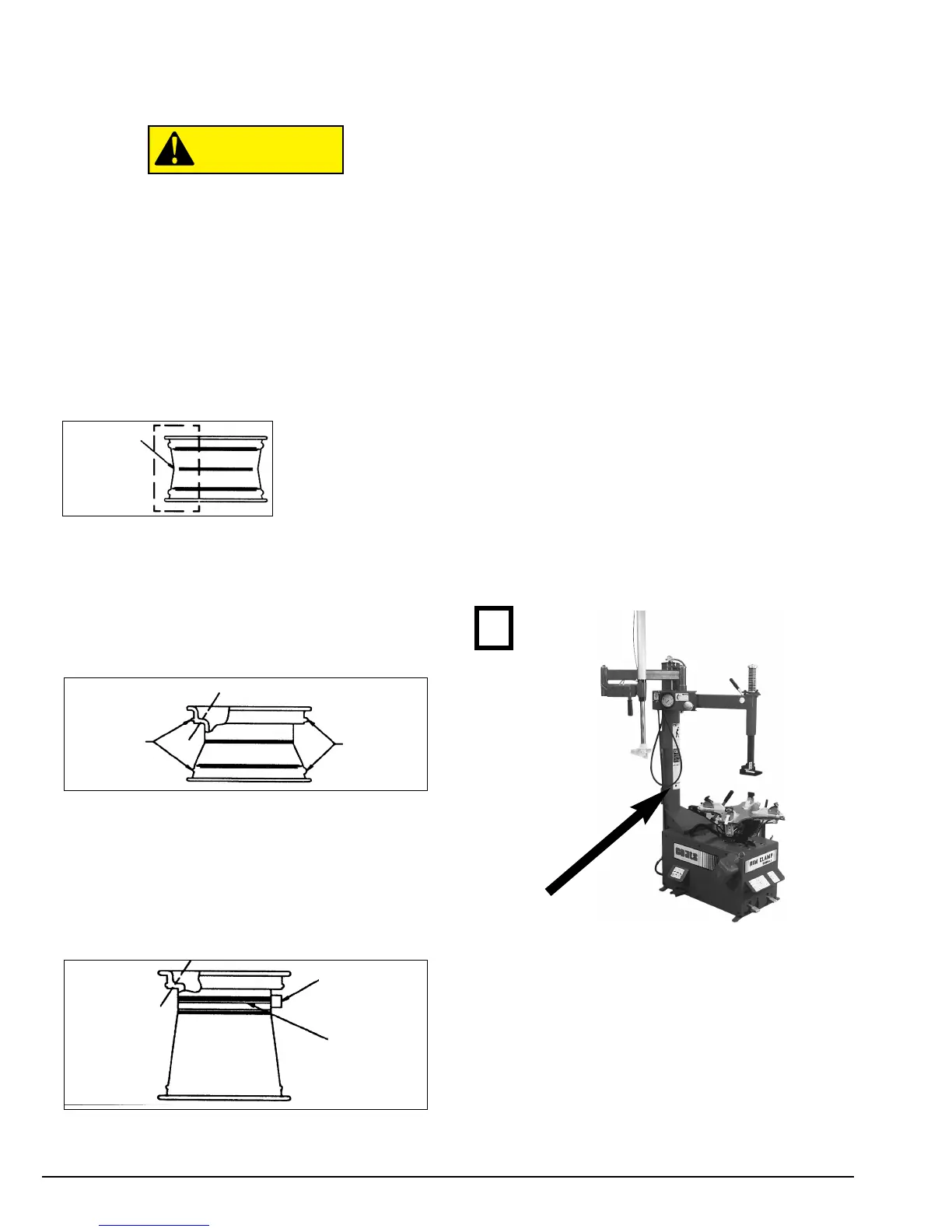
Do It Now
Make sure the instruction and warning decal is clean
and clearly visible to operator.


 To Next Page