This document is the user manual for the SAILOR MF/HF System 6000A/6000B Radiotelex, a communication system designed for maritime use, operating on Medium Frequency (MF) and High Frequency (HF) radio frequencies. It is approved for shipboard installations within the Global Maritime Distress and Safety System (GMDSS).
Function Description
The SAILOR MF/HF System 6000A/6000B Radiotelex facilitates worldwide ship-to-ship, ship-to-shore, and shore-to-ship communication. It can also act as a relay between the Radiotelex system and an end receiver without telex capabilities, particularly through a coast station. The system supports both 4- and 5-digit selective calls, as well as 9-digit Maritime Mobile Service Identity (MMSI) numbers. The Radiotelex application runs on a Message Terminal (SAILOR 6018 or SAILOR 6006 Message Terminal), which serves as the primary interface for reading, writing, and setting up telex calls. The system is well-suited for long-distance transmissions and offers global coverage, including the North and South poles.
Important Technical Specifications
The system operates on MF or HF radio frequencies. For telex distress and safety communication, there are 6 dedicated simplex FEC telex distress frequencies:
- 2174.5 kHz (Channel 1)
- 4177.5 kHz (Channel 411)
- 6268 kHz (Channel 611)
- 8376.5 kHz (Channel 801)
- 12520 kHz (Channel 1287)
- 16695 kHz (Channel 1624)
The Message Terminal has a minimum compass safe distance of 1.3 meters. The Inbox and Sent Items can each hold up to 1000 messages, with older messages being deleted when this limit is exceeded. The system can receive telex messages on all MF and HF telex frequencies, including NAVTEX messages at 490 kHz, 518 kHz, and 4209.5 kHz. The receive frequency for scanning must be between 490 and 27500 kHz, and the transmit frequency must be within a valid maritime frequency band specified by ITU.
The system supports three transmission modes:
- ARQ (Automatic Repetition reQuest): A two-way communication mode where stations can communicate without breaking the connection, with direction changes managed by an "over" command. This mode uses acknowledgements and timeouts for reliable data transmission.
- Selective FEC (Forward Error Correction): A one-way mode for communication to a single station. This mode adds redundant data for error detection and correction without requiring a back-channel.
- Broadcast FEC: A one-way mode for broadcasting to all stations, typically used in distress situations, for news, or coast station traffic lists.
The SAILOR 6081 PSU and Charger, if part of the system, provides power status information including:
- Max charge current: 20.0 A
- Max charge voltage: 29.0 V
- Float voltage: 27.2 V
- Min alarm voltage: 23.2 V
- Max alarm voltage: 29.5 V
- Min alarm temperature: -3 °C
- Max alarm temperature: 54 °C
Usage Features
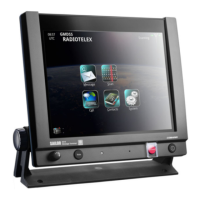
The Message Terminal features a touch-screen and a keyboard for operation, with an optional USB mouse. The Radiotelex application starts automatically when the Message Terminal is powered on.
Distress and Safety Communication:
- Sending a DSC Distress Alert: Initiated by opening the cover and holding the Distress button for more than 3 seconds. The Message Terminal provides a popup with a countdown and beeping sounds from attached control units. If telex is selected as subsequent communication, the Call window automatically sets up for Broadcast FEC on the matching telex distress frequency.
- Sending a Distress Telex: After a DSC Distress alert, users can send further information including the time of the alert, own MMSI and ship name, own position, and details of the distress.
- Cancelling a Distress Alert: Involves cancelling the DSC alert on the MF/HF radio, which sends a Distress cancel message on 1-6 channels. The Message Terminal then guides the user to send a Broadcast FEC message to cancel the alert, including relevant details.
General Communication:
- Setting up a Telex Call: Users select the transmission mode (ARQ, Selective FEC, or Broadcast FEC) and frequency (manual, ITU intership channel, ITU coast station channel, or ITU distress/safety channel). Recipients can be selected from Contacts, Coast stations, or by typing a 9-digit MMSI or 4/5-digit selective calling number.
- Making a Telex Call: Once the mode, frequency, and recipient are set, the call is initiated. Text messages can be typed directly or sent from a file. The system supports automatic identification (DE/WRU) and allows for changing transmission direction in ARQ mode.
- Messages: Users can write longer messages using the Message function, save them to the Message Terminal or a USB stick, print them, or send them directly. The system supports a specific set of telex characters.
- Receiving Telex Messages: The system receives messages on scanned frequencies. A popup appears for incoming messages, and ARQ calls can be continued interactively. All received messages are stored in the Inbox.
- Scan Frequencies: The system scans selected frequencies for incoming telex messages. Users can edit the scan list to add, change, or delete frequencies. Scanning on multiple frequencies is primarily for ARQ calls.
- Contacts: The system stores individual contacts (name, MMSI/SelCall) and coast stations (name, country, call sign, MMSI/SelCall, and associated channels). These lists can be added to, edited, and backed up.
- Cyrillic Characters: The terminal can be configured to use a Cyrillic keyboard for message input.
User Interface:
- Main Menu: Provides access to Message, Scan, Call, Contacts, and System functions.
- Status/Warning Icon: Located in the upper right corner, indicates system status (idle, scanning, ARQ connection, outgoing/incoming FEC, outgoing Broadcast FEC) and signal quality (red arrows for poor signal).
- Error/Warning Icons: Appear alongside status icons to indicate errors or warnings.
- Power Status: Shows the status of the backup battery (if a SAILOR 6081 PSU and Charger is connected).
- Navigation: Can be done via touch screen, keyboard (Alt + for underlined items, Esc to go back, Tab/arrow keys to navigate, Space to select), or F1 for active errors/warnings.
Maintenance Features
- System Information: Provides serial numbers and software versions for each unit in the system (SAILOR 6300 MF/HF Radiotelex, SAILOR 6018 Message Terminal, SAILOR 6081 PSU and Charger, SAILOR 6103 Multi Alarm Panel).
- System Settings: Allows configuration of regional settings (date/time format, Cyrillic characters), screen settings (night mode shift level), call settings (slave delay, automatic DE/WRU), and identification (call code, answer back string). Identification settings require a password and are typically configured during installation.
- Contacts Backup: Users can export contacts to a file or import contacts from a file, adding them to existing contacts.
- Diagnostic Report: The system can generate a diagnostic report, saving a file with diagnostic data to a USB memory stick.
- Troubleshooting Guide: Provides solutions for common problems such as the system not switching on, no battery information, or connection issues between the Message Terminal and the MF/HF radio or printer.
- Status Signaling: The Message Terminal displays basic status and error messages, including popup windows for events requiring attention. The top right corner shows status information and error/warning icons. A list of active warnings and errors can be accessed, leading to an event log that stores up to 100 previous events (errors, warnings, cleared events).

 Need help?
 General



 To Next Page