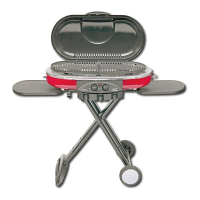
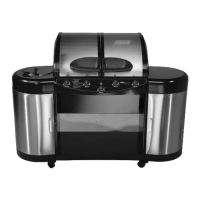
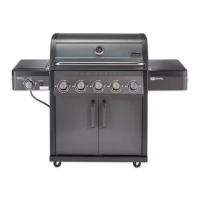
1. Create a mixture of 50% water and 50% liquid
dishwashing soap.
2. Open lid.
3. Ensure all control knobs are set to “OFF”.
4. Brush or spray soapy water solution onto all connections
shown.
5. Slowly open LP cylinder shut-off valve by turning the
hand wheel counter clockwise.
LEAK TEST PROCEDURE
NOTE: The leak test must be performed in an area that has adequate lighting in order to see if bubbles are
developing and not in a windy or noisy area so larger leaks can be detected by smell or sound.
WARNING
Never use your barbecue without leak testing all gas connections, hoses and propane tank.
DANGER
To prevent fire or explosion hazard:
• DO NOT smoke or permit ignition sources in the area while conducting a leak test.
• Perform test OUTDOORS in a well ventilated area that is protected from the wind.
• Never perform a leak test with a match or open flame.
• Never perform a leak test while the barbecue is in use or while barbecue is still hot.
When to perform a leak test:
• After assembling your barbecue and before lighting for the first time, even if purchased fully
assembled.
• Every time LP gas cylinder is refilled, exchanged or if any of the gas components are
disconnected or replaced.
• Any time your barbecue has been moved.
• At least once per year or if your barbecue has not been used for more than 60 days.
Checking for leaks:
WARNING
If you hear a rushing sound or smell gas, turn gas o. Tighten any
leaking connections. If leak is detected at connection nut and
tightening does not stop leak, reinspect propane tank rubber seal.
WARNING
DO NOT use grill if leaks cannot be stopped. Contact customer
hotline at 1-800-275-4617.
Watch For Bubbles
H
I
J
E
D
C
B
A
F
G
A
Supply tank
(cylinder) weld
B
Connection nut to brass
nipple
C
Hand wheel and
connection to tank
D
Brass nipple connection
into regulator.
E
Regulator and hose
connections
F
Metal hose connection
to sear burner valve
assembly
G
Sear burner valve stem
H
Hose connection to gas
manifold
I
Gas supply hose
J
Tank valve and opd
hand-wheel
6. Check each location listed (A–J) for growing bubbles,
which indicates a leak. Large leaks may not be detected
by bubbles but should produce a rushing sound or gas
smell.
7. Turn off gas supply at cylinder valve.
8. Tighten any leaking connections. If a leak is detected
at connection nut and tightening does not stop leak,
reinspect propane tank rubber seal(see page 6).
9. Repeat soapy water test until no leaks are detected.
10. Turn off gas supply at cylinder valve until you are ready
to use your barbecue.
11. Wash off soapy residue with cold water and towel dry.
12. Wait 5 minutes to allow all gas to evacuate area before
lighting barbecue.
9


 To Next Page
 Loading...