Need help?
Do you have a question about the Comnet CNGE11FX3TX8MS and is the answer not in the manual?
Important safety precautions for equipment installation and operation.
Step-by-step guide for mounting the switch on a DIN-rail.
Instructions for mounting the switch using a wall mount panel.
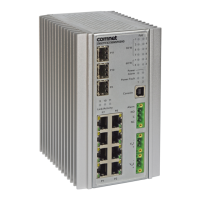
Description of the switch's physical components and indicators.
Details on power supply requirements and front panel LED indicators.
Steps and credentials for logging into the switch's web management interface.
Configuration of IP interfaces, including DHCP and fallback options.
Configuration of the default gateway and IP routes for network access.
Setting the switch's time zone and daylight saving time configurations.
Settings for syslog server mode, address, and message level.
Controls LED intensity and behavior for power saving.
Configuration of port-specific power saving features like EEE, ActiPhy, and PerfectReach.
Define temperature thresholds for turning off ports to prevent overheating.
Configure port speed, duplex, and auto-negotiation settings.
Settings for managing network traffic flow control and maximum frame size.
Global and per-VLAN settings for enabling/disabling the DHCP server.
Manages DHCP pools for IP address allocation to clients.
Manages user accounts, passwords, and privilege levels for switch access.
Configures authentication methods for accessing the switch.
Overview and configuration of user privilege levels and their permissions.
Settings to enable or disable SSH access for secure remote management.
Settings for HTTPS mode, automatic redirect, and certificate maintenance.
Defines rules for IP address-based access management.
Global SNMP system settings including mode, version, and community strings.
Configuration of SNMP traps for network event notifications.
Configuration of SNMPv3 users, groups, and security parameters.
Configuration of RMON statistics for monitoring network traffic.
Configuration of RMON history for collecting traffic statistics over time.
Configuration of RMON alarms and events for network monitoring.
Configuration for limiting the number of MAC addresses per port for security.
Overview of Network Access Server (NAS) port states and system settings.
Detailed NAS status and settings for individual switch ports.
Configuration of ACL parameters for switch ports, including policy, action, and mirroring.
Defines ACEs (Access Control Entries) for traffic filtering rules.
Global and port-specific settings for IP Source Guard to prevent IP spoofing.
Global and port-specific settings for ARP inspection to prevent ARP spoofing.
Specifies which VLANs are inspected by ARP Inspection.
Configuration of RADIUS servers for authentication and accounting.
Configuration of TACACS+ servers for authentication and accounting.
Configuration of static link aggregation groups.
Configuration of Link Aggregation Control Protocol (LACP) on switch ports.
Global and port-specific settings for loop detection and port actions.
Configuration of STP protocol version, bridge priority, and timers.
Mapping of VLANs to Multiple Spanning Tree Instances (MSTI) and priorities.
Configuration of CIST and MSTI port settings, including role and path cost.
Manages IPMC profiles and their associated filtering rules.
Global and per-VLAN settings for Multicast VLAN Registration.
Configuration and status of IGMP Snooping.
Configuration of VLANs for IGMP snooping.
Status of MLD Snooping, including querier information and port status.
Configuration of LLDP transmission parameters like interval and hold time.
Port-specific LLDP configuration.
Status of PoE for all switch ports, showing power allocation and port status.
Configuration of PoE mode, priority, and maximum power per port.
Configuration settings for an EPS instance, including protection type and APS.
Configuration of MEP instances, including domain, mode, direction, and ports.
Configuration of ERPS instances, including ERPS ID, ports, and ring type.
Step-by-step guide for configuring ERPS features using the Web GUI.
Example commands for configuring ERPS features via the Command Line Interface.
Configuration of aging times and learning modes for the MAC table.
Configuration and management of static MAC table entries.
Mapping switch ports to VLAN translation groups.
Configuration of VLAN translation mappings by group ID.
Settings for allowed access VLANs and custom S-port ethertypes.
Configuration of VLAN settings for individual switch ports.
Configuration of private VLAN membership and port assignments.
Settings for enabling or disabling port isolation within Private VLANs.
Mapping protocols to group names for VLAN classification.
Mapping of group names to VLAN IDs and assigning ports.
Mapping IP subnets to VLAN IDs and assigning them to ports.
Configures Voice VLAN port mode, security, and discovery protocols.
Basic QoS ingress classification settings for switch ports.
Settings for mapping DSCP values to QoS class and drop precedence.
Settings for translating DSCP values on ingress and remapping on egress.
Defines QoS Control Entries (QCEs) with various match criteria and actions.
Global settings for unicast, multicast, and broadcast storm rate control.
Enables/disables mirroring functions and selects switch types.
Configuration of source, intermediate, and destination ports for remote mirroring.
Settings for UPnP operation mode, TTL, and advertising duration.
Global GVRP settings, including protocol timers and max VLANs.
Configuration to enable or disable GVRP for individual ports.
Detailed system information about the switch.
Graphical representation of CPU utilization over time.
Status indicators for power supply connections and LEDs.
Status of IP interfaces, including type, address, and flags.
Status of IP routes, including network, gateway, and status.
Status of the neighbor cache (ARP cache).
Displays detailed system log entries with ID, level, time, and message.
Visual illustration of port states (Disabled, Down, Link).
Current status of port power saving features like EEE, ActiPhy, and PerfectReach.
Displays the thermal status of the switch and its components.
General traffic statistics per port, including packets, bytes, errors, drops, and filtered frames.
Statistics for received and transmitted packets per QoS queue.
Displays the status of QCL entries, including conflicts and user assignments.
Detailed counters for receive/transmit packets, octets, queue counters, and errors per port.
Statistics for DHCP server operations, including pools, bindings, and message counts.
Displays all generated DHCP client bindings.
List of IP addresses that have been declined by the DHCP server.
Displays entries from the dynamic DHCP snooping table.
Statistics for DHCP relay packets sent and received.
Detailed per-port TX statistics for DHCP snooping.
Statistics for access management, including received, allowed, and discarded packets.
Status of the Port Security module for securing MAC addresses.
Overview of current NAS port states for the switch.
Displays the status of ACL entries, including conflicts and hardware limitations.
Entries from the dynamic ARP inspection table, sorted by port, VLAN, MAC, and IP.
Entries from the dynamic IP source guard table.
Status of RADIUS servers for authentication and accounting.
Detailed statistics for a particular RADIUS server.
Detailed statistics for monitored ports, including packet counts and errors.
Overview of RMON history entries, including index, sample start, and traffic counts.
Overview of RMON alarm entries, including ID, variable, threshold, and value.
Overview of RMON event table entries, including index, time, and description.
Displays the status of aggregation groups, including ID, name, type, and ports.
Overview of LACP instances, including aggregation ID, partner information, and local ports.
Status of LACP for individual ports, indicating if enabled and link status.
Status of loop protection for switch ports, including detected loops and actions.
Overview of STP bridge instances, including Bridge ID, Root ID, and topology flags.
Detailed information on a single STP bridge instance.
Status of STP CIST ports, including role and state.
MVR statistics information, including VLAN ID and IGMP/MLD query counts.
Displays entries from the MVR group table.
Status of IGMP Snooping, including querier information and port status.
Displays entries from the IGMP group table.
Status of MLD Snooping, including querier information and port status.
Information about detected LLDP neighbors, including chassis ID and capabilities.
Information about LLDP PoE neighbors, including power type, source, and priority.
Information on LLDP neighbor EEE status, including wake times and link partner capabilities.
Counters for LLDP neighbor entries and traffic per port.
Steps to log in and reset the switch configuration to factory defaults.
Procedure to configure the device hostname and set an administrative password.
Assigning an IP address to VLAN 1 using DHCP or static configuration.
How to display the running configuration and save it to flash storage.
Fundamental characteristics and access methods of the ICLI.
Rules for constructing and using ICLI commands and their syntax.
Features for discovering commands and syntax using context-sensitive help.
Rules and examples for naming Ethernet interfaces based on type, switch, and port.
Functions for editing command lines, including cursor movement and deletion.
Functionality for storing and recalling previously entered commands.
Methods for filtering command output using begin, include, or exclude strings.
Control of command set availability based on privilege level and modes.
Procedures for transitioning between Exec, Privileged Exec, and Config modes.
Steps to configure enable secret passwords for privilege levels.
Steps to configure system settings like hostname and IP address.
Practical example of configuring hostname and VLAN 1 IP address.
Overview of configuration file types and available operations.
Methods to reset the system to default configuration.
Examples of listing, displaying, copying, and deleting configuration files.
Procedures for downloading, overwriting, and swapping firmware images.
Step-by-step guide for configuring ERPS features using the Web GUI.
Example commands for configuring ERPS features via the Command Line Interface.
 General
| Layer | Layer 2 |
|---|---|
| Ports | 11 |
| Fiber Ports | 3 |
| Copper Ports | 8 |
| Management Type | Managed |
| Switching Capacity | 22 Gbps |
| MAC Address Table | 8K |
| Jumbo Frame | 9K |
| Operating Temperature | -40°C to 75°C |
| Product Type | Managed Ethernet Switch |
| Power over Ethernet (PoE) | No |
| Power Input | 12-48 VDC |
| Enclosure | Metal |
| Mounting | DIN-Rail |
| Standards | IEEE 802.3, IEEE 802.3u, IEEE 802.3ab, IEEE 802.3z, IEEE 802.3x |
| Port Configuration | 8x 10/100/1000TX + 3x 100/1000FX |

 To Next Page