2VA/AVA/AF IO&M B51146-004
3. Position isolators under fan and secure bolts.
4. Remove blocks and allow fan to rest on oor. Isolators
must be installed on a level surface (leveling should
not be required).
5. Secure isolators to mounting surface.
Ceiling Mounted Spring and Rubber-in-Shear (RIS)
Isolators
1. Elevate fan to operating height and brace.
2. Attach threaded rod to overhead support structure di-
rectly above each mounting hole. Rod should extend
to within a few feet of fan.
3. Attach isolator to end of threaded rod using a nut on
each side of isolator bracket.
4. Insert another section of threaded rod through the fan
mounting hole and isolator.
5. Attach two nuts to threaded rod in isolator.
6. Place adjusting nut and locking nut on threaded rod
near fan mounting bracket.
7. Alternately rotate adjusting nut at each mounting loca-
tion until the fan weight is uniformly transferred to the
isolators. Remove bracing.
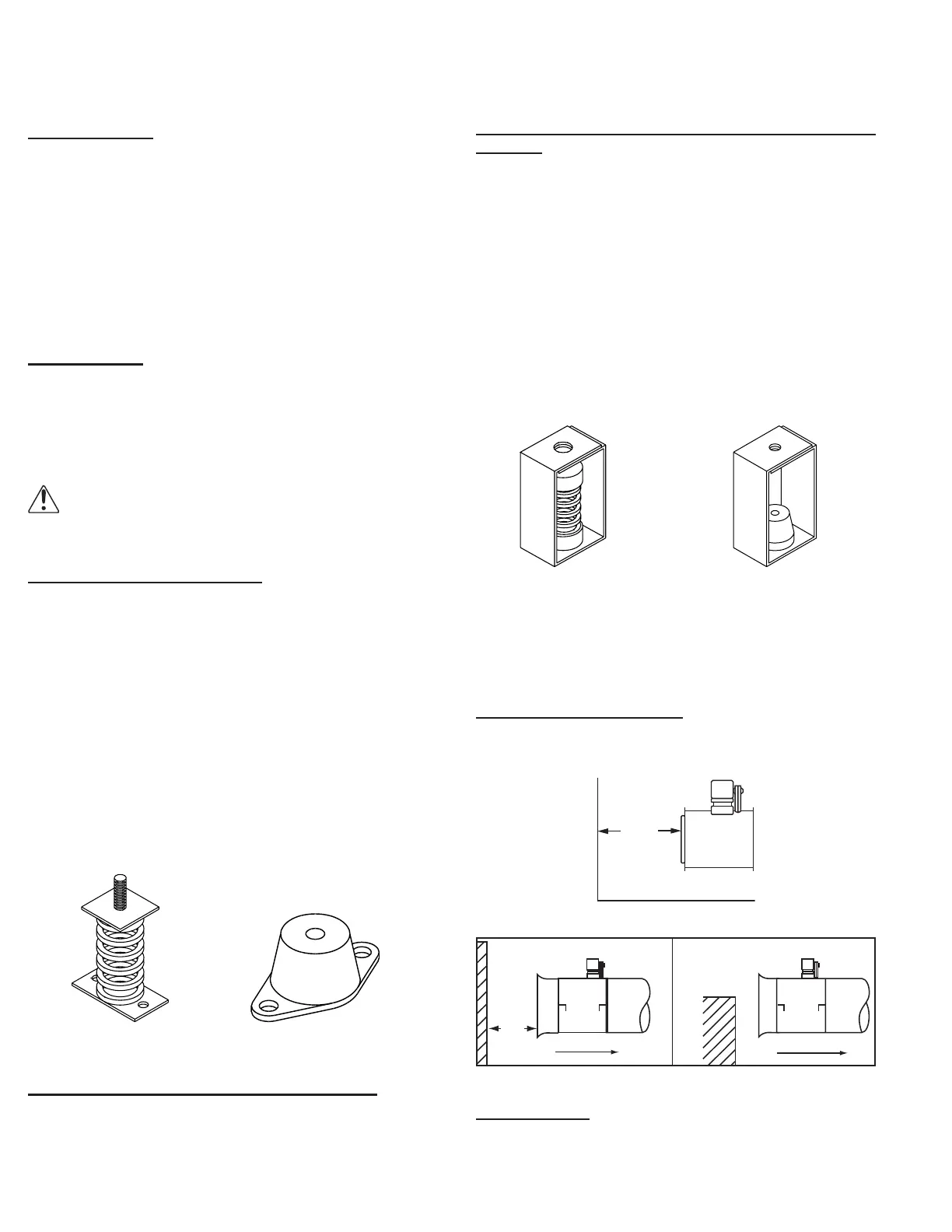
Ceiling Mounted Spring Isolator Rubber-in-Shear Ceiling Isolator
Figure 2 - Ceiling Mount Isolators
Duct Installation
Ecient fan performance relies on the proper installa-
tion of inlet and discharge ducts. Be sure your fan con-
forms to the following guidelines.
Non-Ducted Inlet Clearance
If your fan has an open inlet (no duct work), the fan must
be placed one fan wheel diameter away from walls and
bulkheads.
MIN
1 DIA
Non-ducted Inlet Clearance
Air Flow
Correct
Inlet Bell
Fan
Inlet Bell
Air Flow
Incorrect
Fan
Min
1 Dia.
Inlet Bell
Free Discharge
Avoid a free discharge into the plenum. This will result in
lost eciency because it doesn’t allow for a static regain.
Storage
If the fan is stored for any length of time prior to installa-
tion, completely ll the bearings with grease or moisture-
inhibiting oil (refer to Lubrication, pages 6-7).Store the fan in
its original crate and protect it from dust, debris and weather.
Outdoor Storage
To maintain good working condition of a Vane Axial fan
when it is stored outdoors or on a construction site, follow
the additional steps below.
• Cover the inlet and outlet and belt tunnel opening to pre-
vent the accumulation of dirt and moisture in the housing.
• Periodically rotate the prop and operate dampers (if sup-
plied) to keep a coating of grease on all internal bearing
parts.
• Periodically inspect the unit to prevent damaging
conditions.
Installation
To prevent damage to the fan during shipping, motors
25 HP and larger and extremely heavy motors (cast iron or
severe duty) are shipped loose and must be eld mounted
by bolting the motor on the motor mounting plate in the ex-
isting mounting slots.
NOTICE! Extreme vibration is a serious problem
that may cause structural and mechanical failure.
To help vibration and noise from being transferred
to the building, isolators are recommended.
Isolation Installation
Floor Mounted Spring Isolators
1. Mount fan and motor on unitary base (if supplied).
2. Elevate fan (or isolation base) to operating height and
insert blocks to hold in position.
3. Position isolators under the fan and vertically align by
inserting leveling bolt through mounting holes in the
fan or the base. The isolator must be installed on a
level surface.
4. Adjust the isolators by turning the leveling nut counter-
clockwise several turns at a time alternately on each
isolator until the fan weight is transferred onto the iso-
lators and the fan raises uniformly o the blocks. Then
remove the blocks.
5. Turn lock nut onto leveling bolt and secure rmly in
place against the top of the mounting ange or frame.
6. Secure isolators to mounting surface.
Spring Isolator Rubber-in-Shear Isolator
Figure 1 - Floor Mount Isolators
Floor Mounted Rubber-In-Shear (RIS) Isolators
1. Mount fan and motor on a unitary isolation base (if
supplied).
2. Elevate fan to provide room to insert isolators between
the fan and foundation and block in position.


 To Next Page
 Loading...