Need help?
Do you have a question about the Costway ES10200US and is the answer not in the manual?
Initial safety checks, placement, and general precautions before operation.
Detailed safety guidelines for preparing the ice maker for use, including cord handling and placement.
Critical warnings regarding flammable refrigerant and associated risks of fire or explosion.
Identifies key parts of the ice maker through a list and a visual diagram.
Overview of the control panel, indicators, buttons, and their functions.
Steps for unpacking the ice maker and preparing it for its first use.
Instructions on how to properly connect the ice maker to a power source.
Procedures for regular cleaning and maintaining the ice maker's condition.
Step-by-step guide on how to operate the ice maker to produce ice cubes.
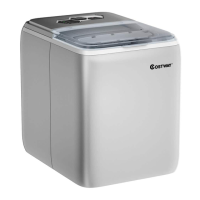
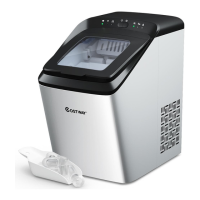
This document describes the COSTWAY Portable Automatic Ice Maker, model ES10200US. It serves as a user's manual, providing essential information for safe operation, maintenance, and troubleshooting.
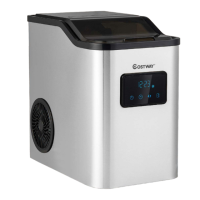
The COSTWAY Portable Automatic Ice Maker is designed to produce ice cubes automatically. It features a user-friendly control panel with visible functions and touch display settings for ease of use. The device allows users to select between small and large ice cube sizes, catering to different preferences and environmental conditions. It incorporates indicators for power, ice-full status, and water shortage, ensuring the user is always informed about the machine's operational state. A self-cleaning program is integrated into the unit, simplifying maintenance and ensuring hygiene. The ice maker is intended for indoor use and is designed to be placed on a flat, steady, and stable surface, away from direct sunlight and heat sources. It is crucial to use only potable drinking water for ice production.
The electrical diagram provided illustrates the internal components and their connections, including the main control PCB (MCU), evaporator, ice full sensor, water level detecting system, DC water pump, compressor motor, DC fan motor, and various micro switches and sensors. The unit requires a standard 110-120 volt, 60Hz electrical outlet with a three-prong ground for safety.
The manual stresses the importance of reading all instructions carefully, retaining them for future reference, and contacting customer service for missing or damaged parts. It highlights that the appliance must be earthed and that any servicing involving flammable refrigerants should only be performed by trained service personnel to minimize risks of fire or explosion.


 To Next Page
 General