2.2 THE PRINCIPLE OF OPERATION
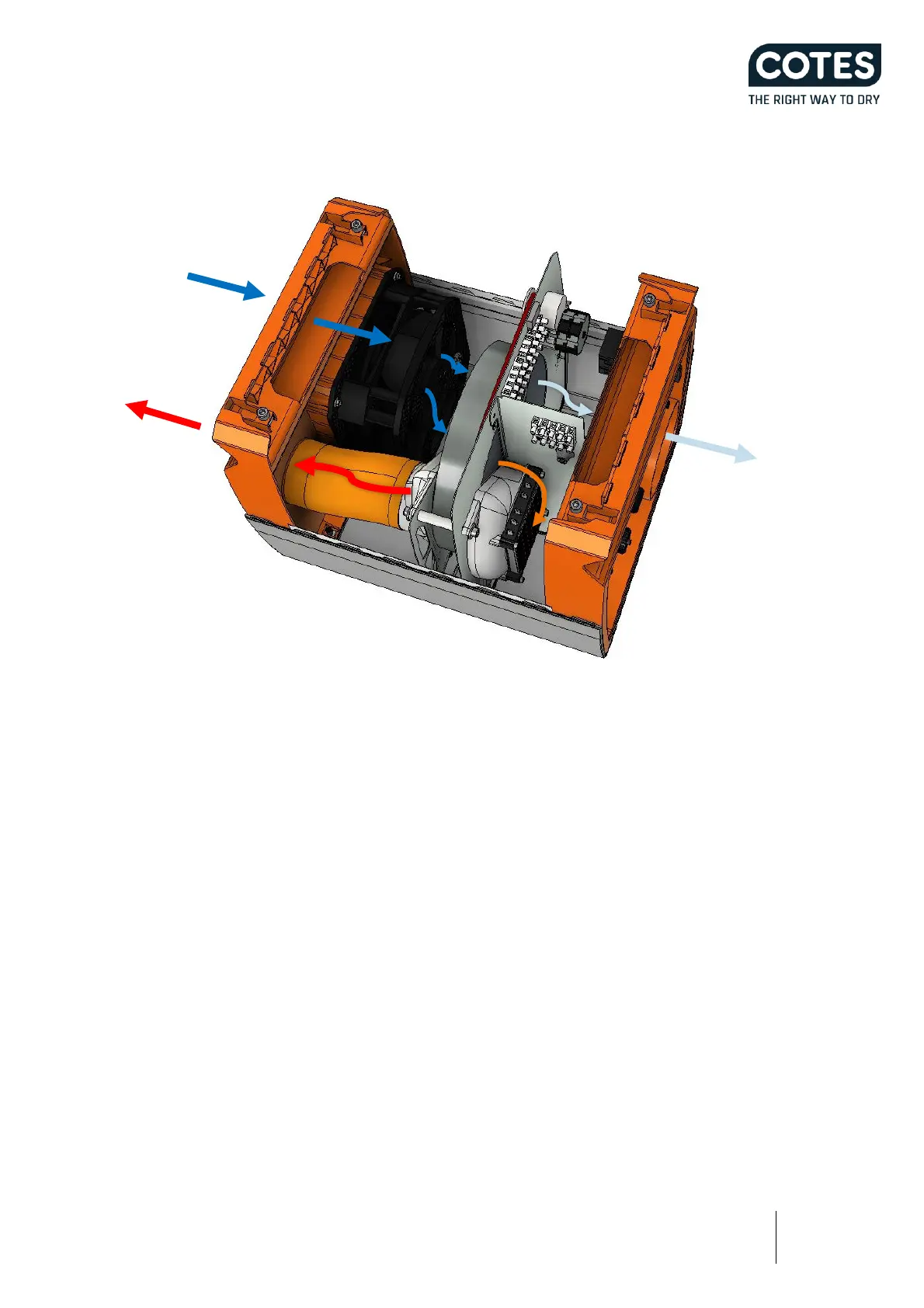
The effectiveness of Cotes adsorption dehumidifiers basically stems from the action (or interaction) of two air
flows. In this case, one fan controls the air, and it is expelled later in the drying process.
The drying process
The incoming moisture-laden airflow enters one side of the cabinet and is filtered by an air filter. The air then
passes through a slowly turning rotor whose inner surfaces are coated with desiccant silica crystals that attract
the water molecules passing through. As the moist air passes through the rotor, water molecules are adsorbed
and lodged in the pores on the silica gel’s surface. This results in the air leaving the rotor with less moisture
(humidity) content than when it entered. Additionally, because the adsorption process releases energy to the
air, the temperature increases during the process. The air is then divided into two separate airflows – Process
air and Regeneration air. Process air represents the now dry air.
Regeneration process
The regeneration air is then heated by a heating element to reduce its relative humidity. While passing through
the rotor, this heat evaporates the moisture previously adsorbed by the silica crystals in the rotor. The resulting
water vapour exits the dehumidifier alongside the outgoing regeneration air.
The two air flows run continuously while the rotor rotates - this ensures an automatic process of simultaneous
adsorption and water extraction.



 To Next Page