2.7
Pinto BT-POM 1212 - Revision 5
Section 2 Safety
Safety must be an Integral Part of
Chemical Farming Operations
• Not Just an After Thought!
The Hazard
All agricultural chemicals or pesticides, as
they are commonly called, are bi o log i cal ly
active. When handled incorrectly or
carelessly, they can be dan ger ous to all
living organisms such as humans, birds,
fi sh, bees, domestic animals and plants.
Method of Pesticide En try
☞ Oral - Direct by drinking,
splashing into mouth,eat ing
and smoking with contaminated
hands, eating sprayed produce,
cleaning noz zles with mouth.
☞ Inhalation - Nose, mouth, but
predominately the lungs.
☞ Dermal - Absorption through the
skin. Increased when skin is
broken or perspiring.
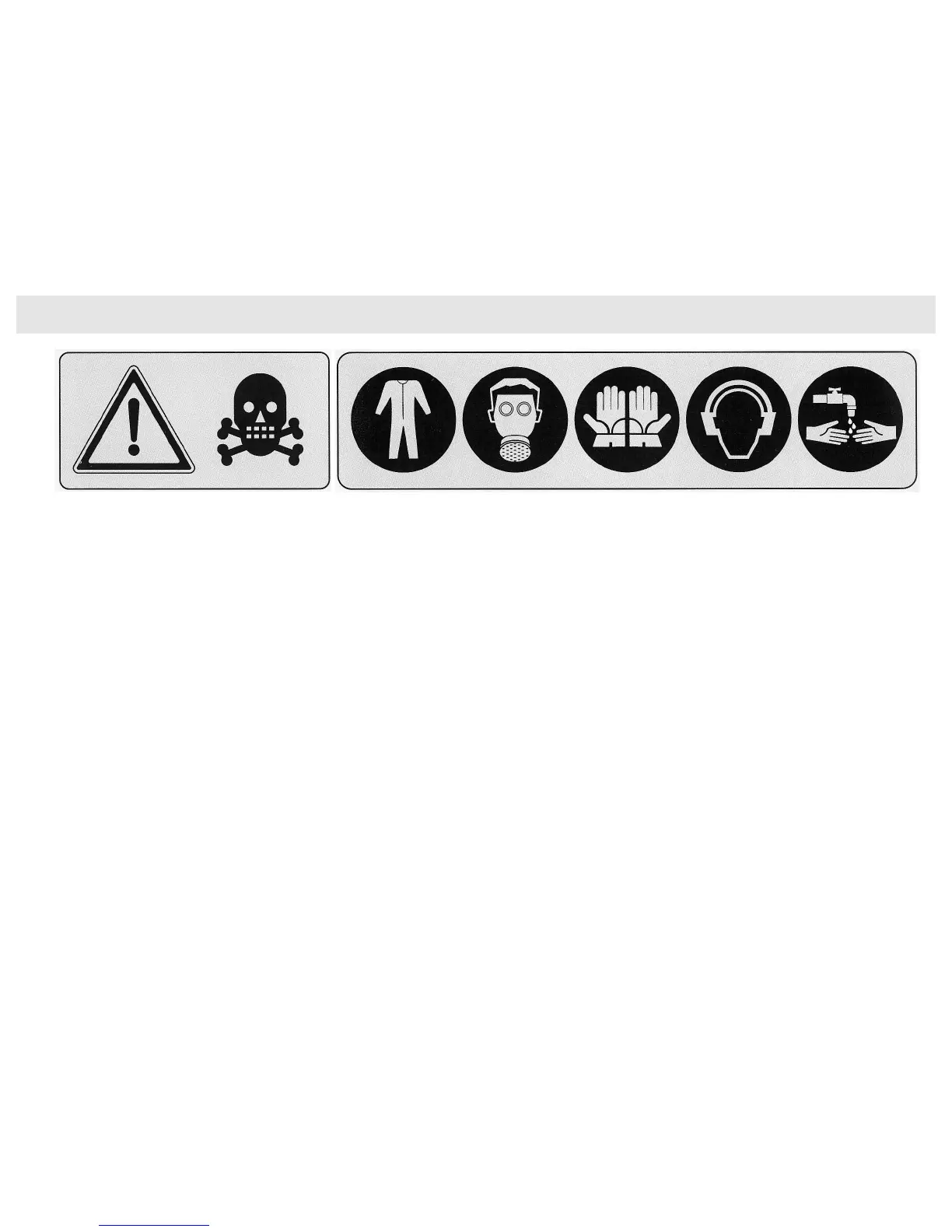
☞ What protective clothing and
equipment is needed?
☞ Know the correct fi rst aid/safety in
case of poisoning.
☞ Seek medical advice if health is
affected by chemicals.
Mixing the Product
☞ Reduce or eliminate operator
contact by using closed loading
systems, auto fi llers, wettable
powder mixtures or wettable
dispersable granules.
☞ Use the right protective clothing
when handling the con cen trate.
The user is at greatest risk when
handling chemical in concentrate
form.
☞ Open bags carefully. Cut to open,
do not tear.
☞ Do not stir chemicals with hands
or arms.
☞ Choose the mixing site carefully &
the fate of the probable residues.
☞ Do not mix more spray solution
than is needed and avoid
needless disposal of unwanted
chemicals.
Rate of Absorption
While pesticides are absorbed more
completely orally and by inhalation,
great er exposure and more poisonings
occur through skin (dermal) contact.
Hazard and Chance of
Poisoning
The hazard and chance of poisoning is
much higher when han dling pes ti cides in
concentrate form than in the dilute form.
Safe Handling
Know your Pesticides:
☞ STOP!! Read the label
☞ Is it the right pesticide?
☞ What is its poisons schedule or
toxicity?
☞ What safety precautions are
required?
☞ What is its persistence and
withholding period?
☞ What is its mode of action?
☞ Will it be a hazard to neighbouring
crops and people?
Plan your Spray Route
☞ Observe weather conditions,
especially wind direction & speed.
☞ Try to travel across wind and into
untreated crop.
☞ Prevent double or over spraying.
☞ Prevent or minimise drift onto
other crops, workers, etc.
Disposal of Unwanted
Pesticides and Con tain ers
☞ Calibrate correctly to ensure you
do not have a large quantity of
unwanted spray left over.
☞ Rinse empty containers and pour
residue into the main tank.
☞ Dispose of containers in the
correct manner and where
provided, use pesticide drum
disposal schemes.


 To Next Page