4.6
Pinto BT-POM 1212 - Revision 5
Sprayer CalibrationCalibration Procedure
Step 7
Calculate Application Rate
When operating the spray controller, the
controller automatically calculates and
shows the rate of application.
Application Rate (l/ha) =
Spray Output (l/min) x 600 ÷
Speed (km/hr) x Swath Width (m)
eg, [18 x 600] ÷ [12 x 18]
= 50 l/ha
f) Discard and replace any nozzle that
deviates more than 10% from the
specifi ed output (eg with a 0.5 l/min
specifi cation- discard any nozzles
0.45 l/min and under or 0.55 l/min
and over).
g) Check replacement nozzles by
collecting and measuring output
from each replacement.
h) Record the output of each nozzle on
the boom. Add the outputs together
and divide by the number of nozzles
to get the required output of each
nozzles in one minute.
eg, Total spray output 18 l/min ÷
36 nozzles = 0.5 l/min per
nozzle.
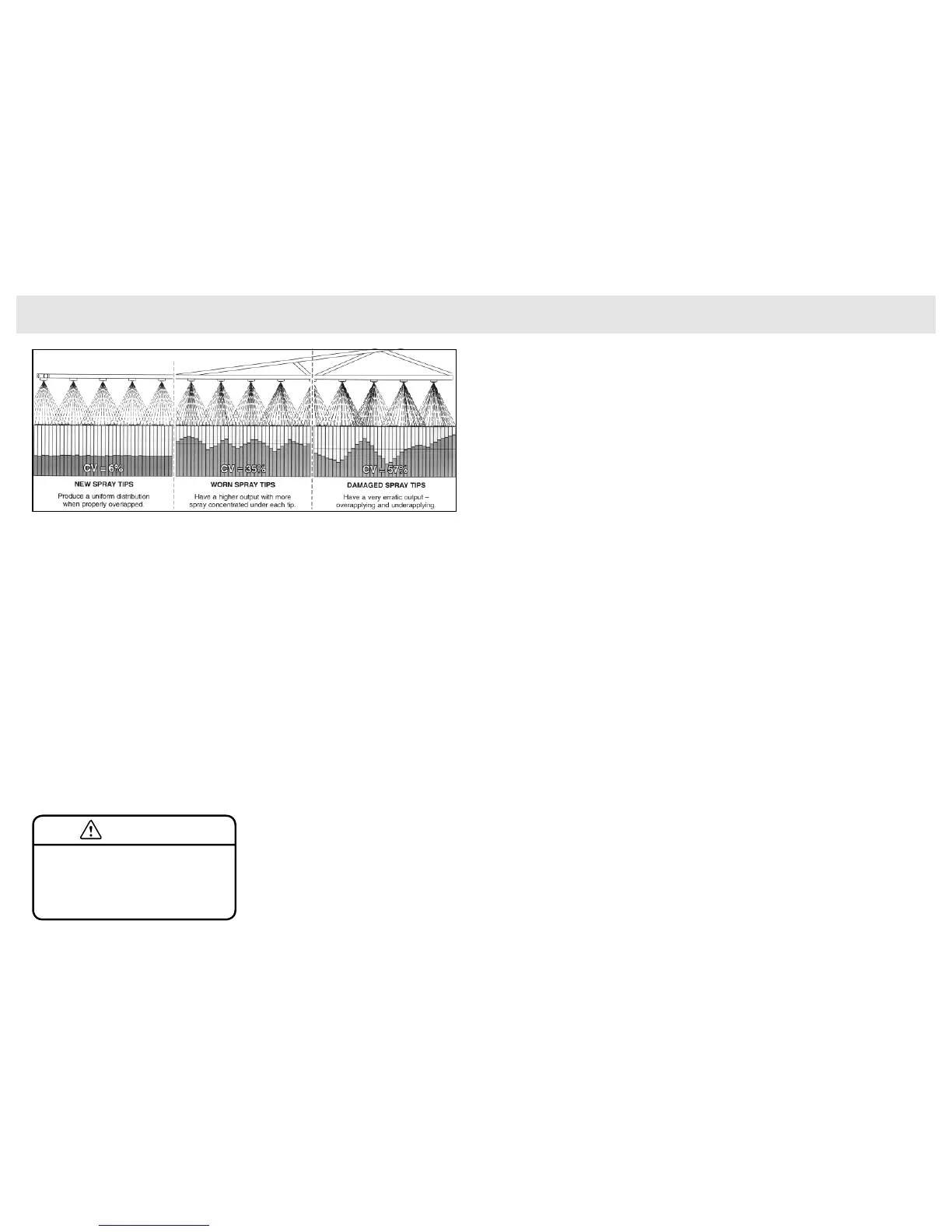
Spray tip wear - courtesy of Teejet.
c) Collect and measure the volume of
spray from one nozzle and adjust
pressure so that the nozzle gives the
specifi ed output (eg 0.5 l/min).
IMPORTANT:
Do not use a worn nozzle to set the
pressure setting and nozzle rates.
If the boom is not fi tted with new
nozzles, fi t one new nozzle and use it
to set the fl ow rate and pressure
setting.
This sets the standard fl ow rate,
pressure setting and spray pattern
with which to test the performance of
other nozzles.
Do not use a worn nozzles to set the pressure
setting and nozzle rates, otherwise inaccurate
calibration will occur.
CAUTION
d) When the pressure is set to give a
specifi ed nozzle output (using a new
nozzle), collect and measure the
volume of spray from each nozzle
for one minute in a collection jar or
calibrating jug.
Specially designed nozzle testing
equipment such as nozzle
calibrating jugs can be used to
simplify nozzle calibration.
e) Visually check nozzle spray patterns
and spray angle for accuracy and,
if necessary, replace any faulty
nozzles.


 To Next Page