
 Need help?
Do you have a question about the Dahua VTO2202F-P and is the answer not in the manual?
Illustrates two common system connection examples using VTO, VTH, and PoE switch.
Step-by-step guide for initializing the VTO using a web browser.
Instructions for initializing the VTO via the Dahua Toolbox application.
Details how to log into the VTO and change device type to Villa Station.
Guide to initialize VTH and configure its network settings and IP address.
How to enter engineer settings by holding the Settings button.
Setting room number, master/extension mode, and master IP for VTH units.
Configuring SIP settings for VTH, including server IP and registration password.
Linking VTO and VTH units by configuring their IP addresses, username, and password.
Adding VTH monitors to the VTO via the Room No Management interface.
Entering resident name and register password for connecting VTH monitors.
How to call the VTH from the VTO and initiate communication.
Activating the Group Call option in VTO's Local Setting for simultaneous calls.
Setting up additional VTH units as extensions with master unit details.
Instructions for downloading iOS and Android mobile applications.
Step-by-step guide to connect the mobile app to the VTO device.
Adding the VTO device to the mobile app by confirming its serial number.
Enabling subscription for VTO events to receive push notifications on the app.
The VTO2202F-P Quick Install Guide provides comprehensive instructions for setting up and configuring a home video door phone (VDP) system, focusing on the VTO (camera unit) and VTH (monitor unit). This guide covers everything from initial device connections and system initialization to advanced configurations like adding extension monitors and setting up mobile application access.
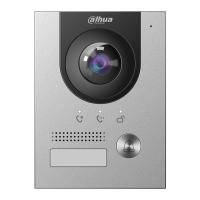
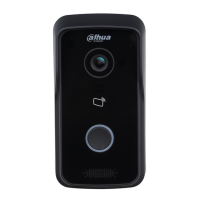
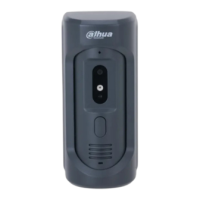
The VTO2202F-P is a camera unit designed for use in a home VDP system. Its primary function is to capture video and audio, allowing for two-way communication with visitors at the door. When integrated with a VTH monitor unit, it enables residents to see and speak with visitors, and even remotely unlock a door. The VTO unit connects to a network, typically via a PoE switch, which provides both power and data connectivity. It supports passive PoE, meaning it requires a 24V passive PoE switch or a 12/24V DC power supply for operation.
The VTH monitor unit serves as the indoor interface for the VDP system. It allows residents to view the live feed from the VTO, communicate with visitors, and manage various system settings. The VTH units are also powered via passive PoE or a DC power supply. In a multi-monitor setup, one VTH acts as a master unit, while others can be configured as extension monitors, allowing for simultaneous calls and communication throughout the residence.
The system utilizes a PoE switch, specifically the VTNS1060A, to facilitate connections between the VTO and VTH units. This switch is crucial for providing the necessary power and network connectivity for all connected devices.
The VDP system offers several features to enhance home security and convenience:
The guide outlines several features and processes for maintaining the VDP system:
 General
| Main Processor | Embedded Processor |
|---|---|
| Video Compression | H.264 |
| Day/Night | ICR |
| Audio Output | Built-in speaker |
| Card Type | IC card |
| Network Protocol | TCP/IP |
| Alarm Input | 1 |
| Alarm Output | 1 |
| Card Capacity | 10, 000 |
| Power | DC 12V/PoE (802.3af) |
| IP Rating | IP65 |
| Operation System | Embedded Linux OS |
| Image Sensor | 1/2.8" CMOS |
| Effective Pixels | 1920(H) x 1080(V) |
| Resolution | 1920x1080 |
| Video Frame Rate | 25 fps |
| Audio Compression | G.711a |
| Audio Input | 1 |
| Two-way Talk | Supported |
| Ethernet | 10M/100Mbps Ethernet port |
| RS485 | 1 |
| Door Control | 1 |
| Exit Button | Supported |
| Door Status Detect | Supported |
| Lock Control | Supported |
| Tamper | Supported |
| Certifications | CE, FCC |
| Installation | Surface-mounted |
| Working Temperature | -30°C to +60°C |
| Working Humidity | 10% to 95% RH |



 To Next Page