RXL-W Series EDUS092213A
89
3P686872-1
8
5. Drain piping
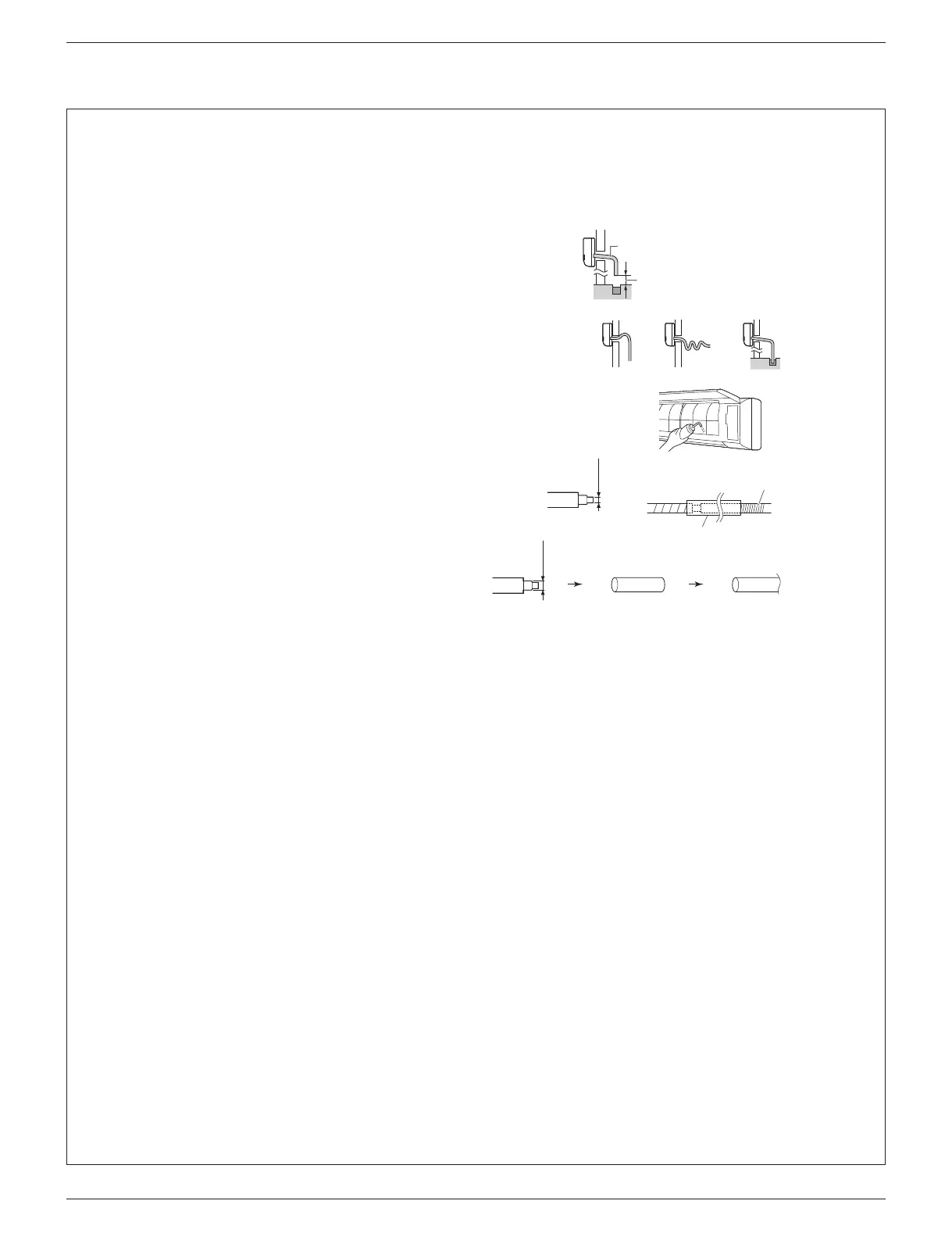
1) Connect the drain hose, as described on the right.
• Avoid placing the end of the drain hose in a drainage location that could
cause bad odours or corrosive gas to flow backward into the outlet.
• The drainage water may change color due to bacteria or other
organisms. Place in a location where the flow of drainage water will not
cause a problem.
• Minimize the number of bends in the drain hose as much as possible.
If bending the drain hose, bend it gently.
2) Remove the air filters and transfer some water to the indoor heat
exchanger by pouring water into the drain pan.
3) Make sure that water flows out of the drain hose.
• When drain hose requires extension, obtain an extension
hose with an inner diameter of 5/8 inch (16mm).
Be sure to thermally insulate the indoor section of the
extension hose.
• When connecting a rigid polyvinyl chloride pipe
(nominal diameter 1/2 inch (13mm)) directly to
the drain hose attached to the indoor unit as with
embedded piping work, use any commercially
available drain socket (nominal diameter 1/2 inch
(13mm)) as a joint.
Make a downward slope
Getting higher
Containing waves
Wrong
With the end of the hose
in the drain outlet
Leave a gap of 50mm or more
at the end of the outlet
Indoor unit
drain hose
Extension drain hose
Heat insulation tube (field supply)
ϕ5/8”
(ϕ16mm)
Drain hose supplied
with the indoor unit
Commercially available
drain socket
(nominal diameter 1/2 inch
Commercially available
rigid polyvinyl chloride pipe
(nominal diameter 1/2 inch
(13mm))
Drain hose supplied with
the indoor unit
ϕ11/16”
(ϕ18mm)
01_EN_3P686872-1.fm 8 ページ 2022年5月13日 金曜日 午後5時45分



 To Next Page