EasyManua.ls Logo

Dake V-16 - User Manual

Dake V-16
27 pages
Print Icon
To Next Page IconTo Next Page
Loading...
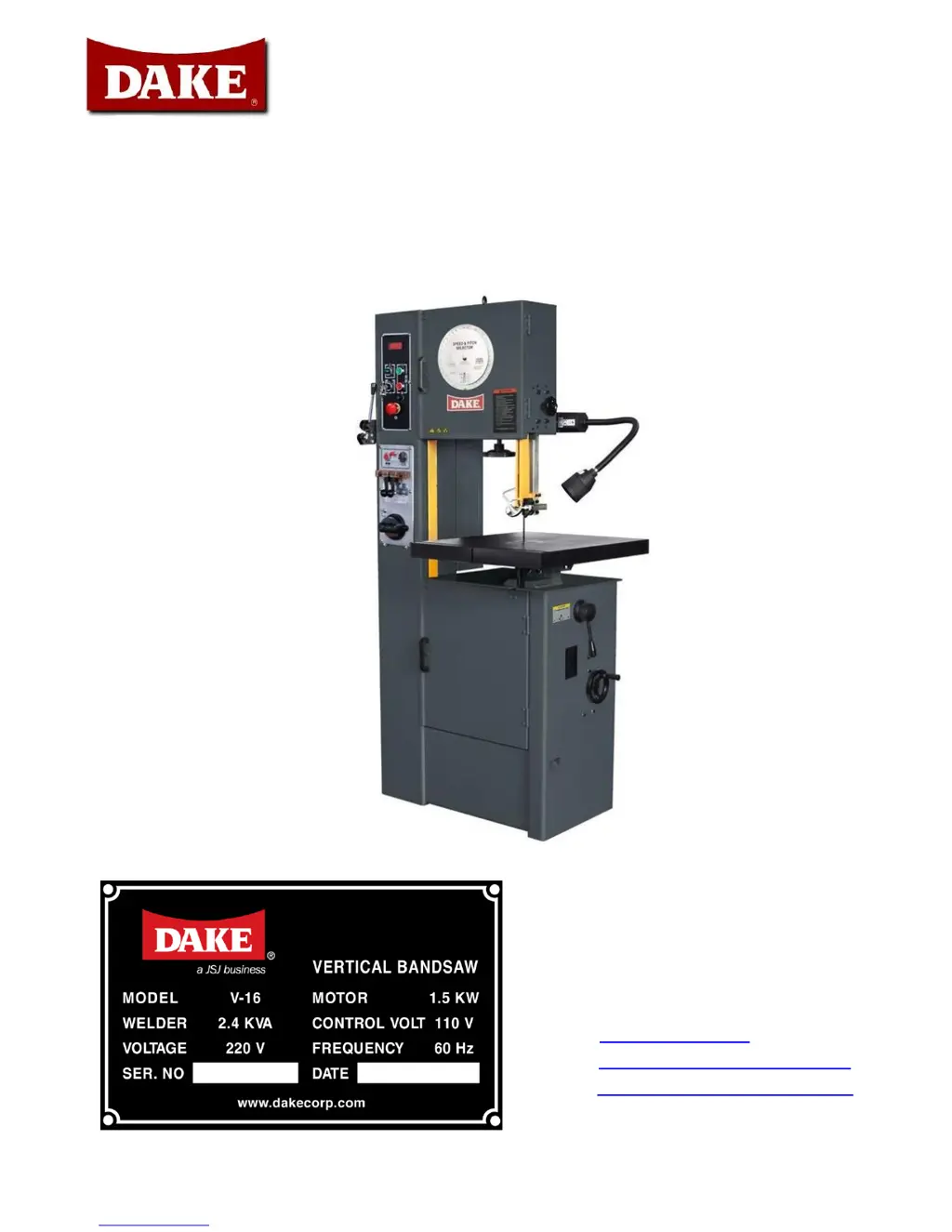
DAKE VERTICAL BAND SAW
Model V-16
INSTRUCTION MANUAL
Please record your saws information
DAKE (Division of JSJ)
724 Robbins Road
Grand Haven, Michigan 49417
616.842.7110 Phone 800-937-3253
616.842.0859 Fax 800-846-3253
Web: www.dakecorp.com
E-mail : customerservice@dakecorp.com
technicalsupport@dakecorp.com

Questions and Answers

  • A
    Ana LewisJul 31, 2025
    Why does the weld break when used on my Dake Saw?
    • C
      Chad BrownJul 31, 2025
      If the weld breaks when used on your Dake Saw, it could be due to a few reasons. First, ensure that the weld is annealed correctly. Second, avoid grinding the weld too thin. Finally, make sure you are not creating a weak or incomplete weld.
  • E
    Elizabeth BellAug 4, 2025
    What to do if the weld area melts the blade on my Dake V-16?
    • G
      greencarrieAug 4, 2025
      If the weld area melts the blade instead of welding when the welding switch is pushed on your Dake Saw, it could be due to a few reasons. First, adjust the welding switch to cut off earlier. Second, turn the welding pressure adjuster clockwise, because the Welding Pressure may be too weak. Finally, increase the speed of jaw movement, because the jaw movement may be too slow.
  • B
    baileyjohnAug 8, 2025
    What to do if there is an incomplete weld on my Dake V-16?
    • I
      Ian AyersAug 8, 2025
      If you're experiencing an incomplete weld with your Dake Saw, it could stem from several issues. First, ensure the initial jaw gap (weld lever position) is set correctly. Second, adhere to proper clamping procedures. Third, replace the defective cut-off switch, because it may not break the circuit at the end of the welding operation. Also, adjust the Cut-off Switch correctly, separate welded points of cut-off switch, clean and oil the Slide Rod, loosen the stop screw, bend cable and untangle wires.
  • B
    Brian RichardAug 13, 2025
    What to do if the jaws do not move on my Dake V-16?
    • K
      Kristina Green PhDAug 13, 2025
      If the weld could not be made and the Jaws do not move on your Dake Saw, it could be due to the following reasons: the wire connection is poor, the connecting point of welding switch is bad (change the welding switch), the transformer is burnt out (change the transformer), there is some oil on the blade (remove the oil), there is some rust on the blade ends (grind off the rust), the adjustment of the welding pressure is incorrect (loosen the adjusting screw that is in center of it).
  • R
    Ricky ColeAug 17, 2025
    How to fix a misaligned weld on a Dake V-16?
    • B
      Brandon HoffmanAug 18, 2025
      If you have a misaligned weld on your Dake Saw, try these solutions: Clean the jaws or blade if there's dirt or scale. Cut the blade ends off square if they aren't. Align the blade ends correctly when clamping. Replace worn jaws or inserts, and ensure the jaws are aligned correctly.
  • A
    Alexis CastilloAug 21, 2025
    What causes misaligned weld-blade ends to overlap on a Dake Saw?
    • E
      Emily BauerAug 21, 2025
      If you are experiencing misaligned welds where the blade ends are overlapped on your Dake Saw, it could be due to the Jaw Upset Force Control being set for a wider blade than the one you are using, so readjust Jaw Upset Force Control correctly or the blade ends or jaws are not aligned correctly, so align blade ends or jaws correctly.
  • T
    Tiffany LeeAug 27, 2025
    Why are the welds brittle on my Dake V-16 Saw?
    • A
      Andrew AllenAug 27, 2025
      If you're getting brittle welds with your Dake Saw, it might be because the weld hasn't been annealed correctly. Refer to the 'Annealing' section in the operation chapter for proper instructions. Also, incorrect annealing heat could be the problem; bring the weld up to the correct color as described under 'Annealing' in the welder operations chapter. Lastly, scale or oil on the weld can cause poor annealing, so remove any scale or oil.

Summary

FOREWARD

General Safety Warnings

Comprehensive list of safety precautions for operating the bandsaw, covering personal protection and machine use.

INSTALLATION

Unloading and Initial Inspection

Procedure for safely removing the machine from packaging and checking for physical damage or missing parts.

CLEANING

POWER SUPPLY

Electrical Connection Safety

Critical warnings regarding electrical connections, emphasizing the need for qualified electricians to prevent injury.

SPECIFICATIONS

CONTROLS

Machine Operation Controls

Description of key operational controls like shift levers, handwheels, and buttons for machine functions.

Blade Adjustment Controls

Details on adjusting blade tension, tracking, and guide posts for optimal performance.

OPERATIONS

Blade Installation

Step-by-step guide for properly installing and tensioning the saw blade.

Blade Tracking

Procedure for adjusting the blade's position on the wheels for accurate cutting.

Guide Post Adjusting

Instructions for setting the height and securing the guide post relative to the material.

Guide Holder Adjustment

Steps for adjusting the blade guide holders to support the blade correctly.

Blade Guide Adjusting

Procedure for setting the blade guides close to the blade without contact.

BLADE SELECTION

Blade Types, Teeth, and Sets

Information on different blade materials, tooth shapes, and set types for various cutting applications.

SAW BLADE SELECTION

SPEED & PITCH SELECTOR

Blade Selection Guidelines

Recommendations for selecting saw blades based on material thickness and desired cutting characteristics.

WELDER OPERATION

Blade Cutting and Tooth Preparation

Procedures for cutting blades to length and preparing teeth for welding.

Blade Welding and Annealing

Steps for welding saw blades, including annealing procedures for carbon and bi-metal blades.

Grinding and Inspecting Welds

Instructions for dressing welded areas and inspecting the quality of the weld joint.

TROUBLE SHOOTING

Weld-Related Issues

Diagnosing and resolving problems with blade welding, including misalignments, breaks, and brittle welds.

Sawing and Blade Problems

Identifying and fixing common issues like twisted blades, incorrect cutting direction, dulling, and noise.

MAINTENANCE

Exploded Diagrams and Parts Lists

Gear Box, Guide Post, and Main Drive Components

Detailed part listings for key mechanical assemblies of the bandsaw.

Wheel, Table, and Control Switch Components

Identification of parts for wheel, work table, and electrical control switch assemblies.

Welder and Lamp Components

Parts breakdown for the blade welder, work lamp, and shear mechanisms.

WIRING DIAGRAM

Dake V-16 Specifications

General IconGeneral
ModelV-16
CategorySaw
TypeVertical Band Saw
Capacity Rectangle (H x W)16" x 16"
Motor Power2 HP
Throat Depth15.5 inches

Related product manuals