Sub
Harmonic
A
tufcwnuUiple of the fundamental
frequency.
For example,
B wave the frequency
of which
is
half the fundamental frequency
of another wave is called the second sub harmonic of that wave.
Sub Woofer
A loudspeaker made
specifically
to
reproduce the lowest of
audio frequencies, usually between 20H2 and lOOHx.
Synthesizer
An ELECTRONIC MUSIC SYNTHESIZER is en audio
processor
that has
a
tatilvin sound generator (oscillator), and
that alters the envelope
of
the sound with voltage controlled
circuitry. Synthesizers can produce familiar sounds ar>d serve as
musical instruments, or they can create many unique sounds
and
effects of their own.
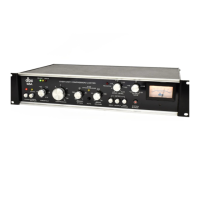
A SUB HARMONIC SYNTHESIZER is a device which is not
used
to
create music, but to enhance an existing audio program.
In the case
of the dbx Modal
100,
the unit creates
a new signal
that corresponds to the volume of the input signal, but is at
1 /2
the frequency of the input signal.
Tape Seturatipn
There is a maximum amount of energy that can be recorded on
any
given
type
of magnetic tape. When
a
recorder *'tries"
to
record
more energy, the signals become distorted, but are not recorded at
arry higher levels. This phenomenon is called tape saturation
because the
magnetic
oxide
particles of the
tape
are literally
saturated with energy and cannot accept any more magnetization.
T.H.D.
(Total Harmonic Distortion) (See ''Harmonic Distortion")
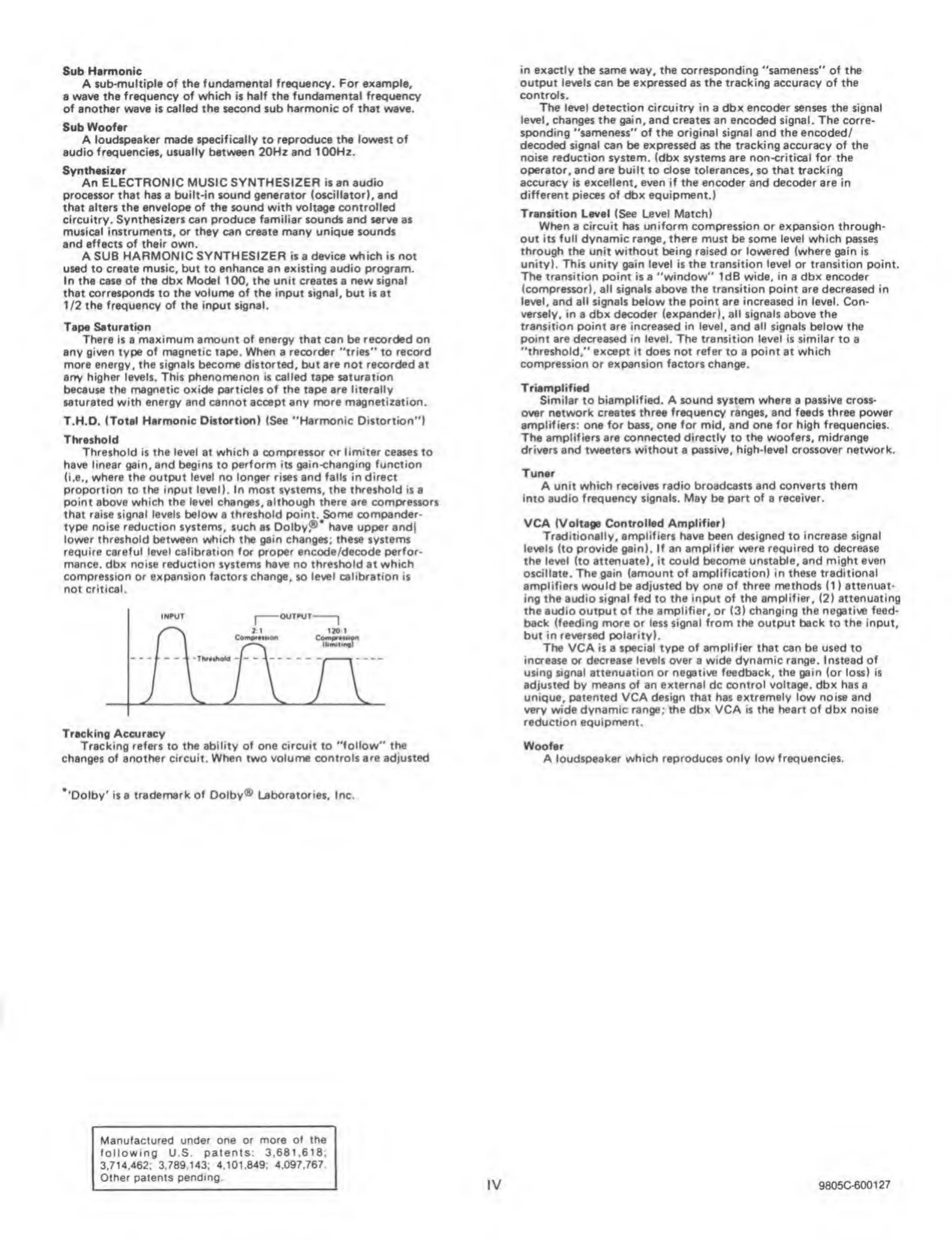
Threshold
Threshold is the level at which a compressor or limiter ceases to
have linear gain, and begins to
perform its gain-changirfeg function
(i.e., where the output
level no longer rises and falls in direct
proportion
to
the input level). In most systems, the threshold is a
point above which the level changes, altfwugh there are compressors
that raise signal levels below a threshold point. Some compar>der-
type noise
reduction
systems, such at Dolby!^* have upper and|
lower threshold between which the gain changes; these systems
require
careful
level calibration
for
proper encode/decode
perfor-
mance. dbx noise reduction systems have no threshold
at
which
compression or expansion factors change, so le^l calibration Is
not critical.
Tracking Accuracy
Tracking refers to the
ability of one circuit
to
"follow" the
changes of another circuit. When two volume
controls are adjusted
**Dolby* ise
trademerkof
Dolby® Laboratories, Inc.
Manufactured under one or
more of the
following
LI.S. patenia: 3.661.618;
3.714.462;
3,789.143; 4,101.649;
4.097.767.
Other
patents pending.
in exactly the same way, the corresponding "sameness" of the
output can be expressed as the tracking accuracy of the
controls.
The level detection circuitry in a dbx encoder senses the signal
level, changes the gain, and creates
an
encoded signal.
The corre-
sponding "samervess" of the origirtal signal and the encoded/
decoded signal can be expressed as the tracking accuracy of the
noise reduction system, (dbx
systems are non<critica1
for
the
operator, and are built to dose tolerances,
so
that tracking
accuracy Is
excellent,
even if the encoder and decoder are in
different pieces of
dbx
equipment.)
Transition Level (See Level Match)
When a circuit has
uniform
compression or expansion through-
out Its
full
dynamic
range, there
must be some
level
which passes
through the
unit
without being raised or lowered (where gain is
unity). This unity gain level is the transition level
or
transition
point.
The transition point is a "window" IdB wide, in a dbx encoder
(compressor),
all signals
above the
transition point
are decreased in
level, and all signals below the point are increased in level.
Con-
versely. in a dbx decoder (expander), all signals above the
transition point are increased in level, and all signals
below the
point are decreased in level. The transition level is similar to
a
"threshold." except it does not refer to a point at which
compression
or
expansion factors
change.
Triamplified
Similar to
biamplified.
A sound system where a
passive
cross-
over
network creates three frequency ranges, end feeds three power
amplifiers: one for bass, one for mid. and one for high frequencies.
The
amplifiers
are
connected directly
to
the woofers, midrange
drivers and tweeters without a passive, high-level crossover network.
Tuner
A unit which receives radio broadcasts and
converts them
into audio
frequency signals. May
be
pert of a receiver.
VGA (Voltage Controlled Amplifier)
Traditiorvally, amplifiers have been designed to
increase signal
levels (to provi^
gain). If an amplifier vwre required to decrease
the level (to attenuate), it could become unstable, and might
even
oscillate. The gain (amount
of amplification) in these traditional
amplifiers would be adjusted
by
one of three methods
(1 )
attenuat-
ing the audio signal fed to the input of the amplifier, (2) attenuating
the audio output
of the amplifier,
or (3)
changing the negative feed-
back (feeding more or less signal from the output back to the input,
but in reversed polarity).
The VCA is a special type of
amplifier
that can be used to
increase
or
decrease levels over
a
wide dynamic range.
Instead
of
using signal attenuation or negatiw
feedback,
the gain (or
loss)
is
adjusted
by
means of an external dc control voltage, dbx has a
unique,
patented VCA design that has extremely
low
noise and
very wide dynamic range; the dbx VCA is the heart of dbx noise
reduction equipment.
Woofer
A
loudspeaker which reproduces only low frequencies.
IV
9805C-600127


 To Previous Page
 Loading...