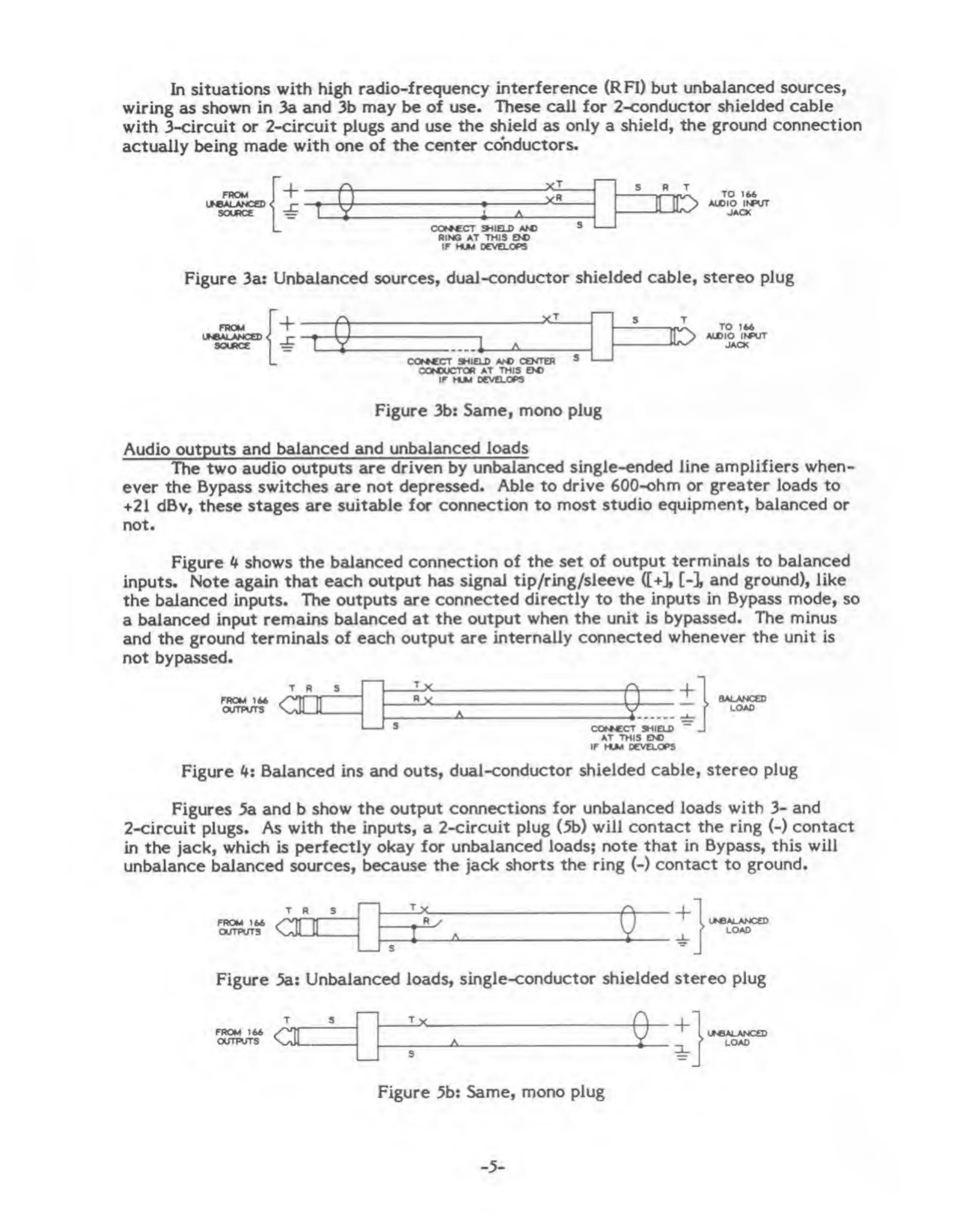
In situations with high
radio-frequency
interference (RFI) but
unbalanced
sources,
wiring as shown
in 3a and 3b may be
of
use.
These call for 2-conductor
shielded
cable
with 3-circuit or
2-circuit plugs and use the
shield as only a shield, the
ground connection
actually being
made with one
of the center ccmductors.
RiNe AT THI9
e>«
If oevCLOM
TO 1M
AUDIO
JACK
Figure 3a:
Unbalanced
sources,
dual-conductor
shielded cable, stereo plug
CCMUCrCM AT THIS
DC
If HJU
OCVCLORS
TO
1W
AUDIO
IKWT
JACK
Figure 3b: Same, mono plug
Audio outputs and
balanced and unbalanced
loads
The
two
audio outputs are driven by
unbalanced
single-ended line amplifiers when-
ever the
Bypass switches are not
depressed. Abie to
drive 600-ohm or greater loads to
+21 dBv, these stages are
suitable for connection to most
studio equipment, balanced or
not.
Figure
4
shows the
balanced connection of the set
of output terminals to balanced
inputs. Note again
that each output has
signal tip/ring/sleeve
([+!t
[-3,
and ground), like
the
balanced inputs. The outputs are
connected directly to the
inputs in Bypass mode, so
a
balanced input
remains balanced at the
output when the unit is
bypassed. The minus
and the ground terminals
of
each
output are internally
connected whenever the unit is
not bypassed.
t R S
FRCM
tl
OJTPiJTS
11
-
AT
THIS OO
IF HUM OeVCLOPS
Figure 4: Baianced ins and
outs, dual-conductor
shielded cable, stereo plug
Figures
3a
and b show the
output connections f(X‘
unbalanced loads with
3-
and
2-circuit plugs.
As with the inputs, a
2-circuit plug (5b) will
contact the ring (-) contact
in the jack, which is
perfectly okay
for unbalanced loads; note that in
Bypass,
this will
unbalance
balanced sources, because
the jack shorts the ring
(-) contact to ground.
cte:
Figure 5a:
Unbalanced loads,
single-conducts shielded stereo plug
noM
OUTWTS
Figure 5b: Same, mono
plug
-
5
-


 To Next Page