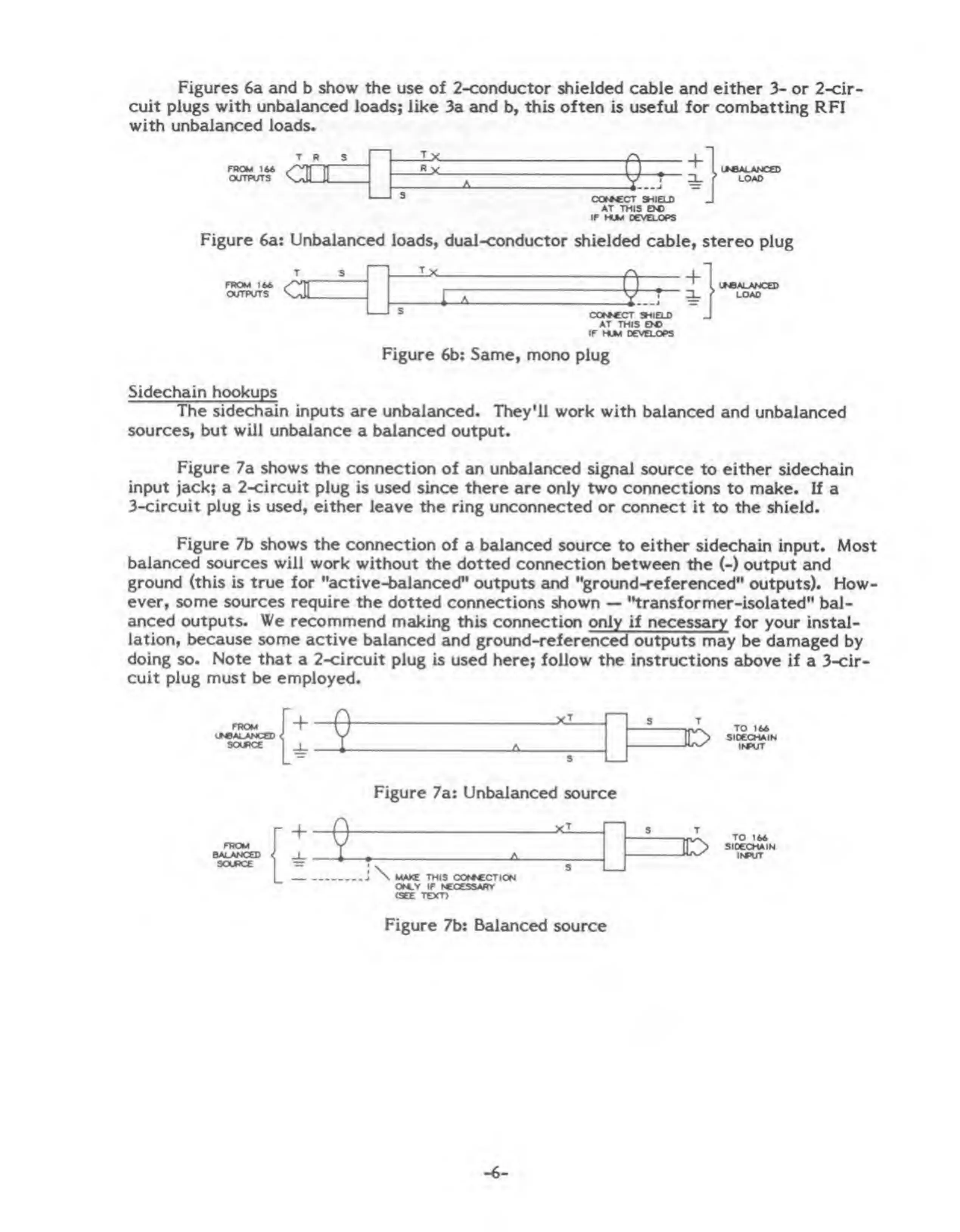
Figures
6a and b show the use of 2-conductor shielded
cable and either
3-
or 2-cir-
cuit
plugs
with unbalanced
loads; like 3a and b, this often is useful for combatting
RFI
with unbalanced loads.
fPQM 164
Ckmm
R S Z-X
A
m
—
—2
^^
0
-»—
1 s
A
COrtCCT
»
1I£LD
iN!L4LWrgP
AT THia
IF HUU
Figure 6a: Unbalanced
loads, dual-conductor shielded
cable, stereo plug
FAOM 164
OUTR/T
8
CC64CCT
AT THIS
D€
IF nu OCVCLOP
9
MALAMCCD
LOAD
Figure
6b: Same, mono plug
Sidechain hookups
The sidechain inputs are unbalanced. They’ll
work with balanced
and unbalanced
sources, but will unbalance a balanced output.
Figure
7a
shows the
connection of an
unbalanced signal source to either sidechain
input jack; a 2-circuit plug is
used since there are only two connections
to make.
If
a
3-circuit plug is used, either leave the
ring unconnected or connect it to the shield.
Figure 7b shows the
c<mnection of a balanced
source to either sidechain input. Most
balanced sources will work
without the dotted connection between
the (-) output and
grourKi
(this is true for "active-balanced"
outputs
and
"ground-referenced" outputs). How-
ever,
some sources require
the dotted connections shown
—
"transformer-isolated"
bal-
anced
outputs. We
recommend making
this connection only if necessary for
your instal-
lation, because some active
balanced and ground-referenced
outputs may be damaged
by
doing so. Note that a
2-circuit plug is used here; follow
the instructions above if
a 3-cir-
cuit plug must be employed.
A
TO It*
SlOeOlAIN
Figure
7a: Unbalanced source
TO 164
SIOCCmiN
Figure
7b:
Balanced
source


 To Next Page