16
Menu
icon
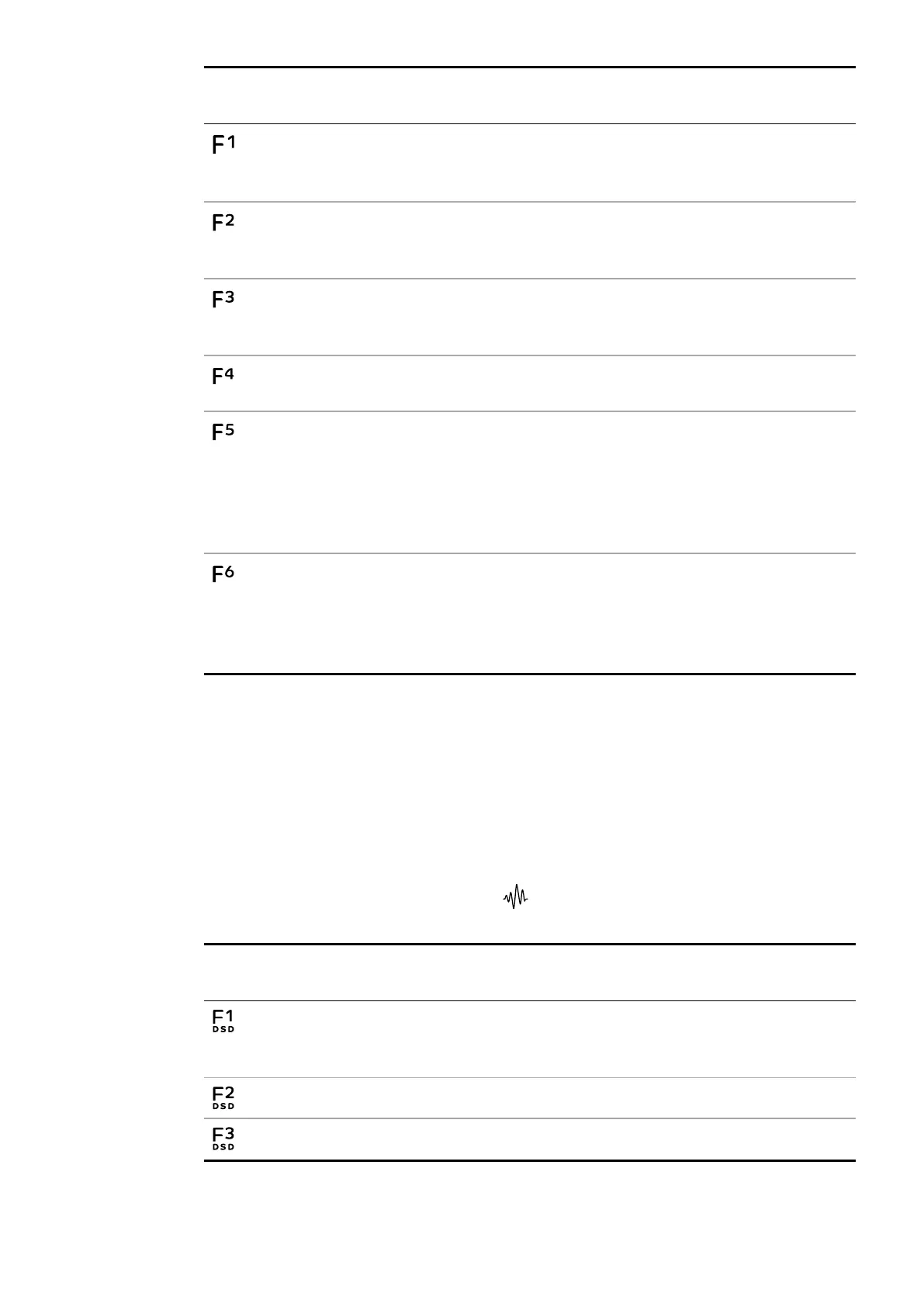
Filter Description
Filter1 This filter has the best rejection of unwanted Nyquist images with the
sharpest roll-off, and the poorest transient response of the first four
filters.
Filter2 Recommended for orchestral music.
This filter has a more relaxed image rejection and better transient
response than Filter1.
Filter3 Recommended for rock music.
This filter has a more relaxed image rejection and better transient
response than Filters1 and2.
Filter4 This filter has the lowest image rejection and the best transient response
of the first four filters.
Filter5 If the sample rate is 176.4, 192, 352.8, or 384kS/s, this filter has a
Gaussian response, which offers no overshoot on transients and a
relaxed roll-off.
If the sample rate is 44.1kS/s, the filter is an asymmetrical design, which
features almost no preringing.
If the sample rate is 48, 88.2 or 96kS/s, Filter5 is not available.
Filter6 If the sample rate is 176.4, 192, 352.8, or 384kS/s, the filter is an
asymmetrical design, which features almost no pre-ringing.
If the sample rate is 44.1kS/s, the filter is an alternative sharp filter,
which has linear phase and pre-ringing.
If the sample rate is 48, 88.2 or 96kS/s, Filter6 is not available.
Changing the DSD filter
The DSD filter is active when you are playing DSD files or converting PCM data to DSD.
If you are playing a DSD file or converting to DSD, and the level of hiss at the output
is high, your amplifier may not work well with wideband DSD signals. Try setting the
DSD filter to Filter2 or3.
1. On the player screen of the app, select .
2. Select the DSD filter you want to apply.
Menu
icon
Filter Description
Filter1 The default setting.
Gives the widest bandwidth and the highest level of out-of-band
noise.
Filter2 Reduces the out-of-band noise and bandwidth.
Filter3 Reduces the out-of-band noise and bandwidth further.
Configuring Varèse
Varèse User Guide


 To Next Page