DEKKER Vacuum Technologies, Inc. – Vmax/July 2016
THEORY OF OPERATION
The DEKKER Vmax oil-sealed liquid ring vacuum pump system includes our high efficiency liquid ring
vacuum pump. Minimal maintenance is required due to the absence of wearing parts such as pistons, sliding
vanes and internal bearings. The impeller assembly is the only moving part which rotates freely in the casing
without metal-to-metal contact. This means that no additional lubrication is required. The function of the
sealing liquid is to create a liquid piston action used to produce vacuum and to remove the heat of
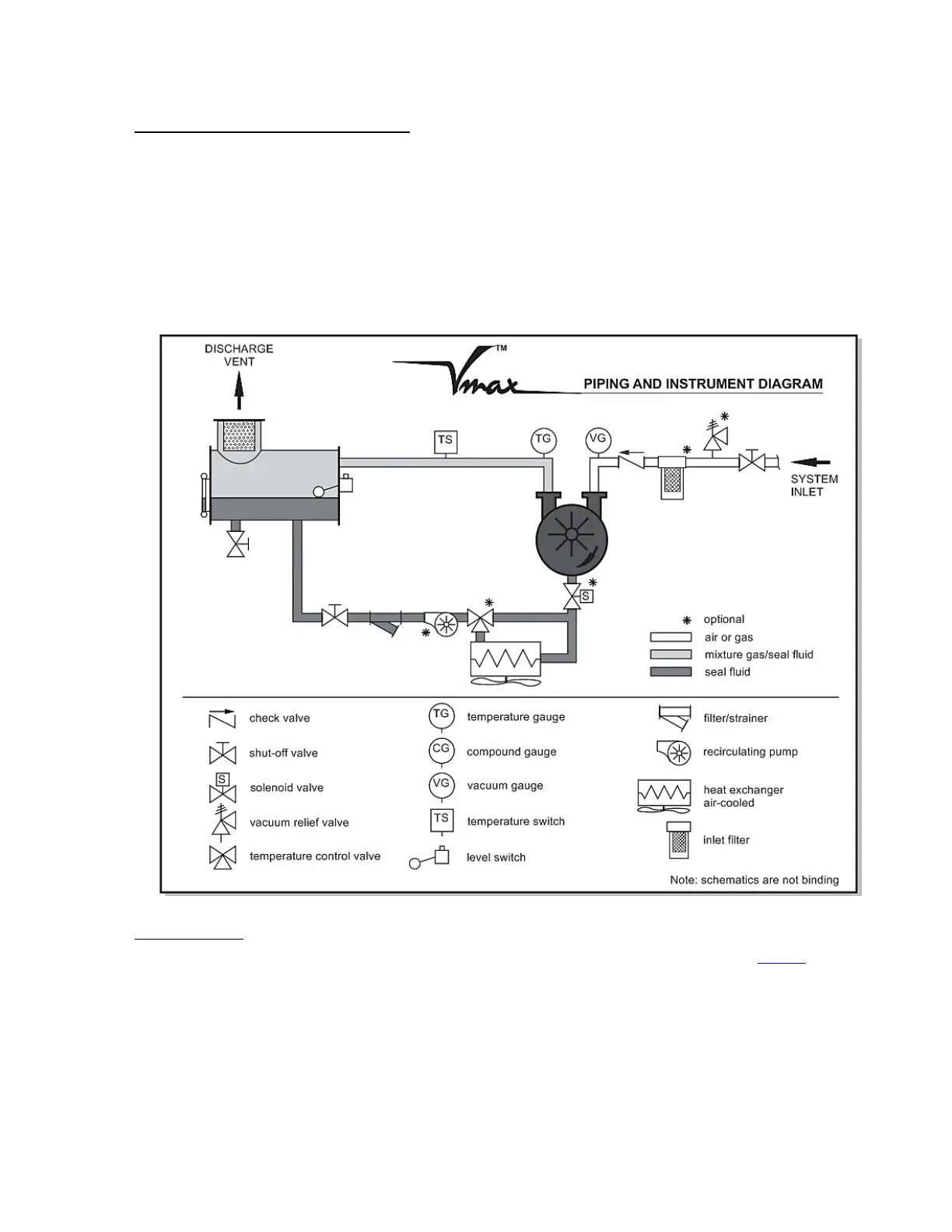
compression. The seal fluid in the system circulates in a closed loop passing through an air- or water-
cooled heat exchanger that removes the heat of compression. The discharge separator/reservoir holds the
seal fluid and incorporates the DEKKER DX-5 or DX-7 patented high-efficiency separator arrangement to
separate the seal fluid from the air or gases discharged by the pump. See “Piping and Instrument Diagram”
of the Vmax oil-sealed liquid ring vacuum pump system below.
STORAGE
Keep the system in a cool dry environment and close the seal fluid isolation valve as shown on page 21.
Plug all open ports to keep out dirt and foreign objects. Every 2 - 3 months rotate the impeller by rotating
the shaft by hand 2 ¼ turns.



 To Next Page