
 Need help?
Do you have a question about the Dell Force10 S25N and is the answer not in the manual?
Explains how keyboard keys and commands are formatted in the document.
Defines the target readers and availability of Dell support.
Lists essential external documents and resources for further information.
Lists physical hardware components needed for the setup.
Details necessary software packages and drivers for the configuration.
Specifies required firmware versions and system configurations for host, switch, and array.
Provides a form for collecting static IP addresses and passwords for network configuration.
Illustrates the physical cabling between servers, Force10 S25N switches, and PS4100 arrays.
Details specific port mappings for connecting S25N switches and PS4100 arrays.
Visualizes the physical connections for Force10 S50N switches and PS4100 arrays.
Maps ports for connecting S50N switches and PS6500 arrays.
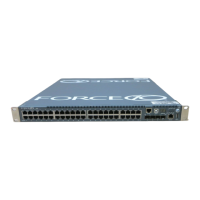
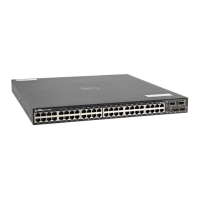
This document outlines the configuration and implementation of a Dell Rapid EqualLogic Configuration Series, specifically focusing on the integration of Dell Force10 S25N or S50N switches, a PS4100 array, and a VMware ESXi™ host environment. It serves as an implementation guide for system and storage administrators, providing essential information for setting up and managing this storage area network (SAN) solution.
The primary function of this system is to provide a robust and scalable iSCSI SAN infrastructure for virtualized environments. It enables efficient storage provisioning, data management, and high availability for VMware ESXi™ servers. The integration of Dell Force10 switches ensures high-performance networking for iSCSI traffic, while the Dell EqualLogic PS4100 array offers reliable and intelligent storage capabilities. The VMware ESXi™ host acts as the compute layer, leveraging the SAN for virtual machine storage.
The guide emphasizes a structured approach to configuration, starting with a comprehensive list of prerequisites. This includes specific equipment such as null-modem DB9 serial cables and switch serial console management cables, which are crucial for initial setup and troubleshooting. The software prerequisites are detailed, highlighting the need for the latest EqualLogic Multipathing Extension Module for VMware vSphere, SAN HeadQuarters installation package, VMware vSphere® Command-Line Interface (vCLI) environment, and up-to-date network device drivers. This ensures that administrators have all necessary components before commencing the installation, minimizing potential compatibility issues.
A key aspect of the usage is the detailed configuration information required for the iSCSI SAN. The document provides a form to record static IP addresses for various components, including host iSCSI initiators (Port 1, Port 2, Port 3, Port 4), array targets (Port 1 (eth0), Port 2 (eth1) for Array #1, Array #2, Array #3), management IPs (Out-of-Band or eth2), Array Group Management IPs (Out-of-Band and In-Band), and Switch Out-of-Band Management (OOB Mgmt) Port. This systematic approach to IP address planning is vital for a well-organized and functional SAN. Additionally, it prompts for switch admin, array group admin, and array membership passwords, underscoring the importance of security and access control within the SAN environment.
Connectivity diagrams are a central feature, offering visual guidance for cabling the SAN. Separate diagrams are provided for Force10 S25N and PS4100 connections, as well as Force10 S50N and PS4100 connections. These diagrams illustrate point-to-point connections between servers (represented by an R710 server example), switches, and the PS4100 array. They clearly show the required iSCSI initiator ports (a minimum of two), stacking cables for the switches, and connections for the management network. The diagrams also indicate that up to four hosts and three arrays can be connected, demonstrating the scalability of the solution. Accompanying point-to-point cable connection tables provide explicit details on which switch ports connect to which server ports and array controller ports, ensuring accurate physical cabling. The tables also specify the OOB Mgmt port connection, which is essential for out-of-band management of the network devices.
The document assumes that the VMware ESXi host has already been installed with version 4.1 Update1 or later and has all critical patches applied. It also assumes that the Force10 switches are running firmware version 8.4.2.4 or later and that the storage arrays are at controller firmware version 5.1.2 or later. This pre-configuration ensures a stable foundation for the SAN setup. The availability of a management system running Windows (2008, Windows 7, etc.) is also a prerequisite for proper vSphere ESXi system configuration.
While the document primarily focuses on initial setup, it implicitly supports maintenance through its emphasis on up-to-date software and firmware. The requirement to download the "latest EqualLogic Multipathing Extension Module for VMware vSphere installation package," "latest SAN HeadQuarters installation package," "VMware vSphere® Command-Line Interface (vCLI) environment," and "latest network device driver update" ensures that the system benefits from the most recent bug fixes, performance enhancements, and security updates. This proactive approach to software management is a fundamental aspect of ongoing system maintenance.
The mention of "driver update package for your network adapter" and instructions for updating from the ESXi command line or using VMware Update Manager (VUM) highlights the tools and processes available for maintaining the host environment. Similarly, the directive to visit Dell and Force10 websites for the "latest update" for array controller firmware and switch firmware, respectively, with "installation instructions and release notes available with the latest downloads," provides a clear path for keeping the hardware components current. This ensures that the SAN operates with optimal performance and stability over time.
The document also references several resources that are valuable for ongoing maintenance and troubleshooting. These include:
The requirement for a login to access the EqualLogic support site for certain downloads implies access to a broader range of support resources, including knowledge bases, forums, and technical assistance, which are all integral to effective system maintenance. By ensuring that administrators are aware of and have access to these resources, the document facilitates the long-term operational health and supportability of the SAN solution. The emphasis on recording passwords for switch admin, array group admin, and array membership also contributes to maintainability by ensuring that access credentials are well-documented for future administrative tasks.
 General
| Switching Capacity | 128 Gbps |
|---|---|
| Rack Units | 1U |
| Product Type | Switch |
| Form Factor | Rack-mountable |
| Jumbo Frame Support | Yes |
| Jumbo Frames | Up to 9216 bytes |
| Power Supply | Dual, hot-swappable |
| Operating Temperature | 0°C to 40°C |
| Storage Temperature | -40°C to 70°C |
| Humidity | 10% to 90% (non-condensing) |
| Dimensions (H x W x D) | 1.72 x 17.3 x 16 in (4.4 x 44 x 40.6 cm) |


 To Next Page