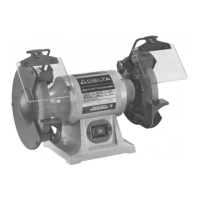
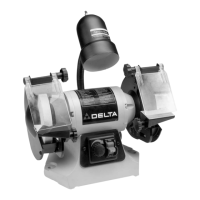
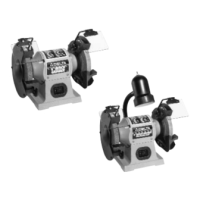
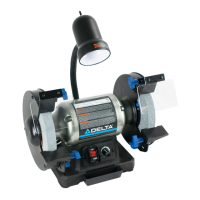
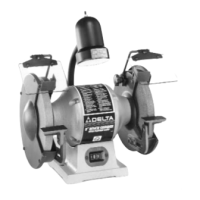
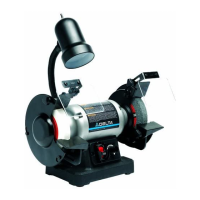
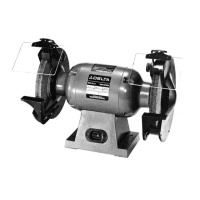
The DELTA 6" Thin-Line Bench Grinder with Flexible Lamp (Model 23-665) is a versatile tool designed for various grinding, sharpening, and buffing operations in a workshop or home shop environment. Its primary function is to provide a stable and powerful platform for abrasive tasks, enhanced by a flexible lamp for improved visibility.
Function Description
The bench grinder features two grinding wheels, typically one 36-grit and one 60-grit aluminum oxide wheel, mounted on opposite ends of a motor shaft. These wheels rotate at a high speed, allowing users to sharpen tools, remove material from workpieces, deburr edges, and perform other abrasive tasks. The "thin-line" design suggests a compact profile, making it suitable for smaller workspaces while still offering the functionality of a standard bench grinder. The integrated flexible lamp is a key feature, illuminating the work area directly, which is crucial for precision and safety during grinding operations, especially when working with small or intricate parts.
Usage Features
- Dual Grinding Wheels: The presence of two wheels with different grits (coarse and fine) allows for a range of tasks, from aggressive material removal to finer sharpening and finishing. Users can switch between wheels without changing accessories, enhancing workflow efficiency.
- Tool Rests: Adjustable tool rests are provided for both grinding wheels. These rests serve as a stable platform to support the workpiece, ensuring consistent angles and control during grinding. They are designed to be positioned as close as possible to the grinding wheel (within 1/8 inch or less) to prevent the workpiece from slipping between the rest and the wheel, a critical safety measure. As the grinding wheels wear down, the tool rests can be re-adjusted to maintain this optimal distance. The tool rests should be set slightly below the center of the wheel for the most practical and safest grinding position. Free-hand grinding, when performed, should always be done on the lower quarter of the wheel.
- Eye Shields: Two safety eye shields are included and are fully adjustable. These shields provide essential protection for the operator's eyes from sparks, debris, and abrasive particles generated during grinding. They can be positioned to suit the user's preference and the specific task at hand.
- Spark Guards: In addition to eye shields, spark guards are mounted to the side of each wheel guard. These guards are designed to contain sparks and prevent them from striking the operator's hands. Like the tool rests, they should be adjusted close to the grinding wheel and re-adjusted as the wheel wears.
- Flexible Lamp: The built-in flexible lamp operates independently of the grinder motor, allowing it to be turned on or off as needed. This feature provides direct illumination of the grinding area, improving visibility and accuracy, especially in dimly lit workshops. The lamp is designed to use a 50-watt or less, 120-volt, reflector track type light bulb.
- Power Switch: The grinder is equipped with a clearly marked power switch on the front for easy "ON" and "OFF" operation.
- Mounting Holes: The grinder base includes two holes, allowing the tool to be securely fastened to a workbench or supporting surface. This prevents the grinder from tipping, sliding, or "walking" during operation, ensuring stability and safety.
- Motor Specifications: The tool is wired for 120-volt, 60 Hz alternating current, providing a no-load speed of 3450 RPM, suitable for effective grinding.
- Grounding Instructions: The grinder is designed with a 3-prong grounding type plug to protect the operator from electric shock, emphasizing electrical safety during use.
Maintenance Features
- Wheel Dressing: To maintain optimal grinding performance and balance, the grinding wheels should be regularly dressed. This process involves using a silicon carbide stick type dresser to clean the face of the wheel and square its corners, removing embedded particles and restoring the wheel's cutting efficiency. Proper dressing also helps reduce vibration and extends the life of the grinder's bearings.
- Wheel Replacement: Instructions are provided for safely changing grinding wheels. This involves disconnecting the machine from the power source, removing side covers, and using a wedge to prevent shaft rotation while loosening the arbor nuts. Specific directions are given for loosening and tightening arbor nuts on both the left and right sides, acknowledging the different thread directions. Users are cautioned not to overtighten wheel nuts, only tightening them enough to drive the wheel and prevent slippage.
- Accessory Use: The manual emphasizes using only recommended accessories and attachments. This ensures compatibility, safety, and proper functioning of the grinder.
- General Maintenance: Users are advised to keep the tool sharp and clean for best and safest performance, and to follow instructions for lubricating and changing accessories. Regular inspection for damaged parts, such as guards or other components, is crucial, with instructions to repair or replace any damaged parts before resuming operation.
- Cord Care: The importance of using proper extension cords and inspecting the power cord for damage or wear is highlighted, with instructions to repair or replace damaged cords immediately.
- Work Area Cleanliness: Maintaining a clean work area is recommended to prevent accidents.
- Dust Management: The manual notes that dust generated by certain woods and wood products can be injurious to health, advising operation in well-ventilated areas and the use of dust collection systems and approved safety equipment like dust masks to filter microscopic particles.

 Need help?
 General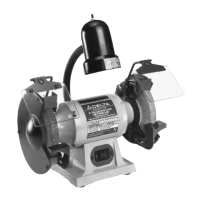

 To Next Page