Need help?
Do you have a question about the Delta 23-840 and is the answer not in the manual?
Essential safety rules for operating the bench grinder to prevent personal injury and accidents.
Specific safety instructions tailored for the operation and use of grinding machines.
Guidelines for safe electrical connections, including circuit requirements and extension cord usage.
Essential information on proper grounding procedures to protect the operator from electric shock.
Information on recommended grinding wheel types (3600 RPM, 8" diameter) and usage warnings.
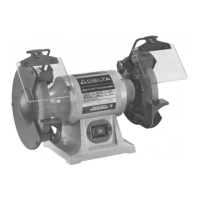
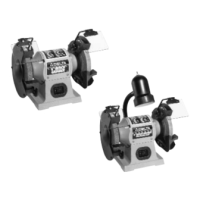
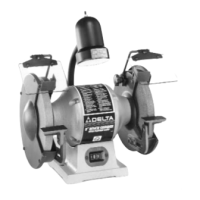
The document describes the 8" Bench Grinder, Model 23-840, manufactured by DELTA MACHINERY. This tool is designed for various grinding operations and emphasizes user safety through a comprehensive set of rules and instructions.
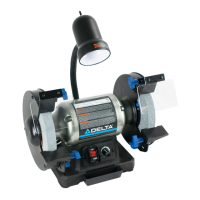
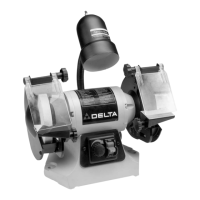
The 8" Bench Grinder is a stationary power tool primarily used for sharpening, shaping, and cleaning metal workpieces. It features two grinding wheels, one 36 grit and one 60 grit aluminum oxide wheel, allowing for both coarse and fine grinding tasks. The motor provides a no-load speed of 3500 RPM, suitable for efficient material removal. The grinder is equipped with a flexible lamp to illuminate the work area, enhancing visibility and precision during operation.
Assembly and Setup: Before operation, the grinder requires assembly of several components, including tool rests, spark guards, and eye shields. The tool rests are adjustable and must be positioned slightly below the centerline of the grinding wheel, maintaining a distance of 1/8 inch or less from the wheel's edge. This ensures maximum support for the workpiece and safe grinding. As the grinding wheels wear down, the tool rests need to be readjusted to maintain this optimal distance. Spark guards are also adjustable and should be positioned close to the grinding wheel to prevent sparks from striking the operator's hand. The eye shields, provided for operator protection, are fully adjustable and can be positioned as needed.
Power Connection: The grinder is wired for 120-volt, 60 Hz alternating current. It is crucial to connect the tool to a properly grounded power source. A separate electrical circuit, not less than #12 wire and protected with a 20 Amp time lag fuse, is recommended. If an extension cord is used, it must be a 3-wire grounding type with a 3-prong plug and 3-hole receptacles. The manual provides detailed grounding instructions and a minimum gauge extension cord chart to prevent power loss and overheating. Before plugging in, the switch must be in the "OFF" position.
Operation: To start the grinder, the left-hand portion of the switch is pushed "ON," and to stop it, the right-hand portion is pushed "OFF." The flexible lamp operates independently and is controlled by a rotary switch. It is important to allow the grinding wheel to run at idle speed for one full minute before applying work, especially when the wheel is cold. This helps maintain balance and prevents damage. Grinding should always be done on the face of the wheel, never on the side, and against the direction of rotation. Freehand grinding, without the tool rest, should only be performed on the lower quarter of the wheel. The manual explicitly warns against forcing the tool, emphasizing that it performs better and safer at its designed rate.
Safety Precautions: The manual includes extensive safety rules, highlighting the importance of wearing eye protection (safety glasses conforming to ANSI Z87.1), keeping guards in place, and maintaining a clean work area. It warns against using the tool in dangerous environments, such as damp or wet locations, and emphasizes keeping children and visitors away. Operators are advised not to wear loose clothing, gloves, or jewelry that could get caught in moving parts. Before any servicing or accessory changes, the tool must be disconnected from the power source. The manual also addresses the hazards of dust generated by grinding, recommending operation in well-ventilated areas and the use of dust collection systems and masks.
Grinding Wheel Maintenance: Proper maintenance of the grinding wheels is essential for optimal performance and safety. The wheels should always be kept properly dressed to maintain good balance and a clean, square grinding face. A silicone carbide stick-type dresser is recommended for this task. Dressing involves bringing the dresser forward on the tool rest until it touches the high point of the wheel face, then moving it back and forth until the face is clean and the corners are square.
Changing Grinding Wheels: To change a grinding wheel, four screws on the side cover must be removed, and the side cover itself taken off. A wedge should be placed between the grinding wheel and the wheel guard to prevent shaft rotation. The arbor nut is then loosened (counterclockwise for the right wheel, clockwise for the left wheel) to remove the old wheel. When installing a new wheel, blotters and wheel flanges must be used. The arbor nut should be tightened enough to drive the wheel and prevent slippage, but not overtightened. It is crucial to inspect each wheel for chips or cracks before mounting and to immediately replace any cracked wheels. Only grinding wheels rated for 3600 RPM and with a 1/2" arbor hole should be used.
General Maintenance: The manual stresses the importance of maintaining tools in top condition, keeping them sharp and clean for best and safest performance. It advises following instructions for lubricating and changing accessories. Regular checks for damaged parts, such as guards or other components, are necessary. Any damaged parts should be properly repaired or replaced before resuming operation. In the event of a power failure, the switch should be moved to the "OFF" position to reduce the risk of unintentional starting. If any part of the grinder is missing, damaged, or fails, or if any electrical component malfunctions, the switch must be shut off, the plug removed from the power supply, and the affected parts replaced before further use.
Troubleshooting: If the grinder shows any tendency to tip over, slide, or "walk" during operation, it must be secured to a supporting surface through the holes in its base. If a wheel vibrates, it should be dressed, replaced, or the shaft bearings checked for wear and replaced if necessary. The manual also provides contact information for parts, service, warranty, or other assistance, including a toll-free number for both the US and Canada, and the company's website.
 General
| Type | Bench Grinder |
|---|---|
| Motor Power | 7.5 Amps |
| Motor | Induction |
| Voltage | 120V |
| Wheel Diameter | 8 in |
| Wheel Arbor Size | 5/8 inches |

 To Next Page