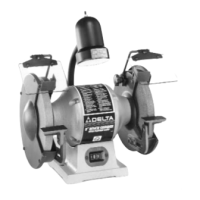
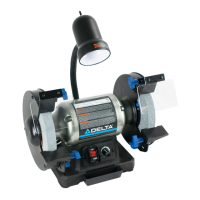
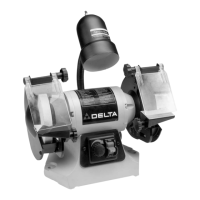
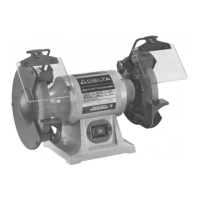
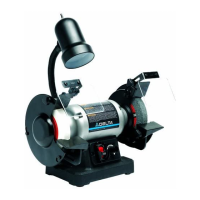
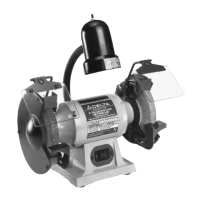
This document is an instruction manual for Delta 8" and 10" Bench Grinders, models 23-880 and 23-980. It provides comprehensive information on the safe operation, assembly, maintenance, and electrical connections for these tools. The manual emphasizes safety throughout, starting with a general set of safety rules applicable to woodworking machinery and then detailing specific safety rules for grinders.
Function Description
The Delta Bench Grinders are designed for various grinding tasks, primarily involving the sharpening, shaping, and cleaning of metal workpieces. They feature two abrasive wheels, typically one coarse (36 grit) and one fine (60 grit) aluminum oxide wheel, mounted on an arbor shaft. The motor drives these wheels at a specified no-load speed, allowing for efficient material removal and finishing. The 8" grinder operates at 3600 RPM, while the 10" grinder operates at 1800 RPM. The grinders are equipped with adjustable tool rests to support workpieces and spark guards and eye shields for operator protection.
Usage Features
The manual outlines several key usage features to ensure safe and effective operation:
- Tool Rests: Adjustable tool rests are provided on both sides of the grinder. These rests can be positioned slightly below the centerline of the wheel and as close as possible to the grinding wheel (1/8-inch or less) to provide maximum support for the workpiece. Proper adjustment of the tool rests is crucial for stability and safety, especially as the grinding wheels wear down. Freehand grinding should only be performed on the lower quarter of the wheel.
- Spark Guards: Spark guards are mounted to the side of each wheel guard. They should be adjusted as close as possible to the grinding wheel to prevent sparks from striking the operator's hand. Like the tool rests, these guards need to be re-adjusted as the wheels wear down.
- Eye Shields: Two safety eye shields are supplied for operator protection. These shields are fully adjustable and can be positioned to cover the grinding area, protecting the operator's eyes from flying debris and sparks.
- Power Connections: The grinder is wired for 110-120 volt, 60 Hz alternating current. It requires a separate electrical circuit, preferably protected by a 20 Amp fuse and using #12 wire. The manual strongly emphasizes proper grounding using a 3-prong plug and a matching 3-hole receptacle to prevent electric shock. Temporary adapters are discussed for situations where a grounded outlet is not available, with a clear warning that this is not applicable in Canada and that a qualified electrician should install a proper grounded outlet as soon as possible.
- Starting and Stopping: The grinder is turned "ON" by pushing the left-hand portion of the switch and "OFF" by pushing the right-hand portion. It is important to ensure the switch is in the "OFF" position before plugging in the power cord.
- Grinding Wheels: The grinders are supplied with two aluminum oxide grinding wheels (36 grit and 60 grit). It is critical to use grinding wheels that are rated higher than the grinder's no-load speed and have a bore diameter equal to the arbor shaft (5/8" for the 8" grinder, 1" for the 10" grinder). The manual advises against grinding on a cold wheel; the grinder should run at idle speed for one full minute before applying work. For best results and to maintain balance, wheels should be kept properly dressed.
- Dressing a Grinding Wheel: A silicon carbide stick-type dresser is used to clean and square the face and corners of the grinding wheel. The dresser is moved back and forth on the tool rest, gradually removing material until the wheel face is clean and true. This process is essential for maintaining grinding efficiency and accuracy.
- Workpiece Handling: The manual stresses the importance of securing workpieces with clamps or a vise when practical, as this frees both hands to operate the tool safely. It also warns against forcing the tool, overreaching, and grinding near flammable materials.
Maintenance Features
Proper maintenance is crucial for the longevity and safe operation of the Delta Bench Grinders:
- General Maintenance: Tools should be kept in top condition, sharp, and clean for best and safest performance. Lubrication and accessory changes should follow the provided instructions.
- Wheel Inspection and Replacement: Before mounting, each grinding wheel must be inspected for chips or cracks. A cracked wheel must be replaced immediately. When changing wheels, the side covers are removed, and a wedge is placed between the grinding wheel and the wheel guard to prevent shaft rotation. The arbor nut is loosened by turning it down and tightened by turning it up. A critical warning is given not to overtighten wheel nuts.
- Wheel Dressing: Regular dressing of grinding wheels is recommended to maintain good balance and grinding efficiency. This helps extend the life of the bearings and reduces vibration.
- Cord and Plug Inspection: The power cord and plug should be inspected regularly for damage or wear. Any damaged or worn cord should be repaired or replaced immediately by a certified electrician.
- Guard and Component Check: Before each use, all guards and other parts should be checked for damage. Any damaged part should be properly repaired or replaced to ensure it operates correctly and performs its intended function. This includes checking for alignment of moving parts, binding, breakage, and mounting issues.
- Electrical Safety: The manual advises disconnecting the tool before servicing, changing accessories, or when mounting, connecting, or reconnecting the motor to the power supply. If any electrical component fails to perform properly, the switch should be shut off, and the plug removed from the power supply outlet.
- Cleanliness: Keeping the work area clean and well-lighted is emphasized to prevent accidents.
- Storage: When not in use, the grinder should be stored in a secure location, preferably childproofed with padlocks or master switches.
The manual concludes with a two-year limited warranty from Delta, covering defects in workmanship or material under normal use, provided the product is returned with proof of purchase. It clarifies that the warranty does not cover normal wear, misuse, abuse, or unauthorized repairs.

 Need help?
 General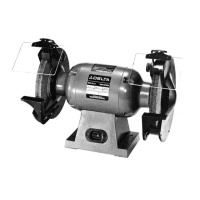

 To Next Page