DVP-ES2/EX2/EC5/SS2/SA2/SX2/SE&TP Operation Manual - Programming
S
3
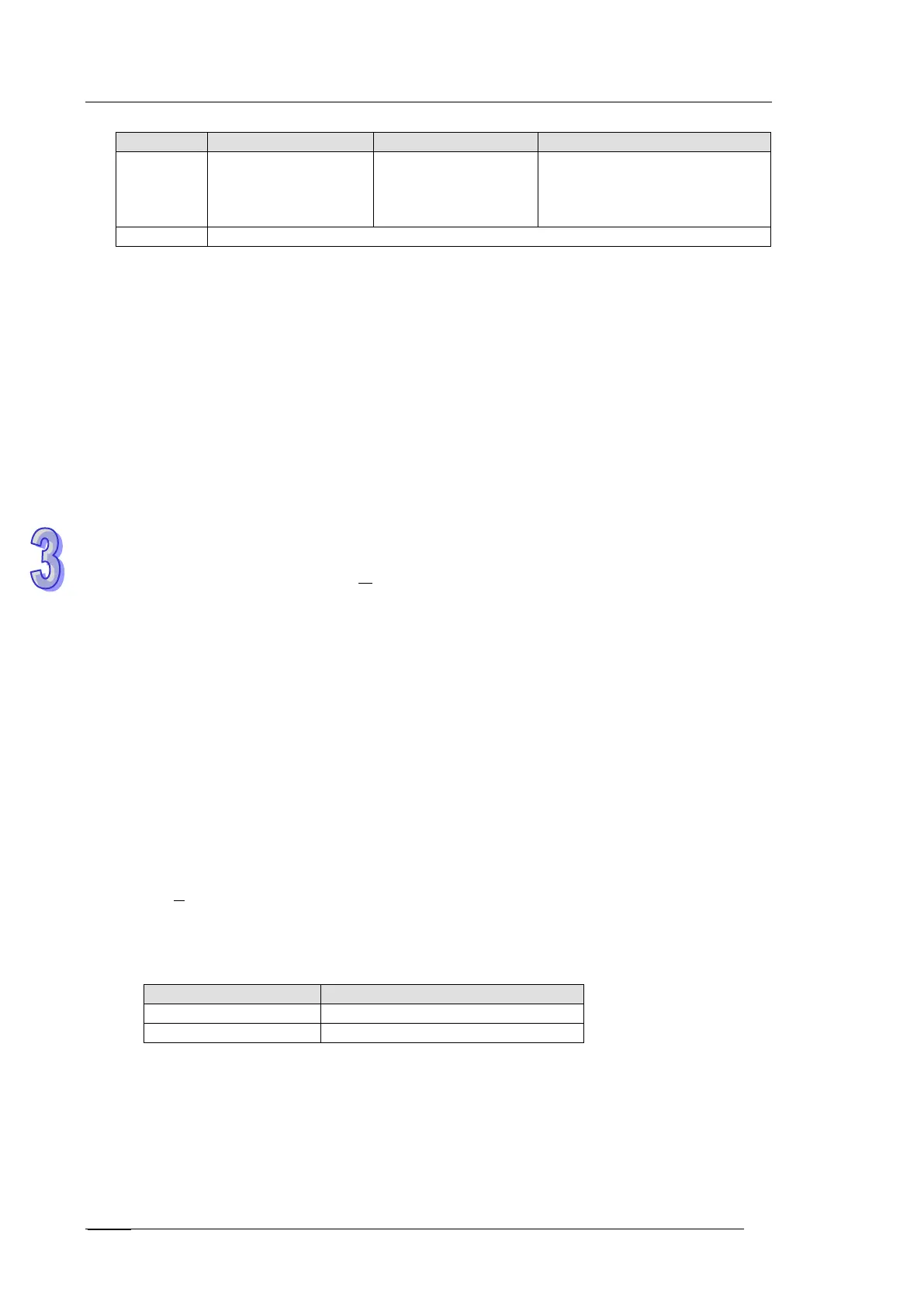
+17, 18 The previous PV, 32-bit
-2,147,483,648~
2,147,483,647
The previous PV is usually for
reference. Users can clear or
modify it according to specific
12. The explanation of 32-bit S
3
and 16-bit S
3
are almost the same. The difference is the capacity
of S
3
+5 ~ S
3
+20.
PID Equations:
1. When control mode (S
3
+4) is selected as K0, K1, K2 and K5:
In this control mode, PID operation can be selected as Automatic, Forward, Reverse and
Automatic with MV upper/lower bound control modes. Forward / Reverse direction is
designated in S
3
+4. Other relevant settings of PID operation are set by the registers
designated in S
3
~
S
3
+5.
PID equation for control mode k0~k2:
( ) ( )
( )
StPVK
S
tEKtEKMV
DIP
*
1
** ++=
where
: Output value
: Proprotional gain
: Error value
(t): Present measured value
(t): Target value
: Derivative gain
: Derivative value of PV(t)
: Integral gain
: Integral value of E(t)
When
is smaller than 0 as the control mode is selected as forward or inverse,
will be regarded as “0"
Control diagram:
In diagram below, S is derivative operation, referring to “(PV﹣previous PV) ÷ sampling
time”. 1 / S is integral operation, referring to “previous integral value + (error value ×
sampling time)”. G(S) refers to the device being controlled.


 To Next Page