43
a
re found to be satisfactory and
occlusal discrepancies are identified in
the mouth, the dentist is confident that
the error was not introduced in the labo-
ratory. He can then re-evaluate his pro-
cedure to determine the source of error.
In other words, if the restoration fits the
mounted casts but not the mouth, the
technician cannot be expected to par-
ticipate in the additional cost of remakes
not attributed to laboratory procedures.
CLASSIFICATIONS OF OCCLUSAL
CARVINGS
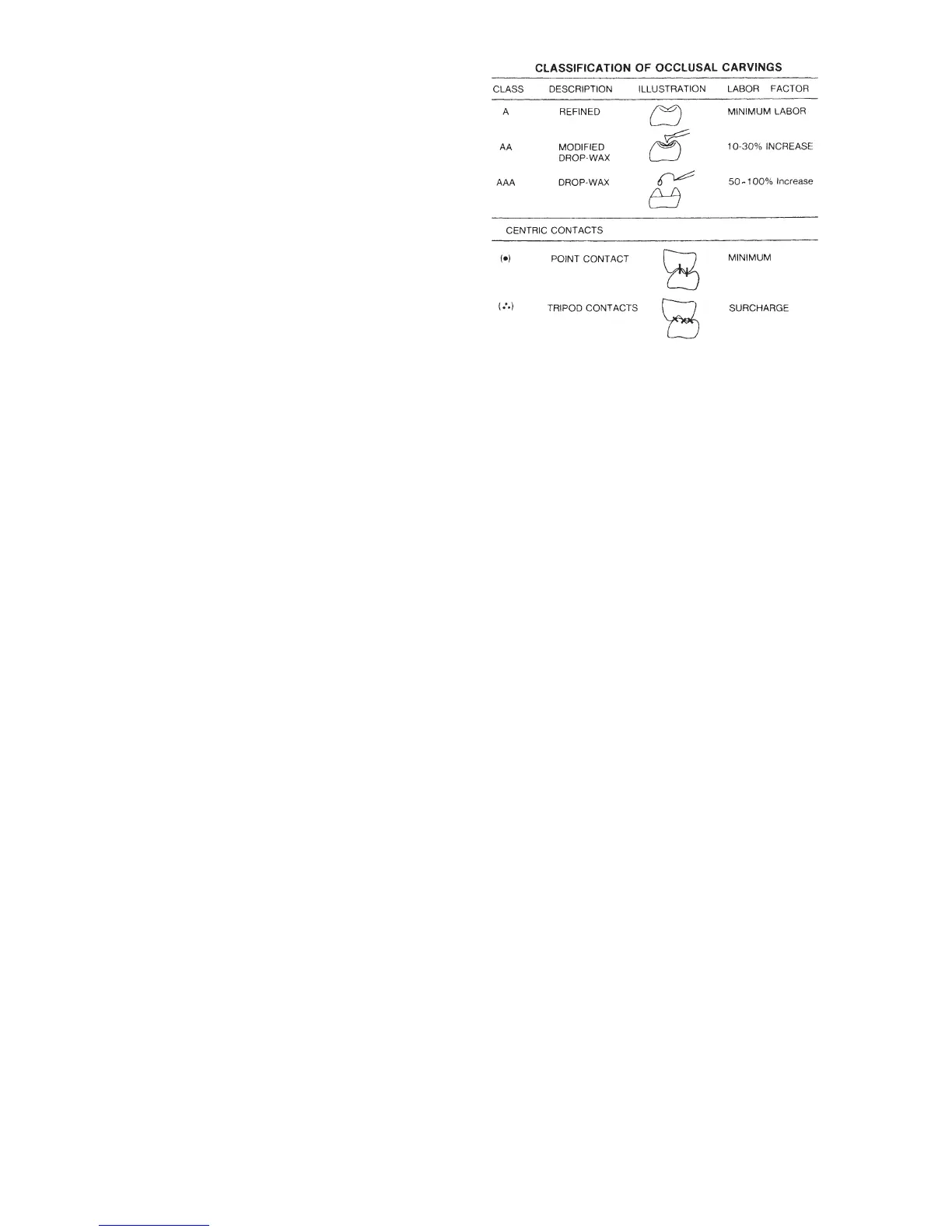
The following classification of occlusal
carvings as illustrated in figure 82
enables the dentist to specify to the lab-
oratory the relative amount of time and
effort he desires the laboratory to
expend (and consequently the laborato-
ry fee) to fabricate the prescribed occlu-
sion.
Alloy Restorations
Class A
__
Refined Occlusal Carving
The restoration is fabricated in the man-
ner the technician might employ when
using a simple crown and bridge hinge
mechanism. When the occlusion is
semi-developed, the technician simply
bruxes the instrument to burnish away
eccentric interferences and refines the
anatomy of the remaining wax.
Eccentric irritations are removed from
the occlusion in the laboratory. This is
the application of principles of occlusion
in its simplest form and consequently is
a minimum fee laboratory service.
Class AA
__
Modified Drop Wax
Basically, this is a Class A carving with
more refinement. The technician carves
in supplemental grooves and then
accentuates triangular, cuspal and mar-
ginal ridges with the drop wax tech-
nique. The ultimate appearance will be
similar to a Class AAA carving. A Class
AA carving requires more laboratory
time than a Class A carving and so the
laboratory fee should reflect 10% to
30% increase in the labor factor of the
Class A carving.
Class AAA
__
Complete Drop Wax
The drop wax technique is employed to
restore the total occlusal surface and all
restored axial surfaces to obtain the
maximum esthetic cusp height, opti-
mum cusp distribution, and to harmo-
nize the occlusal anatomy with condylar
paths of movement. This type of
occlusal fabrication requires more time
and skill than a Class A or Class AA
carving and consequently the laboratory
fee reflects a 50% to 100% increase in
the labor factor of a Class A carving.
However, this can only be done on a
restoration involving extensive tooth
reduction. For example, if the restora-
tions are MOD inlays or onlays with min-
imum tooth reduction, the cusp distribu-
tion has already been accomplished and
the laboratory only needs to do the fill-
in-procedures of the drop wax tech-
nique. Consequently, a Class AA or AA+
carving would suffice.
Centric Contacts
The character of the centric contacts
must produce axial loading of the teeth.
This can be accomplished by:
1. Point Contact (•). There is an
absence of contacting inclines.
fig. 82


 To Next Page