44
C
entric stops are on high spots or
low spots of cusps.
2. Tripod Contacts (.
.
.). Centric cusps
do not hit on their tips but are sup-
ported by three or sometimes only
two centric contacts on the
perimeter of cusp tips.
Developing tripodized centric contacts
(.
.
.) requires more laboratory time than
point contacts (•). Consequently, an
additional laboratory fee is required.
When the dentist’s prescription speci-
fies a Class AA (.
.
.) occlusion, it means
he desires a Class AA carving with
tripodized centric stops and he antici-
pates a laboratory fee which will allow
the technician adequate time to perform
this service.
PORCELAIN RESTORATIONS
An extension of the above classification
for alloy restorations is used for specifi-
cations of porcelain restorations.
Class A porcelain restorations are
carved to look like Class A alloy restora-
tions. Class AA porcelain restorations
are carved with more detail to accentu-
ate supplemental grooves and cusp
height to look like a Class AA or AAA
alloy restoration. A plus symbol (+)
denotes additional staining and charac-
terization.Thus a Class AA (•)+ porcelain
restoration is carved to be similar to a
Class AA alloy, has point contact centric
stops with an absence of contacting
inclines and has special staining charac-
terization.
DISCUSSION
Laboratory Fees and Instruments for
Occlusal Treatment
The laboratory fee is for the time and
skill which the technician employs in
harmonizing the occlusion to condylar
paths of movement and is not deter-
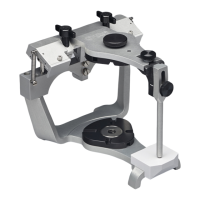
mined by the instrument used. A fully
adjustable or semi-adjustable articulator
can be bruxed as easily as a simple
crown and bridge hinge mechanism that
has springs for condylar posts.
The above classification of occlusal
carvings is not an attempt to establish
laboratory fees. It is offered as a means
of establishing more accurate communi-
cations between dentist and laboratory.
SUMMARY
The protocol which requires the dentist
to mount the mandibular cast gives the
dentist “laboratory-control”. This control
of services usually results in better labo-
ratory work. The laboratory on the other
hand receives “dentist control” and less
reduced fee remake discussions.
The dentist who mounts his mandibular
cast and provides the technician with
complete specifications for fabrication
of the occlusal aspects of the restora-
tion enjoys the benefits of improved
communications with his laboratory,
laboratory control, better laboratory
work, and improved dentist
__
laborato-
ry relations.


 To Next Page