53
or at the middle of the anterior margin of
the hole on the lateral aspect of the
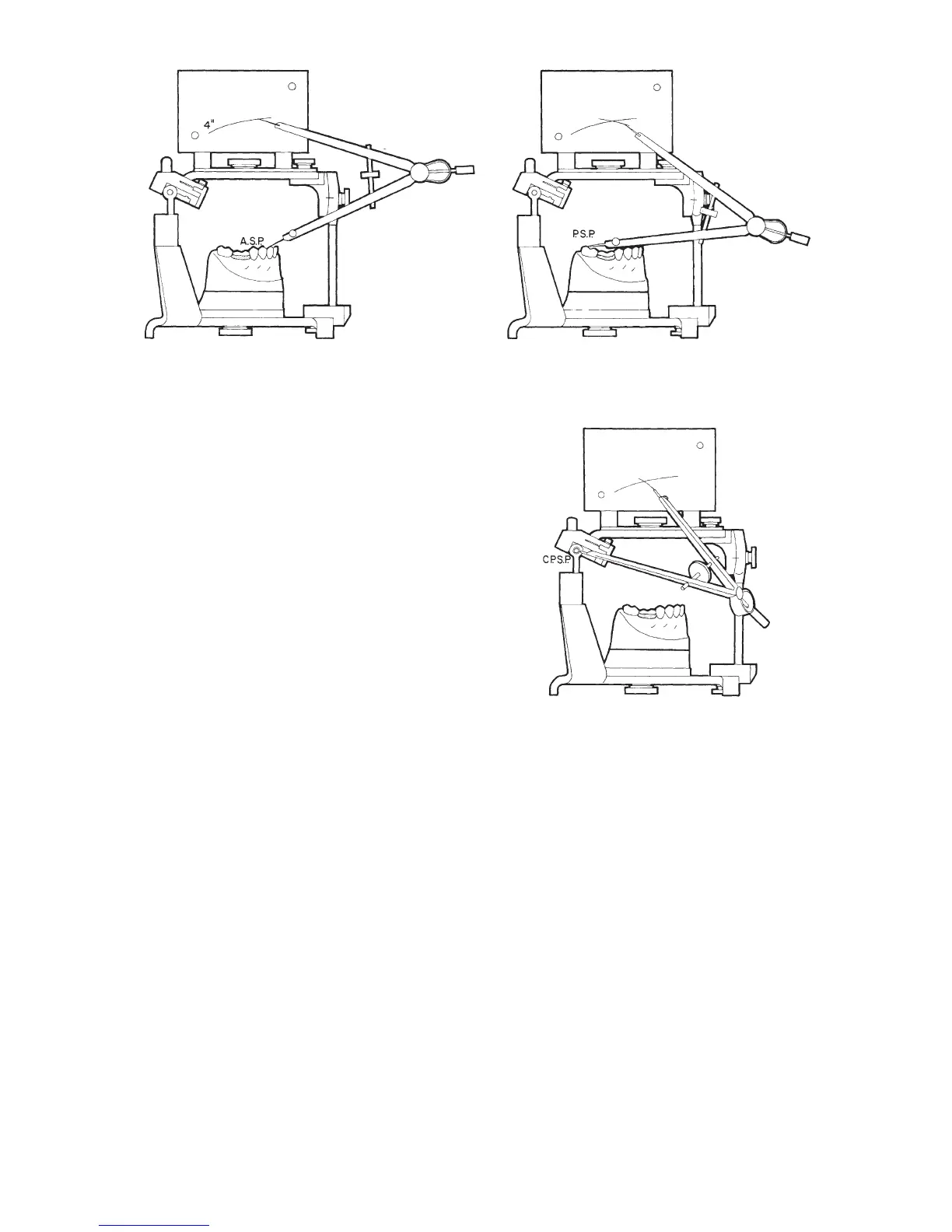
condyle (fig. 102). Position the center
point of the bow compass on the
condylar posterior survey point
(C.P.S.P.) and apply an arc with the
graphite lead to intersect the arc formed
from the A.S.P.
Continue with fig. 101 or 102 and sub-
stitute the needle point for the graphite
lead. Place the center point of the bow
compass adjusted to the 4” radius at the
intersection of arcs on the plastic record
card (initial occlusal plane survey cen-
ter). Sweep the needle point over the
occlusal surfaces of the lower posterior
teeth to see how the arc conforms to the
existing occlusal plane. Shift this
occlusal plane survey center (O.P.S.C.)
on the long arc on plastic record card
(A.S.P. line) until the most acceptable
line and plane of occlusion is found. To
raise the line and plane of occlusion at
the distal end, move the point anterior to
the arc intersection.
To lower the line and plane of occlusion,
move the point posterior of the intersec-
tion. By trial and retrial, the ideal survey
center forming the most acceptable line
and plane of occlusion will be located.
Upon thorough and considered study,
locate the best possible line and plane
of occlusion for the lower posterior teeth
to harmonize with all other factors. The
center point of the bow compass is now
pierced into this ideal O.P.S.C. on the
plastic record card and circled with pen-
cil or ink for subsequent relocation. It
may be advantageous to mark “R”
(right) in the upper corner of the plastic
index card for identification (fig. 103).
fig. 100
fig.101
fig.102


 To Next Page