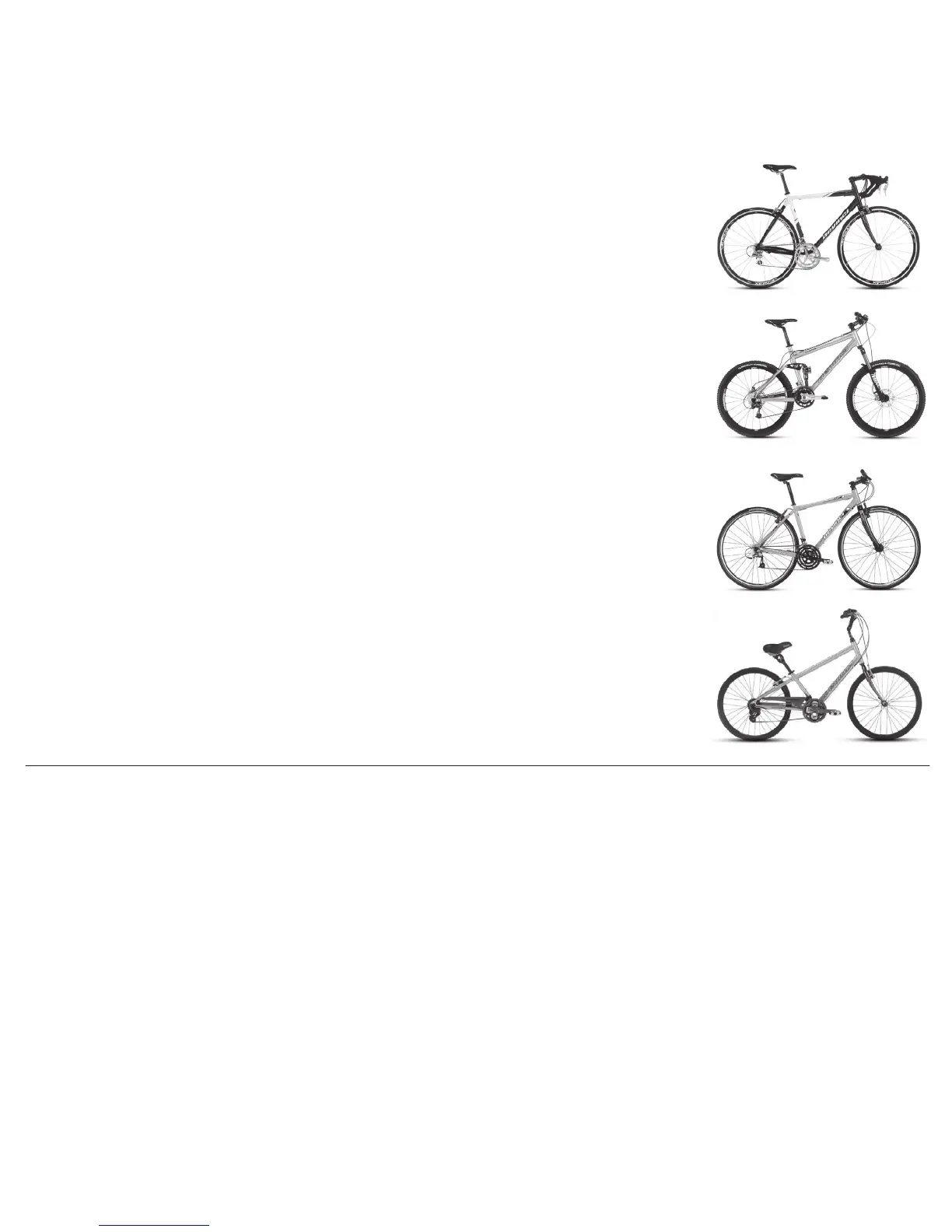
4.1 Road
The term “road bike” refers to any bicycle designed for paved roads or paths. Like most products that grow in popularity, so does their
design to meet the specific demands of the consumer. The road bike can be further divided into four types: Road, Time-trial/Triathlon,
Touring and Cyclo-cross.
4.2 All-terrain
The term “all-terrain” refers to any bicycle designed for off-road riding. Since the beginning, off-road riders have pushed the limits of their
bikes and begun to ride a wider variety of terrain, forcing the market to split into four categories of mountain bikes: XC racing, XC Trail,
Freeride and Downhill.
4.3 Hybrid
The desire to ride freely on a comfortable bike, both on cycle paths and in the city, has led to both on cycle paths and in the city, has led
to bike and the mountain bike, the hybrid is well-adapted to touring trips or your daily transportation to work. The hybrid offers a wide
range of gear ratios and large wheels for a smoother ride than the road bike and a faster one than the all-terrain.
4.4 Comfort
The comfort bike is meant for those who enjoy life on the paved paths. With larger tires than the hybrid bike and a more comfortable
saddle, it allows a straighter position for riders looking for a pleasant and safe ride. The comfort bike is an excellent choice for cyclists
that prefer comfort over speed.
04
THE BIBYCLE FAMILIES
5.1 Getting started
It is strongly recommended that you read this manual thoroughly before your very first ride. Make sure you understand the following points and be sure to refer to the detailed sections if you
have any doubts. Remember that your authorized Devinci dealer is also available to answer your questions.
5.1.1 Bike Dimensions
First, you should know the answers to the following questions:
a. Is the size of your bike adequate for you? To check, refer to section 5.2.1. A bike that’s too large or too small results in loss of stability and could make you fall.
b. Is your saddle properly adjusted? To check, refer to section 5.2.2. Before adjusting the saddle by yourself, make sure you respect the minimal insertion height by referring to section 7.2.
c. Have you correctly tightened the saddle and the seat post? If so, you shouldn’t get any movement whatsoever.
d. Are the handlebars and the stem in the right positioned for you? Before adjusting, make sure you refer to section 5.2.3 to learn how to do it the right way.
e. Are the reach and angle of your brakes convenient for you? It is possible to adjust your brakes to make them more comfortable to use. Please refer to section 5.2.4.
f. Do you know precisely how everything works on your bike? If you to have any doubts, do not hesitate to contact your authorized Devinci dealer who will be pleased to describe and teach
the functioning of every mechanism to you.
5.1.2 Security and Bicycling
a. A regulation standard helmet by CSA (Canada), CPSC, Snell, ASTM (America) or CEN (Europe) is an essential piece of equipment. Do you have one? It is imperative that you ALWAYS
wear a regulation standard helmet when riding your bike. Also, make sure it fits your head, that it is well-adjusted and that the chin strap is securely buckled. The use of a poorly
adjusted, wrongly positioned and/or incorrectly attached helmet may cause serious injury and could even lead to death.
05FUNDAMENTALS OF CYCLING



 To Next Page
 Loading...